China Swings Into Action on Trade as ‘Tariff Man’ Trump Ups Pressure China said Wednesday the trade meeting with the U.S. was “very successful”.
Beijing will start to quickly implement specific items where there’s consensus with the U.S. and will push forward on trade negotiations within the 90-day “timetable and road map,” the Ministry of Commerce said in a statement on Wednesday morning in China.
Hours later, Bloomberg News reported that officials have begun preparing to restart imports of U.S. soybeans and liquefied natural gas — the first sign confirming the claims of President Donald Trump and the White House that China had agreed to start buying some U.S. products “immediately.” In the afternoon, a Ministry of Foreign Affairs spokesman said China hopes to speed up talks and is devoted to finding a solution to settle issues. (…)
China Says There Is ‘Clear Timeline’ on Trade Negotiations Beijing is beginning to flesh out details of a weekend tariff truce with the U.S., after days of vague Chinese statements and a barrage of comments from President Trump and other administration officials.
China’s Commerce Ministry in a statement Wednesday acknowledged for the first time that Beijing on Saturday agreed to a 90-day cease-fire to allow negotiations to take place. The statement, attributed to an unnamed spokesman, said that the negotiations have a “clear timeline and road map†and that China aims to quickly implement “an agreed upon consensus.â€
The Chinese statement said “the Chinese side will work to carry out the items on which consensus has been reached, the sooner the better.â€
Also this week, key government agencies and China’s supreme court announced tough punishments for infringing on intellectual property—a prominent complaint by the Trump administration. (…)
Chinese officials have suggested that China will step up purchases of U.S. farm and energy products such as soybeans and natural gas as part of Saturday’s deal. Demand for those products is immense. Still, it’s unclear how large China’s purchases will be and whether Beijing will remove the punitive tariffs or offer rebates to the buyers. (…)
Beijing still has yet to confirm many of the items the Trump administration has said were decided on Saturday.
The Commerce Ministry’s statement also didn’t specify a start date for negotiations nor say when the 90-day clock would start ticking; U.S. officials, after some confusion, say it started on Saturday, meaning the deadline would fall around March 1. Mr. Trump has tweeted that the deadline could be extended. (…)
In a recent joint statement, three dozen Chinese government agencies and official bodies laid out 38 punishments for companies that violate intellectual property rights. The punishments go into effect this month and include restricting the violators’ access to financing, including state subsidies.
The statement was dated Nov. 21 but only made public Tuesday. (…)
Mr. Trump, in a series of tweets Tuesday morning, said he expected to see China start buying more U.S. agricultural exports immediately, which the U.S. said had already been agreed upon in the meeting between Mr. Trump and Chinese President Xi Jinping in Buenos Aires, a commitment Beijing hasn’t commented on.
“When people or countries come in to raid the great wealth of our nation, I want them to pay for the privilege of doing so,†he said, adding: “I am a tariff man.†He also noted that the U.S.’s 90-day deadline for negotiations began last weekend. (…)
Mr. Mnuchin emphasized that the Argentina meeting marked the first time that China responded to U.S. demands with specific commitments. He didn’t expand much on the commitments beyond saying the U.S. and China engaged on topics including intellectual property rights and joint ventures.
Mr. Mnuchin said it is significant Chinese senior leaders are willing to engage. He acknowledged differences in opinions on China among Mr. Trump’s top advisers, but insisted that it was standard to have a range of views within any administration.
Mr. Trump tweeted U.S. Trade Representative Robert Lighthizer will be working closely with Mr. Mnuchin, Commerce Secretary Wilbur Ross, Mr. Kudlow and China adviser Peter Navarro to determine whether a deal is possible.
“President Trump said in the meeting with (Chinese President Xi Jinping), even joked, about the fact that we have different people with different views,†Mr. Mnuchin recalled. “President Xi smiled and said ‘yeah, I have the same thing across my table’.â€
Workers at a Boeing Co. plant in Los Angeles are nearing completion of a new satellite, which uses restricted technology relied on by the U.S. military. It was ordered by a local startup that seeks to improve web access in Africa.
In reality, the satellite is being funded by Chinese state money, according to corporate records, court documents and people close to the project.
About $200 million flowed to the satellite project from a state-owned Chinese financial firm in a complex deal that used offshore companies to channel China’s money to Boeing. It included a discussion with a longtime friend of China’s president, said the startup’s founders. (…)
The American founders of the startup, Emil Youssefzadeh and Umar Javed, said they told Boeing from the outset over two years ago that Chinese government money was financing their satellite order. Later, they warned Boeing the Chinese financiers were actively interfering in the project. (…)
(…) “Plainly said: there is state-sponsored espionage in Canada,†said Mr. Vigneault Tuesday, according to published remarks at a luncheon hosted by the Economic Club of Canada. “No matter how it’s done or who’s behind it, economic espionage represents a long-term threat to Canada’s economy and to our prosperity.â€
His remarks avoided citing which states are operating covertly in Canada. However, Mr. Vigneault said sectors where CSIS has observed increased activity by state-sponsored actors include artificial intelligence, quantum technology, 5G mobile networks and biopharmaceuticals. (…)
Eurozone economic growth continues to slow in November
After accounting for seasonal factors, November’s final IHS Markit Eurozone PMI® Composite Output Index registered its lowest level since September 2016. Posting 52.7 in November, the index was down from October’s 53.1 though slightly higher than the earlier flash estimate of 52.4.
It was in Germany where the euro area’s growth slowdown was centred, with latest data showing the weakest expansion here in nearly four years. However, Italy remained the
weakest-performing country, with activity slightly down for a second successive month. In contrast, firmer growth was seen in Ireland, France and Spain, although rates of expansion remained down on those seen earlier in the year.
Goods producers did, however, record only a marginal increase in output, the weakest in the current expansionary cycle which began in July 2013. Service sector growth remained at a solid level, albeit the weakest seen in over two years.
The downturn in overall activity growth was closely correlated with a similar fall in the rate of new business expansion to a 27-month low. Jobs continued to be created during November, albeit to a lesser degree than seen in previous months. Although solid, employment growth was the slowest recorded since the start of 2017 with weaker gains seen in Germany, France and Ireland.
Where jobs were created, growth was linked to ongoing capacity pressures as evidenced by another increase in backlogs of work. However, with falls in unfinished business seen in Germany and Italy, plus slower growth in France, the net gain in overall work outstanding was only marginal.
On the price front, input cost pressures remained elevated in November and above the survey’s long term trend. There were reports of increased wages being paid, plus ongoing evidence of high energy and fuel bills. Higher input prices encouraged companies to raise their own charges. Competitive pressures, however, served to restrict pricing power, especially in Italy, France and Spain where only modest rates of inflation were recorded. Subsequently, output charges at the aggregate level rose to the weakest degree for six months.
Finally, expectations regarding activity were at their lowest level in nearly four years during November. Political and economic uncertainties, especially around trade, continued to weigh on sentiment.
The final IHS Markit Eurozone PMI® Services Business Activity Index was slightly down on October’s 53.7 during November, dropping to a level of 53.4. That was the lowest reading recorded for over two years.
New business volumes also rose at the slowest rate in over two years but at a sufficiently strong enough degree to generate another rise in work outstanding. Backlogs rose modestly and have now increased throughout the past two-and-a-half years. Rising workloads subsequently encouraged further job creation, with growth in staffing levels remaining solid despite easing to a six-month low. The sharpest increases in employment were again seen in Germany and Ireland, which also recorded the strongest rises in input costs amid evidence of higher wages being paid.
With energy and fuel costs also reported to be higher, overall input prices in the eurozone service sector continued to increase at an elevated rate. In response, output charges were again raised at a solid pace although limited pricing power in France, Italy and Spain served to restrict overall inflation.
Finally, business confidence deteriorated to its lowest level since August 2016. Optimism about the future was at its lowest level for two years in both France and Germany.
Chris Williamson, Chief Business Economist at IHS Markit:
(…) The survey responses highlighted intensifying headwinds of Brexit and trade war worries, a struggling autos sector and rising uncertainty regarding the economic and political outlook. Business optimism is running at its lowest since late 2014, adding to downside risks for growth as we move into 2019. Furthermore, hiring, which has hitherto shown surprising resilience as firms have hoarded labour despite the slowdown in demand, is now also showing signs of weakness. Employment growth in November was the lowest for almost two years.
(…) with Germany reporting the weakest growth for nearly four years, the survey raises question marks about the extent to which GDP will rebound in the fourth quarter. Growth looks more resilient in France and Spain, thanks mainly to robust service sector performances.


Chinese business activity rises modestly in November
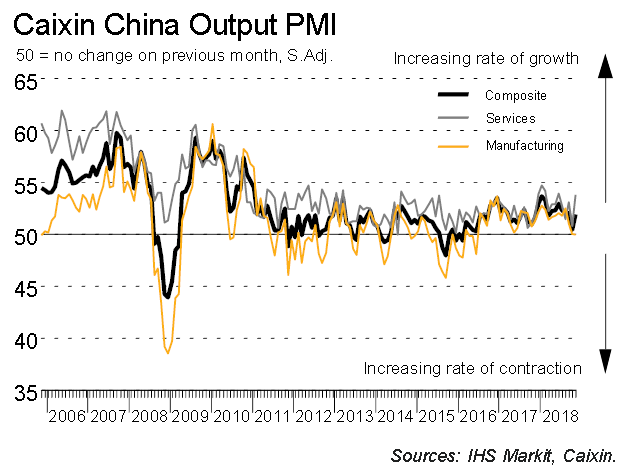
The Caixin China Composite PMIâ„¢ data (which covers both manufacturing and services) pointed to a stronger rise in total business activity across China in November. Notably, the Composite Output Index rose from a 28-month low of 50.5 in October to 51.9 in November, to signal a modest rate of expansion.
The stronger performance was supported by a rebound in activity across the service sector, as manufacturing production was stable for the second month in a row. Furthermore, the latest upturn in services activity was the most marked for five months, with the seasonally adjusted Caixin China General Services Business Activity Index climbing from October’s 13-month low of 50.8 to 53.8 in November. According to panellists, improved underlying demand conditions and greater client numbers contributed to higher activity levels. At the same time, relatively subdued demand across the manufacturing sector meant that factory output remained unchanged.
In line with the trend for activity, services companies signalled the steepest increase in total new orders since June during November. That said, the rate of expansion was moderate overall. New business meanwhile rose at a quicker, albeit still marginal, pace across the manufacturing sector. At the composite level, total new work increased at a modest rate that was the strongest for five months.
Divergent trends were seen regarding export sales, with Chinese service providers noting a modest increase in new business from abroad while manufacturers saw a further decline. New export work at the composite level consequently fell for the eighth month running.
Expectations that new orders will rise further in the coming months led services companies to increase their workforce numbers for the second consecutive month. That said, the rate of job creation remained marginal, and failed to offset a further modest reduction in manufacturing employment. As a result, overall staff numbers fell for the sixth month in a row, albeit marginally.
Outstanding business at service providers fell slightly for the third month in a row during November amid reports of greater efforts to clear backlogs. In contrast, unfinished workloads continued to expand at manufacturing companies. Taking both sectors into account, the amount of work-in-hand (but not yet completed) rose marginally at the composite level.
Average input costs continued to rise across both the manufacturing and service sectors during November, and at similarly solid rates. However, the latest increase in manufacturing cost burdens was the weakest seen for seven months, while the rate of cost inflation was unchanged from October across the service sector.
Prices charged by Chinese companies were unchanged from the previous month in November. Data broken down by sector showed that a fractional decline in factory gate prices offset a slight increase in charges set by service providers. Companies widely commented that relatively subdued demand conditions and efforts to remain competitive had weighed on overall pricing power.
Businesses operating in China remained optimistic that output would increase over the next year, but confidence remained subdued in the context of historical data. Although sentiment among manufacturing firms picked up from October’s 11-month low, it remained among the lowest seen in the series history. At the same time, services companies expressed the weakest level of optimism since July, with a number of respondents citing concerns over the strength of future client demand and intense competition.
FINANCIAL SERVICES
Mark alerted me to this Dec. 4 Goldman Sachs Financial Services conference in NYC accessible here. Mark helpfully guides us through the process:
Example. If you click through the BNY Mellon links for a certain conference (scroll down in email), it might say who is presenting or you can google “Goldman Sachs Financial Services Conference” – then you find a press release that Wells Fargo presenting.
They provide the link – https://cc.talkpoint.com/gold006/120418a_as/?entity=25_5TQY87E
You take the link and delete “?entity=25_5TQY87E” – you get to the main section of the webcast.


