The enemy of knowledge is not ignorance, it’s the illusion of knowledge (Stephen Hawking)

It ain’t what you don’t know that gets you into trouble. It’s what you know for sure that just ain’t so (Mark Twain)

Invest with smart knowledge and objective odds

THE DAILY EDGE: 12 February 2024

CONSUMER WATCH

January retail sales are out Thursday (CPI tomorrow).

Cold weather chills spending

Consumers cooled spending last month as inclement weather rocked much of the U.S., according to new data from Bank of America Institute.

Total card spending per household fell 0.2% from the prior year after rising by the same amount in December, the bank says, citing its internal data.

Restaurant spending was particularly weak in January, reversing the boom seen the previous month: Spending on cards per household at eateries fell 3.2%, compared to the 3.6% gain in December.

Bad weather — freezing temperatures, snow and rain across the nation — was mostly to blame for the spending pullback as opposed to broad signs of consumer weakness, BofA said.

“[W]here the weather was better, such as the West, spending was resilient, and in the later part of the month, total card spending per household rebounded across the country,” economists wrote in the data release. (Axios)

For instance, card spending in the Western region of the U.S. rose 1.7% from a year earlier.

Source: BofA Global Research; @MikeZaccardi

A BROAD WEALTH EFFECT!

Americans under 40 saw a massive increase in wealth since 2019

Americans under 40 saw their wealth rise by a staggering 80% since pre-pandemic — a far higher rate than any other age group, per new data from the Federal Reserve Bank of New York.

This is about “stonks and stimmies” — as well as the risk-taking proclivities of youth.

During the pandemic, those under 40, many flush with stimulus checks, took to the stock market and saw big gains.

The big differentiator between the young and the old was in financial assets, according to the NY Fed’s analysis.

  • Those under 40 saw the value of their financial assets rise more than 50% from Q1 2019 to Q3 2023. Those who were 40-54 saw a 3% increase, and those over 54 saw their financial assets rise 20%.
  • The under-40 crowd’s share of financial assets invested in stocks and mutual funds rose by 39%, while the share for those 40-55 decreased, and for the 55+ crowd, it grew by 12%.
  • Of note: The data doesn’t distinguish between changes in asset allocation and changes in returns (more money gained from those investments). The results are a combination of both.

The shift “likely reflects the fact that younger adults, being farther away from retirement, can afford to invest in risky assets at a higher rate than older adults,” the researchers write in a blog post published Wednesday.

  • “The youngest age group is also the poorest and thus received much of the COVID-era fiscal stimulus, granting them
  • Many of these folks also didn’t have to make a student loan payment for most of that period.

All age groups saw gains in the value of their homes real estate assets increased about 40%.

Overall, the older cohort is far wealthier than the young. The net worth of those 55 and over was $97 trillion in the third quarter of 2023.

That’s compared to $8.6 trilly for Americans under 40.
(…)

HORNY?

From the Carson Group:

(…) Since the Chinese New Year typically starts between late January and mid-February, we looked at the 12-month return of the S&P 500 Index starting at the end of January dating back to 1950. And wouldn’t you know it? The Year of the Dragon has been up five out of six times and up a median of 11.5%. But if you look closer below, you’ll notice that stocks see double digit returns only every other appearance of the Year of the Dragon, which could mean this time it’s due for a breather.

Here’s how all 12 signs have done since 1950. Turns out the Year of the Goat has the strongest returns, but you’ll have to wait till 2027 to see that one again. More bad news—the Year of the Snake is the worst performer and that takes place after the Dragon next year.

Lastly, we found it amusing that animals with horns saw some of the best returns, while a slimy reptile like the snake or a dirty little rat saw the worst. Given Dragons have horns, maybe this will be a nice year for the bulls?

You might think these guys are not serious. Read on, they also do really good serious stuff:

Much of China’s economy is based on investment spending (43% of GDP) compared with the US, which is mainly consumer based (nearly 70% of GDP is consumer spending). Given much of China’s investment is based on real estate and debt, the ongoing property investment crash in China will continue to hinder any recovery. In fact, property investment was down 10% last year, compared with up 10% in 2018 and 2019 before the pandemic.

Here are some stats from Sonu Varghese, Global Macro Strategist, on China’s real estate issues:

  • In March 2021, China was building residential property at a rate of 1.71 billion square meters per year.
  • That was cut in half, to ~ 881 million square meters, by December 2022.
  • As of October 2023, it’s been cut by another 20%, to 699 million square meters.

Additionally, China has a lot of debt (so does the US), but most of their debt is private debt, which can be a much bigger issue than public debt (like the $34 trillion our government has racked up).

More from Sonu on this:

  • Significant amounts of private debt are actually more detrimental than public debt, and a big risk factor, for an economy.
  • Private debt is serviced with revenues from business operations.
    • If there’s a slowdown, private sector revenues contract.
    • The contraction is even more severe if there is leverage.
    • That is what happened in the US in 2008 (high household debt) and in 2001 (high corporate debt).

Just kidding Also this smart analysis helping us better analyze this NDR table:

High five Not All Rate Cuts Are the Same

Here’s the thing—many think the Fed cutting rates is a sign we’re in or near a recession. It is true that some rate cuts have come during times of economic weakness, even recessions. Many immediately think about 2001, 2007, and 2020 as times the Fed cut to stimulate the economy amid troubles. Here’s the truth: Not all rate cuts are the same, as some take place during what we would call periods of normalization.

A normalizing first cut is a cut that takes place likely after the Fed hiked to slow things down, the economy wobbled but didn’t fall into a recession, and then began to expand again amid lower inflation. Think of this like the first cuts in 1984, 1995, and 2019.

Then of course there are what we’d classify as panic cuts. Think times like after the 1987 crash, the fall of 1998 during the Russian ruble and Long-term Capital Management crises, and of course March 2020.

Breaking it down by these three types of cuts shows very interesting results. When the Fed cut during a recession, the S&P 500 has been down an average of more than 14% only three months later and down nearly 12% a year later!

Compare that with a cut to normalize and stocks are up nicely across the board and higher 13.2% on average a year later.

Panic cuts see the best performance, up 17.4% a year later. That makes sense, as times of panic and pure fear are historically great buying opportunities.

As Sonu Varghese, our VP, Global Macro Strategist, has noted time and time again, we simply aren’t seeing any signs of a recession on the horizon and believe any cuts now would be to normalize.

(…) But will the Fed really cut with the stock market at an all-time high? Let’s remember their dual mandate, which is full employment and stable prices. Nowhere does it say how stocks are doing should matter, but the world isn’t so black and white. Still, I looked back and found 20 other times they cut when the S&P 500 was within 2% of an all-time high (based on the day before the cut) and wouldn’t you know it, stocks were higher a year later EVERY. SINGLE. TIME.

2019 was the last time we saw this. You have to go back to the mid-‘90s before that. We’ve said many times we see many similarities between the mid-‘90s and now. Both periods saw an aggressive Fed amid an economy that avoided a recession, inflation tame, strong wages, and high productivity.

We think we are going to see additional productivity strength, which is the key to all of it. High productivity allows the Fed to cut rates and not worry about higher inflation, while wages stay strong. Bottom line, the Fed has cut near all-time highs before and usually it has been a bullish development.

That still leaves 2 questions:

  1. What happens post a “normalizing cut” after the Fed hiked to slow things down but things did not really slow down?
  2. What about when equities rallied strongly before the first “normalizing cut”?

The Fed is now seen cutting rates in May, amid a strong (strengthening?) economy.

Meanwhile, the ECB is guiding investors towards June, amid a weak (weakening?) economy.
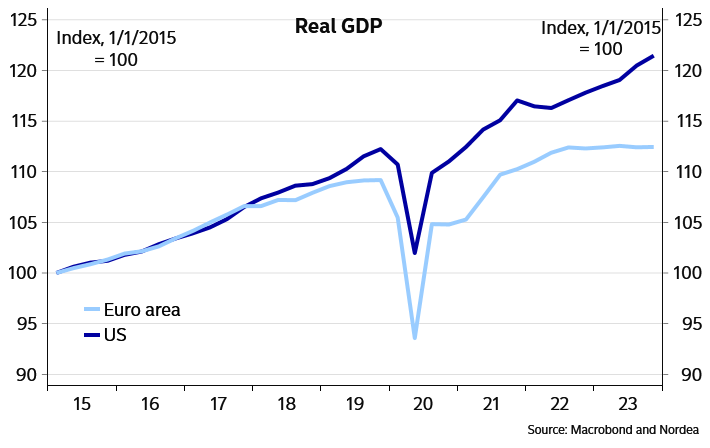
Even though inflation is at target…

…amid a weak (weakening?) economy.

image

Nordea:

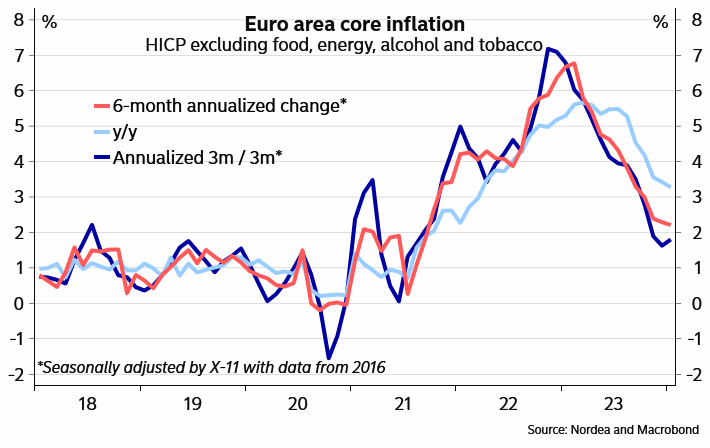
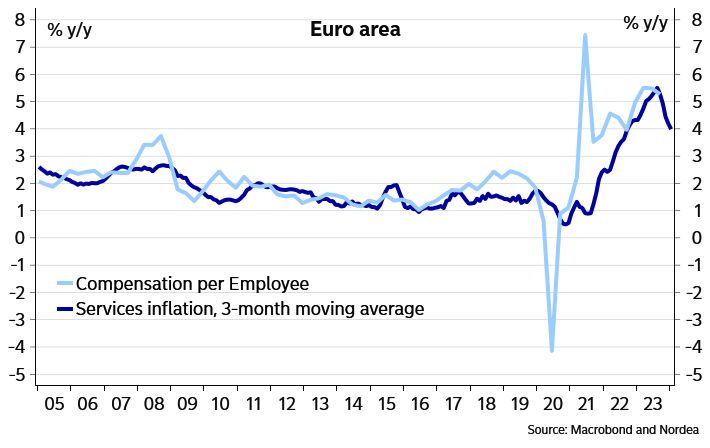
Despite favourable inflation dynamics, the ECB continues to worry that the tight labour markets will continue to boost wages and with that contribute to upside inflation risks longer out. Given the structural rigidities of Euro-area wage formation, such worries are not without merit. Several ECB Governing Council members have pointed to the importance of getting a better picture of the labour market situation before drawing firmer conclusions on the inflation outlook. (…)

The coverage of the Euro-area labour market and wage data is quite poor, at least relative to the US, and the data are released with long lags. For example, the comprehensive Q1 data will not be available until the ECB’s June meeting – an important reason to expect the first cut at that meeting.

If the ECB waits for labour market data to confirm weakened inflation dynamics, it is almost bound to be late in starting to reduce rates. However, for now that seems to be an acceptable price to pay for the central bank.

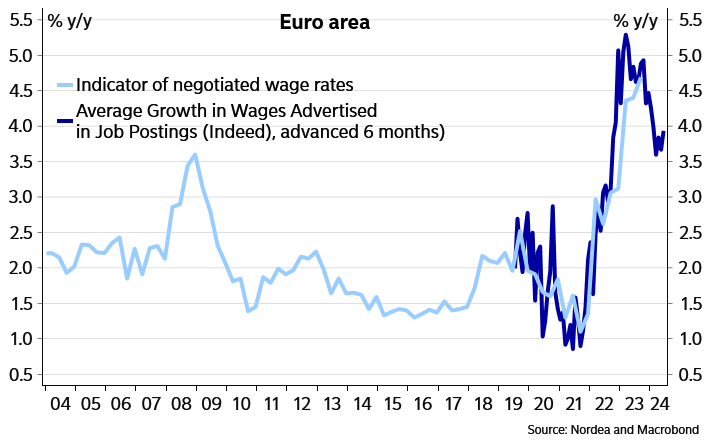
The labour market situation continues to look tight. The unemployment rate remains at its lowest level seen in the era of the Euro area. The latest comprehensive indicator of negotiated wages (Q3 2023) showed y/y growth of close to 5%. Wage demands remain elevated in many sectors, not least in German construction.

Lagarde has argued that 40% of the workforce will have their employment terms, including wages, determined in the coming months, so near-term developments certainly have an impact on the inflation outlook.

High wage demands are naturally not equal to high pay rises. Many of the more timely indicators of the labour market situation point to at least some cooling. The y/y rate in the Indeed wage measure based on average growth in advertised wages has fallen from more than 5% towards 3.5%, though the recent readings again suggest the downward move has stalled.

The European Commission surveys point to labour shortages easing, but from high levels and even the recent readings remain clearly above the pre-pandemic situation.

High wage growth still causing headache to the ECB

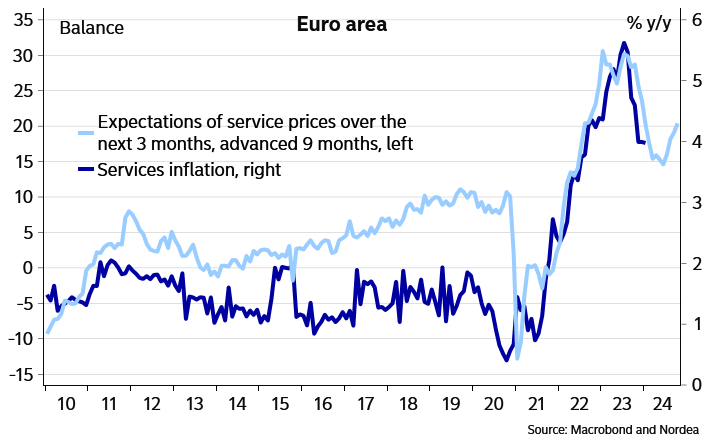
Some surveys are actually pointing to a renewed increase in price pressures. The output price index of the composite PMI index has risen for three straight months already. In turn, the net share of service sector companies expecting to see higher prices over the next three months has been climbing for four months already. It is thus not clear yet, whether especially service sector inflation will continue to fall going forward.

Surveys point to renewed upside pressures in the service sector

One key question remains, whether the demand situation has weakened sufficiently for companies to reduce their margins and not pass on higher labour costs fully to consumer prices.

Productivity developments are naturally also important, though quite difficult to measure especially in the short term. The ECB has warned that the strong unit labour cost development poses an upside risk to the inflation outlook, but in the past, the link from unit labour costs to inflation has not been particularly strong in the short run.

Further, the recent data has been encouraging, as ECB’s Lane argues: “The contribution of unit profits to domestic price pressures continued to fall in the third quarter of 2023, suggesting that unit profits are absorbing some of the price pressures coming from rising unit labour costs.”

Our baseline remains that inflation pressures are easing for good in the Euro area, which will allow the ECB to start cutting rates later this year. Given the central bank’s need to see more data on the labour market developments and given the fact that the more comprehensive data are not in use yet in the April meeting, the June meeting remains the most likely starting point for the cuts.

April is not out of the question, but other data need to surprise more notably to the downside to bring April into play. Still, we see risks tilted towards an earlier rather than a later start to the cuts. That said, if the Q1 labour market data point to sticky wage pressures and tight labour markets, also a later start to the cuts is possible.

When demand is weak, higher labour costs are not unlikely to be passed on to final prices in full
In July 2023, the PMI Prices Index pointed to inflation below 3%. The latest readings show inflation stabilizing around 2.0-2.5%.

 image image

German commercial property prices post biggest-ever drop, data shows

German commercial property prices fell 12.1% in the final three months of 2023 compared with a year earlier in their biggest-ever drop, the VDP banking association said on Monday, as the nation’s struggling property industry suffers its worst crisis in decades.

For the full year, commercial real estate prices dropped 10.2%, accelerating their decline after small drops of less than one percent in 2022 and 2021, VDP’s data showed.

Reuters GraphicsReuters GraphicsImage

A New York Rent-Control Bank Panic Investors fret about NYCB’s multi-family housing portfolio.

Regional bank share prices have tumbled since New York Community Bancorp (NYCB) reported surprisingly large losses on real-estate loans. Don’t blame this mini-bank panic only on underwater office buildings. Primary culprits are Albany’s destructive rent-control laws. (…)

But what worries investors more is the bank’s $37 billion multi-family housing portfolio, about half of which are comprised of New York rent-regulated units.

The bank flagged that 14% of its $18 billion rent-regulated loan book is at risk of default. Its eventual losses could be bigger as rent-regulated buildings have recently been selling at a 30% to 60% discount from their purchase price. The values of rent-regulated buildings have fallen by some $75 billion, according to one estimate.

NYCB acquired the failed Signature Bank’s deposits and some of its loans last spring. But the Federal Deposit Insurance Corp. struggled to find a buyer for Signature’s $15 billion in loans that were backed primarily by New York rent-regulated buildings. Last autumn the agency finally unloaded the loans at a roughly 40% discount. Why have these loans become toxic?

Blame Democrats in Albany, who in 2019 restricted landlords’ ability to raise rents to pay for renovations and “de-regulate” rent-stabilized units. These apartments account for nearly half of the city’s rental housing. Landlords used to be able to charge the market rate once the rent exceeded $2,800 a month and a tenant moved out. No longer.

One result is that landlords have removed rent-regulated apartments from the market and are leaving them vacant rather than spend on maintenance and improvements that they can’t recoup. Tighter supply has pushed up rents in the non-regulated market—one reason Manhattan’s average market-rate monthly rent has surged 30% over the last two years.

Lower anticipated future rents have also slashed property values. Loans for buildings that were issued at low-interest rates—the average coupon for NYCB’s rent-regulated portfolio is 3.85%—will also have to be refinanced in the coming years. Some underwater owners may walk away. NYCB’s rent-regulated portfolio could be a ticking time bomb. (…)

Few investors until recently appreciated the financial impact of New York’s rent-control regulations. NYCB’s troubles are a reminder that bad government policy is a source of financial instability. What other risks could be hiding in plain sight?

Canada: An increasing number of cracks are appearing in the job market

In normal times, a 37k increase in employment combined with a one-tenth drop in the unemployment rate would cause us to breathe a sigh of relief and believe in the continuation of the economic cycle. Not in these unusual times, and especially not in a month when the population aged 15 and over grew at a record pace of 125K (a six standard deviation move, past 20 years).

The 37K gain therefore remains well below the 77K jobs that would have been needed to keep the employment rate at the same level.

The sizable three-tenths drop in the participation rate over two months means that the unemployment rate probably understates the fragility of the labour market. There is a risk that the participation rate could reverse in the coming months as the pressure to find a job increases for some individuals over time.

To illustrate, if the participation rate had not fallen over this period, the unemployment rate could be 4 ticks higher than it is now.

Returning to the January data, the composition of new jobs is far from reassuring. Part-time jobs improved the overall picture, while full-time jobs fell for the second month in a row. What’s more, businesses appear to be in a hiring freeze. In fact, the public sector added 48K jobs in January, while non-public employment fell for the second month in a row.

This weakness in the business sector comes as no surprise and is consistent with data from the Bank of Canada’s Business Outlook Survey. Labour shortages are a thing of the past, with 27% of firms now reporting that they are experiencing labor shortages, a far cry from the 46% recorded at the start of the rate hikes.

What’s more, the high proportion of firms experiencing a decline in sales (40%) and the gloomy outlook could mean outright job cuts in the coming months.

 image image

EARNINGS WATCH

With 332 reports in, the beat rate is 81% and the surprise factor +6.8%, broadly distributed.

Those 332 companies reported earnings up 7.4% on a 3.7% revenue gain. Huge increase in margins.

image

image

Trailing EPS are now $222.44. Full year 2024: $243.12e. Forward EPS: $242.77.

image

THE DAILY EDGE: 9 February 2024

China’s Property Crisis Is Starting to Ripple Across the World

Chinese investors and their creditors are putting up “For Sale” signs on real estate holdings across the globe as the need to raise cash amid a deepening property crisis at home trumps the risks of offloading into a falling market. The prices they get will help finally put hard numbers on just how much trouble the wider industry is in.

The worldwide slump triggered by borrowing-cost hikes has already wiped more than $1 trillion off office property values alone, Starwood Capital Group Chairman Barry Sternlicht said last week. But the total damage is still unknown because so few assets have been sold, leaving appraisers with little recent data to go on. Completed commercial property deals globally sank to the lowest level in a decade last year, with owners unwilling to sell buildings at steep discounts.

Regulators and the market are nervous that this logjam could be concealing large, unrealized losses, spelling trouble both for banks, who pushed further into bricks and mortar lending during the cheap money era, and asset owners. (…)

The European Central Bank is concerned that banks in the region have been too slow to mark down the value of loans and the UK’s Financial Conduct Authority is to review valuations in private markets, including real estate.

Now, a new batch of overseas assets acquired in a decade-long Chinese expansion spree are starting to hit the market as landlords and developers decide they want cash now to shore up domestic operations and pay off debts — even if that means taking a financial hit. Beijing’s crackdown on excessive borrowing has left few developers unscathed, even those once considered major players. A unit of Guangzhou-based China Aoyuan Group Ltd., for example, which is in the middle of a $6 billion debt restructuring plan, sold a plot in Toronto at about a 45% discount to the 2021 purchase price late last year, according to data provider Altus Group.

“With motivated sellers, the market freeze could thaw, improving transparency and price discovery,” said Tolu Alamutu, a credit analyst at Bloomberg Intelligence. “Portfolio valuations may have further to fall.”

With every transaction, the market gets more clarity about the capitalization rate — a measure of the return an investor is willing to do a deal at. That data will then be used by appraisers to value other assets, which could trigger wider impairments. As a consequence, landlords may have to inject more money to cure any loan-to-value breaches or risk having the properties seized by lenders. (…)

Just this week, distressed developer Guangzhou R&F Properties Co. agreed to sell its stake in a £1.34 billion ($1.69 billion) property project in London’s Nine Elms district in return for some of its dollar bonds and 10 pence, while an office block in Canary Wharf is selling for 60% less than it sold for in 2017 after it was seized by lenders from a Chinese investor. The sales are part of a rebound in disposals after some developers paused for breath last year while working on restructuring plans. (…)

Sales are picking-up outside Europe too, including in Australia. Only a few years ago, ambitious Chinese developers were major players in the local market. Now most have largely stopped buying and have pivoted instead to offloading projects. (…)

To be sure, China is by no means the only source of potential distress in the commercial real estate market. South Korean investors timed a huge bet on offices badly, and higher interest rates have already caused German and Nordic landlords to sell off properties at large discounts. A wave of loans maturing in the US are also expected to lead to foreclosures by regional banks and sales of the underlying assets. But China is the market where perhaps vendors have the most incentive to sell quickly. (…)

US Commercial Real Estate Contagion Is Now Moving to Europe

The troubles in the US commercial property market, which have already hit banks in New York and Japan, moved to Europe this week, elevating fears about broader contagion.

The latest victim was Germany’s Deutsche Pfandbriefbank AG, which saw its bonds slump on concern about its exposure to the sector. It responded by issuing an unscheduled statement Wednesday that it had increased provisions because of the “persistent weakness of the real estate markets.”

It described the current turmoil as the “greatest real estate crisis since the financial crisis.” (…)

On Tuesday, Treasury Secretary Janet Yellen said that losses in commercial real estate are a worry that will put stress on owners, but added that she thinks the problem is manageable.

For offices in the US, where the return to work following the pandemic has been slower and less substantial, the value destruction has been particularly bad. And some predict the full impact might not even be fully priced in yet. Analysts at Green Street said that a further writedown of as much as 15% may be needed this year. (…)

“There are serious concerns in the US CRE market,” said Rabobank credit strategist Paul van der Westhuizen. “It’s a not an issue for larger US and European banks but the smaller property-focused German banks are feeling a bit of pain. Right now it’s more a profitability issue than a solvency issue for them though. They have sufficient capital and are less exposed to the threat of deposit runs than pure retail banks are.”

In its results last week, Deutsche Bank AG recorded provisions for losses in US commercial real estate that were more than four times bigger than a year earlier. It warned that refinancing poses the greatest risk to the struggling sector as asset values suffer. (…)

Germany’s central bank warned last year about the risks surrounding commercial real estate, saying there could be “significant adjustments” that lead to higher defaults and credit losses.

“The outstanding volume of loans granted by the German banking system to the US commercial real estate market is comparatively small, but relatively concentrated at individual banks,” the Bundesbank said. (…)

If the CRE losses spread to Europe through smaller German banks, that would have an echo of the 2008 global financial crisis. Back then, it was the Landesbanks that got into trouble, when their exposure to subprime mortgages in the US led to billions of euros of writedowns. (…)

For the record, here’s what Mrs. Yellen actually said:

  • On Tuesday, to the House Financial Services Committee:

I’m concerned. I believe it’s manageable, although there may be some institutions that are quite stressed by this problem

  • On Thursday, to the Senate Banking Committee:

Valuations are falling. And so it’s obvious that there’s going to be stress and losses that are associated with this. I hope and believe that this will not end up being a systemic risk to the banking system. The exposure of the largest banks is quite low, but there may be smaller banks that are stressed by these developments.

Hope and belief. Sounds more like an opinion than actual knowledge and conviction. She could have said it more CREdibly…

Sun Life Sees Value of Its US Office-Property Stakes Sink 26% Executive banks on long-term turnaround, not a ‘forced seller’

(…) The declines came as mark-to-market valuations sunk amid stress in the commercial real estate space, with US office investments taking the biggest hit, dropping in value to C$476 million from C$647 million a year earlier. Sun Life’s Canadian office properties, in contrast, shed almost 11% of their value, declining to C$1.6 billion.

Some of those shifts in value came from selling some buildings and buying other ones, but most of the losses were on paper as Sun Life reduced the value of unrealized gains on properties it’s held for many years, Randy Brown, chief investment officer and and head of insurance asset management, said in an interview Thursday.

Sun Life previously sold all but one of its office buildings in San Francisco, and that property took a major hit in the fourth quarter as increased sales activity reset market comparables lower, Brown said. (…)

Sun Life took a C$148 million charge on lower real estate market values in the quarter, which was the main driver behind a 36% decline in fourth-quarter reported earnings. Still, the company beat analysts’ estimates on underlying results amid strong insurance sales, particularly in Hong Kong.

The firm is likely to take further real estate charges, totaling C$225 million, in the first half of this year, followed by “stability from there,” according to a note to clients Thursday from TD Securities analysts Mario Mendonca and Masa Song.

Biden Is Looking Beyond Tariffs to Keep Chinese ‘Smart Cars’ Out of the US

The Biden administration is considering restrictions on imports of Chinese “smart cars” and related components that would go beyond tariffs to address growing US concerns about data security, according to people familiar with the matter.

The measures would apply to electric vehicles and parts originating from China, no matter where they’re finally assembled, to prevent Chinese makers from moving cars and components into American markets through third countries like Mexico, the people said. The measures could also apply to other countries about which the US has data concerns, one of the people said. Tariffs alone, they added, won’t fully address this issue.

US officials are particularly concerned about the troves of data collected by so-called smart cars — which include EVs and other types of connected and autonomous vehicles — said the people, who were granted anonymity to discuss confidential conversations.

The administration may try to address data security concerns using existing Commerce Department authorities to regulate some information and communications technology transactions, some of the people said, but no decision has been made as officials conduct a sweeping policy study.

A separate executive order intended to ensure data privacy in general is expected to be released as soon as next week, and officials are also weighing adjustments to a 27.5% tariff on Chinese EVs originally imposed by President Donald Trump. (…)

Commerce Secretary Gina Raimondo worries that data could wind up in Beijing’s hands, she said last week, pointing to China’s ban on Tesla Inc. cars near government gatherings and for military use. “You can’t drive a Tesla on certain parts of Chinese roads, they say for national security reasons,” she said at an Atlantic Council event. “Well, think about that. What are the national security concerns?”

Chinese automakers like BYD Co. have stayed out of American markets in part because of high tariffs, but US officials think they may eventually choose to swallow those costs. The retail price of EVs made in China is less than half that of those manufactured in the US, so a flood a Chinese cars could upend President Joe Biden’s efforts to turbocharge domestic EV production. There’s also worry in Congress that Chinese companies like Contemporary Amperex Technology Co., the world’s biggest EV battery maker, may try to take advantage of tax credits in the Inflation Reduction Act, Democrats’ signature climate law. (…)

Companies including BYD have been considering sites in Mexico for factory investments, and Treasury Secretary Janet Yellen said in December that the US intends to help Mexico beef up screening of foreign investments, including from China. (…)

Can Dividend Investing Rise From the Dead? The once-blockbuster strategy of picking big payers has been battered by growth-focused tech titans, but the right approach could bring it back.

U.S. stock data from the economist Robert Shiller shows that the contribution of dividends to total returns averaged 80% from the 1870s to the 1950s, with the rest made up of capital gains. This past decade, it was 30%. The average dividend yield has been stuck below 2% for most of the past 25 years, compared with a historical average of 4.3%.

image

“The notion that large, successful businesses wouldn’t make a cash distribution to company owners is abnormal,” says Peris.

From the launch of the Amsterdam stock exchange in 1602 until the mid-20th century, buying a share in a company was almost exclusively about the dividend that investors could expect to receive. A more-mature tech sector, higher rates and heightened scrutiny of buybacks will lead minority shareholders to demand income again, Peris argues.

But many of today’s investors own stakes in companies through diversified savings portfolios and 401(k)s. It is unclear whether they care as much about dividends as their forebears did.

Of course, price gains unmatched by profit are speculative and can easily reverse. But if earnings rise in tandem, the company’s owners might not mind whether cash is distributed or kept on the balance sheet (tax considerations notwithstanding). (…)

The 21st century has benefited “growth” sectors such as tech and healthcare. Manufacturers, banks and utilities—mature businesses that still tend to pay dividends—have fallen behind. Since 2020, the pandemic and now the craze for AI have turbocharged this trend. Over the past year, investors have pulled a net $21 billion from dividend funds, even as they added $12 billion to broader equity funds, EP

But that doesn’t mean investors should simply look for stocks with high dividend yields. These are often low-quality companies with unsustainable payouts. A smarter strategy is to focus on companies that can increase dividends sustainably—often dubbed “dividend growth” or “dividend aristocrats.”

Alternatively, investors can pick dividend stocks that exhibit low volatility. This approach has done terribly of late—but on a risk-adjusted basis, it has outperformed other big strategies roughly 60% of the time since 1998.

For a modern investor, the point of shares that pay income regularly is that cash returns are less risky. The ideal role for dividend strategies in portfolios isn’t beating sexier growth companies, but rather occupying a middle ground between them and the low-risk bonds that do better during downturns. They should be judged on the basis of returns adjusted for volatility—the so-called Sharpe ratio. (…)

 image image

Global Share Buybacks Return With a Bang as Stocks Hit Records US firms see best start to February ever in announced buybacks

Stronger than expected earnings are leading companies on both sides of the Atlantic to announce share buybacks at a blistering pace as 2024 gets going — a potentially crucial pillar of support for global stock markets already trading at all-time highs.

Facing the highest borrowing costs in decades, corporations turned stingy on share repurchases in 2023, but that’s changing with buybacks projected to increase this year. (…)

US companies have announced $105 billion in planned share repurchases in the first seven days of February, surpassing the full-month tally in January. It’s the strongest start to a February ever for announced buybacks and the second-best start to a year after 2023, data by research firm Birinyi Associates Inc. show. (…)

S&P 500 firms are expected to repurchase $885 billion in stock this year, up 10% from 2023 but down 4% from the record-setting pace in 2022, according to preliminary data from S&P Dow Jones Indices. (…)

Buyback announcements have increased in Europe as well, particularly in the financials and energy sectors, which that returned the most to shareholders last year. With banks continuing to reap the benefits of higher borrowing costs, share repurchase programs at Unicredit SpA, Intesa Sanpaolo SpA, Deutsche Bank AG and Banco Bilbao Vizcaya Argentaria SA are pushing stocks higher. (…)

“The economy continues to improve, inflationary pressures continue to subside, interest rates will continue to decline — and all of the above is giving corporate executives the confidence they need to announce share buybacks,” Front said by phone, referring to the US. “It means that companies don’t expect a major economic downturn.”

From Ed Yardeni:

image

Einhorn Says Markets ‘Fundamentally Broken’ By Passive, Quant Investing

Greenlight Capital was forced to shift its strategy as the growth of passive investing and algorithmic trading transformed markets, founder David Einhorn said.

“I view the markets as fundamentally broken,” Einhorn, 55, said on Barry Ritholtz’s Masters in Business podcast. “Passive investors have no opinion about value. They’re going to assume everybody else has done the work.”

Investors have increasingly looked beyond active money managers, instead opting for passive strategies with lower fees. By late 2019, passive vehicles such as index funds accounted for more than half of publicly traded assets in US equity funds.

That means fewer people are paying attention to individual stocks, posing a problem for funds looking to invest in undervalued companies, according to Einhorn. Value strategies pay off when others notice a company’s potential, driving up its stock.

At the same time, Einhorn said that quants base their trades on short-term price moves rather than a company’s actual worth. Algorithmic investing “has an opinion about price,” he said. “Like, what is the price going to be in 15 minutes?” (…)

Greenlight still bets on undervalued companies, but it looks for even lower market capitalizations relative to earnings than before, as well as strong cash flows that can fund share buybacks.

“We can’t count on other long-only investors to buy our things after us,” Einhorn said. “We’re going to have to get paid by the company.” (…)

Funny that, on the same day, the WSJ and Bloomberg feature two actually related stories: nobody cares about value because of passive investing. We’ve been there before.

What China Really Needs Is More Bad News Ramping up censorship will only feed rumors, dampen risk-taking, and deprive top officials of the data they need to revive markets.

(…) Convinced that pessimism is fueling the selloff rather than poor fundamentals, Party leaders have turned to propaganda, censorship and even veiled threats in order to accomplish what limited stimulus measures haven’t: revive faith in the Chinese economy at home and abroad. (…)

Beijing’s strategy is counterproductive as well as unintentionally comic. Smothering bad news won’t persuade ordinary Chinese to believe official propaganda. The Party’s credibility has suffered irreparable damage after a series of self-inflicted missteps, such as sticking with a failing Covid Zero strategy for too long and compounding the error with a chaotic opening that claimed an estimated 1.4 million lives.

Harsher censorship only leads people to assume the worst, achieving precisely the opposite effect as intended. One perverse consequence is the creation of a thriving market for rumors. People denied sources of reliable information and skeptical of the Party line usually turn to the rumor mill, which can do far more damage than bad-but-factual news.

If anything, suppressing negative data will only increase already high levels of uncertainty among investors, further dampening enthusiasm for Chinese stocks. Few CEOs and asset managers will dare to make big bets on China when there is so little visibility into the country’s economy.

More credible data would at least allow investors to assess whether things are about to bottom out. Lacking such confidence, the only prudent course of action is to withhold capital, thus prolonging the slump. (…)

Ultimately, Chinese President Xi Jinping himself could fall victim to his own censorship regime. Given the Chinese state’s outsize role in the economy, Xi’s administration requires high quality economic data and impartial analysis in order to make decisions, even more than private investors do.

Yet the Party’s emphasis on political loyalty has increased pressure on lower-level officials not to report upward any news that may reflect poorly on Xi’s leadership. Internal communication channels are now so politicized that positive data almost certainly flows more easily to top decision-makers. Without more accurate numbers and analysis from independent sources, Xi and his chief economic advisers will have a hard time choosing the right course of action.

Negative comments aren’t to blame for pervasive pessimism in China. The real issue is a feeling among investors that Chinese leaders have been too timid in addressing economic challenges. Instead of muzzling journalists, economists, and analysts, officials could lift the sour mood with a bolder and more concerted reform effort.

Entrepreneurs and investors want to see a comprehensive and credible package of measures to tackle the real estate crisis, local government debt, and anemic domestic demand. Few Chinese expect instant results. But they are looking for decisive and intelligent leadership, similar to that displayed three decades ago by hard-charging former premier Zhu Rongji when he became the country’s economic czar.

By contrast, the Party’s current ham-fisted approach suggests top leaders have not learned much about how a market economy works. Unless they begin respecting the intelligence of consumers and investors, the markets’ slide will surely resume.