Faltering Demand for New Workers
On net, the JOLTS data for July continue the cautionary tale about labor demand that the openings and turnover data have been telling for some time now. While in early August the July nonfarm payroll numbers forced markets to come to terms with the end of the exceptional jobs market that had followed the pandemic, JOLTS data has shown a labor market that is at, or slightly looser than, its 2019 state for some months now.
The most recent job openings data show few signs of the past year’s cooling in labor market coming to an end. Job openings at the end of July fell to 7.67 million from a downwardly revised 7.91 million (previously 8.18 million) in June. The continued downward trend adds to the latest readings on ebbing employer demand for new workers. A leveling-off in small business hiring plans has perhaps allayed some fears of further cooling in labor market conditions, but both today’s JOLTS data and Indeed’s new job postings provide little evidence that demand for workers is stabilizing.
Job openings per employed person, one of the Fed’s favorite metrics to gauge the balance between the demand and supply for workers, plummeted to 1.07 in July—about half of its post-pandemic peak. The drop in this measure comes as little surprise given the increase in unemployment in July. Still, as it slips, workers are becoming less confident in the prospects of finding work. Separately released data on consumer confidence has seen the share of consumers who report jobs as “plentiful” less the share reporting jobs as “hard to get” fall back to 2017 levels.
Decreased confidence and employers regaining the upper hand in hiring is manifesting in a depressed rate of workers quitting their jobs. Through the month-to-month volatility, the three-month moving average of the quit rate remains near its 2016–2017 level. Still, the anemic quit rate and dismal consumer perceptions of the labor market are not necessarily a reason to panic. After the feverish pace of turnover and an altered perception of “plentiful” given the remarkable post-pandemic environment, a return to a quieter period was not only somewhat inevitable, but by design as a part of the Fed’s tightening cycle. With fewer workers voluntarily leaving their jobs, employer hiring needs have settled down. The hiring rate remained suppressed on trend, and sits in the range of 2014 onboarding levels.
Even as demand for new workers continues to slide, employers remain reluctant to let go of existing workers. In July, the involuntary separation rate (i.e., employer-initiated layoffs and discharges as a percent of total employment) ticked up slightly to 1.1% but remains historically low. Other more timely measures of layoffs (such as initial claims, WARN notices and Challenger layoff announcements) provide little indication that separations are set to increase dramatically in the near term, keeping involuntary job separations as one of the brightest spots in labor market data at present. Even so, given the feeble demand for new workers, layoffs need to stay low in order to avoid a more marked slowdown in net hiring.

Source: U.S. Department of Labor and Wells Fargo Economics
As we flagged in our May JOLTS report, while for years the job market was able to cool via decreases in excess job vacancies without increases in the unemployment rate, we are now at the point where further slowing looks set to translate to higher joblessness. This is apparent in the Beveridge Curve, which plots the relationship between the unemployment rate and the rate of vacant job openings. The notable increase in the unemployment rate over recent months has accompanied a return of the job opening rate (4.6% in July) to 2019 levels and pushed the labor market firmly off the vertical portion of the Beveridge Curve.
We will get the unemployment rate for August on Friday, and we expect the jobless rate edged back to 4.2%. Even as the unemployment rate likely moderated after temporary layoffs carried the increase in July, between month-to-month volatility the labor market still appears on track to get somewhat worse before it gets better. With the jobs market back on the flatter portion of the Beveridge Curve, additional weakening in labor demand is likely to result in firms adjusting current staffing and not just job postings. While the continued cooling in the labor market evident in today’s JOLTS report—cooling beyond just normalization in the jobs market—is at this point undesired by the Fed, the key metrics in Friday’s job report—headline payrolls and the unemployment rate—will be critical in determining how much the FOMC may cut rates at its September 18 meeting.

This JOLTS report is for July. Indeed job postings, through August 30th, suggest labor demand may have stopped declining last month.

Wage growth may have stabilized in the 4.5-5.0% range vs 3.5-4.0% pre-pandemic.

Fed’s Beige Book Shows Stagnant, Declining US Economic Activity Employers more selective with hiring but layoffs remain rare
Employment levels were generally flat to up slightly, according to the report released Wednesday. While reports of layoffs were rare, some firms noted cutting shifts and hours, leaving advertised positions unfilled or reducing headcount through attrition.
“Employers were more selective with their hires and less likely to expand their workforces, citing concerns about demand and an uncertain economic outlook,” the report said.
Prices and wages increased modestly during the period, according to the Fed.
The Cleveland Fed compiled the latest edition of the Beige Book using information gathered on or before Aug. 26. The report includes commentary and anecdotes about business conditions in each of the Fed’s 12 regional districts, collected directly from businesses and other contacts.
The number of districts reporting flat or declining activity rose to nine in recent weeks, up from five in the prior period. Economic activity grew in three districts. Contacts, however, generally expected economic activity to remain stable or improve somewhat in coming months. (…)
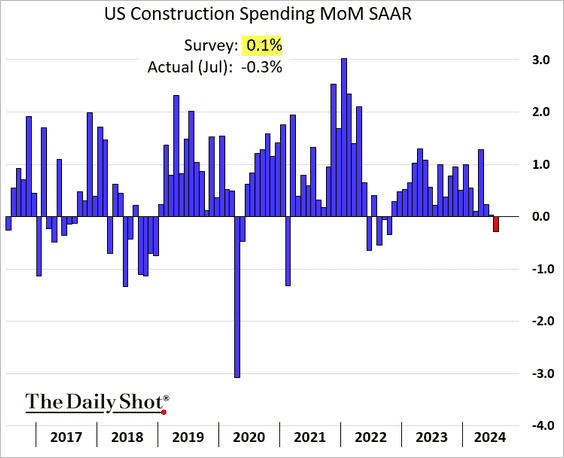
This is helping a lot:
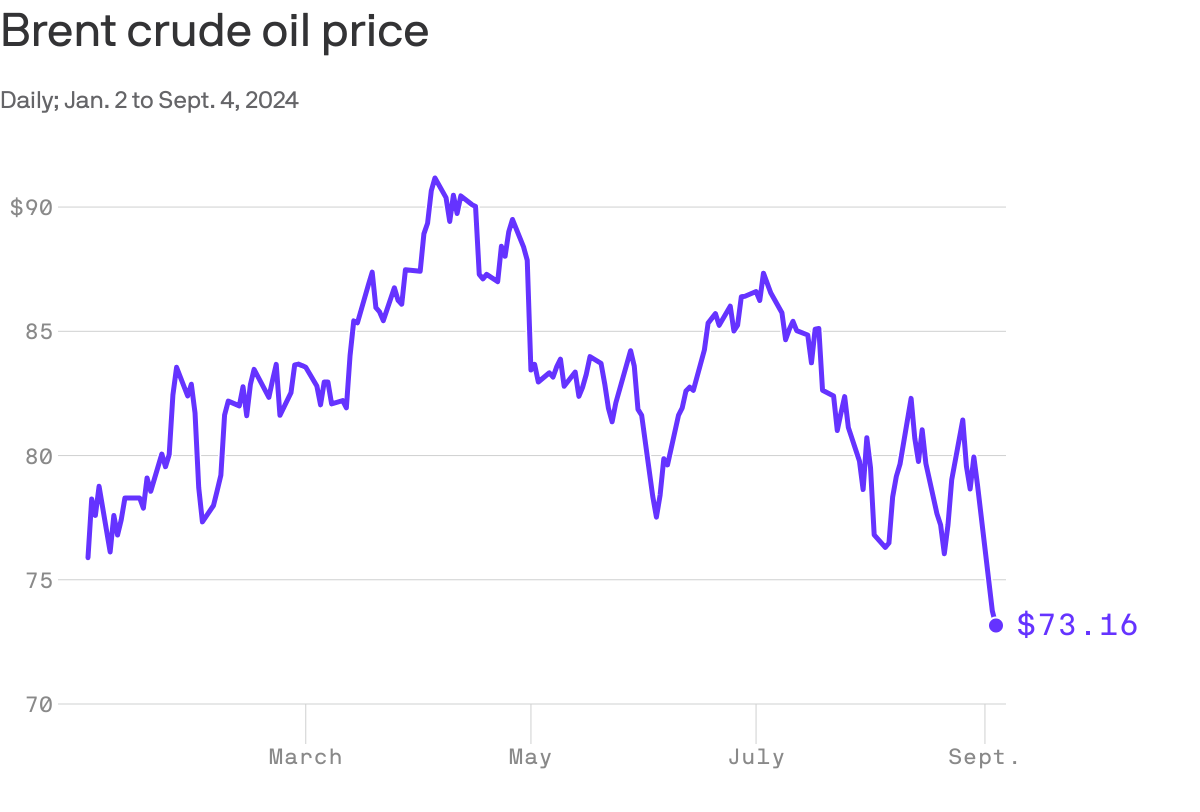
Analysts see several unrelated reasons for the recent declines.
- Weak Chinese economic data keeps arriving.
- Reports of a deal among rival Libyan factions to restore production.
- The end of the U.S. summer driving season.
“As long as we don’t see a major hurricane head into the Gulf,” Patrick De Haan, GasBuddy’s head of petroleum analysis, said in a research note, “the national average could fall below $3 [per gallon] in the next two months.”
Data: Yahoo Finance. Chart: Axios Visuals
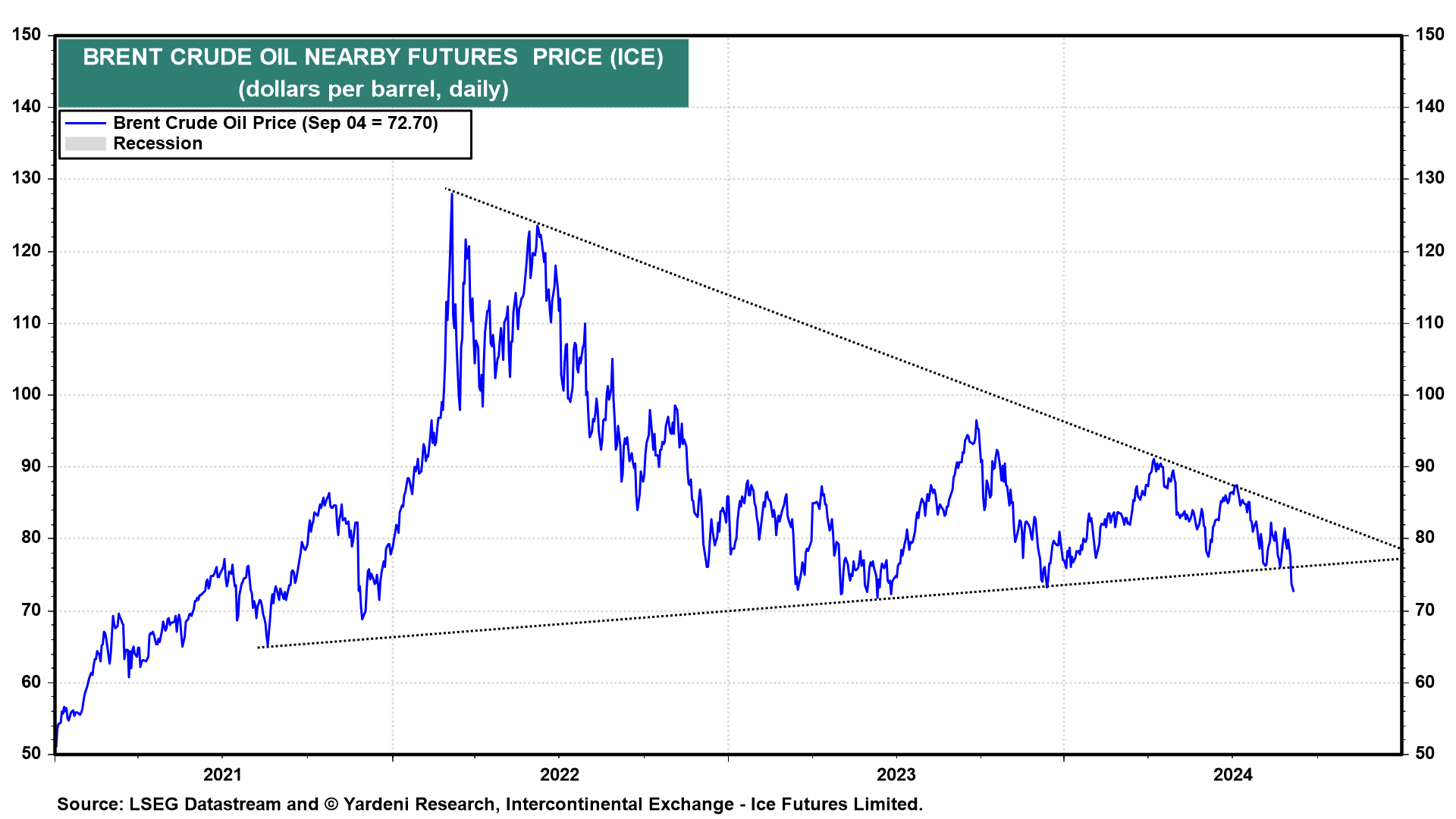
In spite of geopolitical concerns, the price of oil fell sharply in recent days (chart). OPEC+ may delay production increases scheduled to start next month as a result of weaker Chinese oil demand. Furthermore, traders may be betting that a direct war between Israel and Iran is less likely. So oil’s geopolitical risk premium is falling and the technical picture looks quite bearish. That’s been bullish for bonds. (Ed Yardeni)
AI Adopters Aren’t Slashing Jobs So Far, NY Fed Survey Shows
On net, about 5% of service-industry firms in the New York area that reported using AI said that they reduced employees over the past six months, according to the Fed study conducted in August. The survey found little change in employment at manufacturers that adopted AI.
The researchers found that churn in employment among firms deploying AI is set to increase. But service companies using the technology said they’re more likely to add jobs than reduce them over the coming six months, a reversal of the pattern in the preceding period. (…)
Overall, 25% of service firms reported using AI and the share is set to rise to 32% in the coming six months. Among manufacturers, it’s forecast to remain at the current level of 16%. Across both industry groups, AI adopters said they are retraining around one-quarter to one-third of their staff, and predicted that the share will rise sharply in the coming months.
The most widely cited use of the technology was for marketing, advertising, business analytics and customer service, according to the survey. (…)
BoC Policy Monitor: Three in a row and plenty more to go
(…) Overall, there was very little changed relative to July as Macklem reiterated it is still “reasonable” to expect further rate cuts (as long as inflation cooperates). At the margin, there appears to be a bit more confidence on the inflation outlook as shelter prices are seen as “starting to slow”. And as we got a sense of in July, they “increasingly” want to guard against too much slack and inflation undershooting over the projection horizon.
They therefore “need” growth to pick up. What does it mean for the meetings ahead?
To us, the BoC’s base case outlook is for continued 25 basis points cuts at each of the remaining meetings in 2024 (and likely well into 2025 too). However, there is a growing focus on downside inflation/economic risks which should keep markets pricing some probability of a larger-than-25 basis point cut. That’s appropriate in our view given the balance of risks in the labour market and on the growth outlook. (…)
Eurozone economy grows at fastest pace in three months
The seasonally adjusted HCOB Eurozone Composite PMI Output Index increased for the first time since May to a three-month high of 51.0 in August, from 50.2 in July. Rising further above the 50.0 no-change mark, the latest figure therefore pointed to a re-acceleration of growth, although the overall pace of expansion that was implied was only marginal overall.
Growth in the euro area was fueled entirely by services activity, which rose at the fastest rate in three months. Manufacturing production continued to shrink, extending the current sequence of decline in factory output to 17 months.
A major force behind August’s accelerated euro area expansion was France, where private sector output rose at the quickest rate since May 2022. Despite this, the eurozone’s second-largest economy still ranked behind Spain (the best-performing nation for which Composite PMI data are available), which posted a solid and slightly stronger upturn. Improved growth rates were also seen in Ireland and Italy, while Germany bucked the trend by posting a second successive decline in private sector business activity.
Although output growth quickened across the single currency union in August, latest HCOB PMI survey data revealed a further modest decrease in the volume of incoming new business received by private sector firms. Weighing on demand was a sharp and steeper deterioration in sales across the manufacturing sector, more than offsetting a slightly quicker improvement in service sector new orders.
Export business presented a headwind to sales performance in August. The latest survey data showed that new orders received from non-domestic clients shrank at the quickest rate since January. Manufacturers and service providers both recorded weaker new export business midway through the third quarter.
Capacity pressures continued to dwindle across the eurozone’s private sector, as evidenced by a seventeenth successive monthly reduction in backlogs of work. Additionally, the pace at which outstanding business fell was the quickest since February.
For the first time since the start of 2021, the seasonally adjusted HCOB Employment Index recorded below the critical 50.0 threshold, signalling a reduction to workforce numbers across the euro area private sector. That said, the decline was only fractional overall as sustained (albeit softer) job creation across the service sector was only narrowly cancelled out by headcount reductions across the manufacturing industry.Nevertheless, renewed job cutting came amid a further deterioration in business confidence – the third in as many months. Although eurozone firms anticipate output to rise over the coming 12 months, the degree of optimism slipped to its lowest in the year-to-date.
Meanwhile, the latest HCOB PMI survey revealed a marked cooling of input price inflation, with overall operating costs rising at a pace that was the weakest in 2024 so far and broadly aligned with its pre-pandemic average. There was a particularly marked easing of cost pressures across the service sector. However, prices charged for euro area goods and services rose at the quickest pace since April.The HCOB Eurozone Services PMI Business Activity Index signalled a quicker pace of expansion in output across the single currency union’s services economy midway through the third quarter. Increasing to 52.9 in August, from 51.9 in July, the index was at its highest level in three months and broadly in line with its historical average since 1998 (52.7).
Stronger activity was supported by a concurrent rise in new business inflows. The upturn in sales was slightly stronger than that seen in the previous survey period, but only mild overall. Demand growth was reflective of improved domestic market conditions, as new export business shrank at the quickest rate since February.
Outstanding order volumes fell for a fourth month in succession during August. The rate of backlog depletion also accelerated to its fastest for six months. A faster workload completion rate came amid a further uplift in employment levels. The rate of job creation was the softest in 2024 so far, however.
Input prices faced by eurozone service providers rose again in August, albeit to the weakest extent in over three years. Despite cost pressures abating, prices charged increased at the strongest rate since May
Commenting on the PMI data, Dr. Cyrus de la Rubia, Chief Economist at Hamburg Commercial Bank, said:
“The Olympic Games in Paris brought plenty of victories, and the French service sector was certainly among the winners. The latter helped drive accelerated growth in the eurozone’s service sector for August. But the big question is whether this boost is sustainable. The positive vibes from the Games and the ongoing Paralympics might carry through into September in part, but we expect the slowdown in growth, which started in May, to likely resume in the coming months.
“As for the ECB, they are probably breathing a small sigh of relief thanks to the latest prices data. Although service providers nudged up their prices slightly more in August compared to July, overall cost pressures, especially those driven by wages, have eased. This will likely weigh more heavily in the ECB’s considerations. Coupled with the favourable inflation numbers Eurostat recently released for August, the ECB is likely to see this as further justification for cutting interest rates at their September 12 meeting.
“The “Olympic effect” is also set to ensure that the eurozone’s GDP will show growth in the third quarter. It’s encouraging that the service sector is showing growth across the board geographically, with the HCOB PMI above 50 points in all four major eurozone economies. However, it’s a tale of two sectors: while services are driving the growth, the manufacturing sector remains stuck in recession, with conditions worsening in several countries, including Germany and France.”
Eurozone retail sales continue to flatline
(…) Retail sales have been slowly bottoming out after a large post-pandemic correction, but there is no evidence yet of a real recovery. The 0.1% increase in July still leaves retail sales 0.3% below the May reading.
Retail sales have suffered from the reopening of services after the pandemic and from a decline in real incomes for Europeans, which has limited goods consumption. While the reopening effects have been wearing off and real incomes are recovering, there is still no evidence of a rebound for retail. This also limits inflation expectations for goods, even though input costs have increased recently.
As a first reading of what the consumer is doing in the third quarter, this does not give us much hope of a surprise surge in household consumption. Perhaps the Olympics have boosted consumption in France, but don’t expect major surprises there. Today’s sluggish sales figures illustrate the weak economic growth environment that the eurozone is currently in.
Country Garden Seeks Fresh Onshore Debt Overhaul as Sales Slump Builder says home sales yet to recover, funds being restricted
(…) “The company seeks to negotiate a new debt management plan with bondholders to better align with the latest situation in the property market and corporate funding,” Country Garden told Bloomberg News on Thursday. The firm has yet to secure enough cash to repay its onshore bond principal and interest and needs to seek debt extensions, it added.
The distressed real estate company pointed to waning homebuyer demand and a deteriorating market outlook, which led to a 78% plunge in its contracted sales in the first eight months. Fund allocation restrictions also made it unable to collect enough money for payments due, the company added.
Country Garden, once China’s biggest developer by sales, has seen a sharper slowdown than its peers due to its focus on projects in smaller cities. It defaulted on dollar notes in October and has been pushing back onshore bond payment dates.
As the impact of China’s latest housing rescue package wanes, new-home sales in so-called tier-3 cities have shrunk faster, according to a note by researcher China Index Holdings. Country Garden’s year-to-date sales decline is more than double the 36.5% slide at the 100 biggest real estate companies tracked by China Real Estate Information Corp. (…)
China’s Earnings Setback Sows Fresh Doubts About Stock Rebound Major tech firms’ EPS growth was the slowest since late 2022
Earnings per share for the MSCI China Index fell 4.5% from the year earlier in the second quarter, its worst in five quarters, according to data from Bloomberg Intelligence. Underscoring the contraction was weakening support from the country’s eight biggest tech firms, whose overall EPS growth at 19% was the slowest since the last quarter of 2022. (…)
“The biggest drag on this earnings season is weakening domestic demand,” said Minyue Liu, an investment specialist for Greater China and global emerging-market equities at BNP Paribas Asset Management. (…)
As the nation’s tech giants intensify cost control to boost profitability, investors are shifting their focus toward their ability to generate revenue in an increasingly tough climate.
“Overall, the guidance from many of these tech companies on the sales outlook suggests lingering consumer weakness, and that is what is holding back market sentiment at the moment,” said Marvin Chen, a Bloomberg Intelligence analyst. (…)
The earnings picture is even more bleak in other industries.
Real estate and consumer staples firms, the most direct casualties of weaker purchasing power, were among the biggest laggards in the latest earnings season: major developer China Vanke Co. suffered a half-year loss for the first time in more than two decades, while retailers including Li Ning Co. have toned down sales guidance.
Banks are also under pressure as falling interest rates and depressed loan demand has driven margins to record low levels.
All that has fueled pessimism about the outlook of Chinese stocks. The consensus EPS growth estimate for MSCI China this year has slid to about 11%, from 15% at the beginning of the year and a peak of 16% late last year, a Bloomberg Intelligence analysis shows.
“We expect more disappointing earnings results to come through and trigger further consensus downward revisioning,” Morgan Stanley strategists including Laura Wang wrote in a note last week. “We therefore continue to caution against premature optimism at the broad index level and see a largely range-bound market.”

US Election a Top Global Risk But Tricky to Forecast, BofA Says Variables include president and congress makeup, geopolitics
The US election is emerging as one of the top risks to the global economic outlook, though it’s tougher than usual to predict just how it will play out, according to Bank of America’s head of global economics research.
Both candidates — former President Donald Trump and Vice President Kamala Harris — have yet to specify their policy platforms and are operating in an economy that’s quite different from just four years ago, Claudio Irigoyen said in an interview in Hong Kong Thursday. (…)
“The market is not trading the election yet. The market has been focusing a lot on the behavior of the US economy” and how much the Fed will cut interest rates this year, he added. (…)
Goldman Sachs Group Inc. this week cautioned that US GDP faces a hit in the case of a Trump victory as the drag on growth from tariffs and tighter immigration would outweigh the boost from a positive fiscal impulse.
Trump has floated across-the-board tariffs of 10% on imports and levies of 60% on Chinese goods. Harris has described such plans as a tax on the middle class, but is broadly expected to continue on President Joe Biden’s path of trying to reduce reliance on Chinese imports and block its access to advanced technologies.
The challenge for the Fed will be contending with the risk of higher inflation if heavy tariffs are implemented, Irigoyen said. A Republican sweep would present the highest risk of abrupt policy change, Bank of America found in a July report, with the boost from lower taxes canceled out by higher tariffs. (…)


