The enemy of knowledge is not ignorance, it’s the illusion of knowledge (Stephen Hawking)

It ain’t what you don’t know that gets you into trouble. It’s what you know for sure that just ain’t so (Mark Twain)

Invest with smart knowledge and objective odds

THE DAILY EDGE: 14 JANUARY 2022: Retail Sales Down 1.9% vs Consensus -0.1%

ADVANCE MONTHLY SALES FOR RETAIL AND FOOD SERVICES, DECEMBER 2021

Advance estimates of U.S. retail and food services sales for December 2021, adjusted for seasonal variation and holiday and trading-day differences, but not for price changes, were $626.8 billion, a decrease of 1.9 percent (±0.5 percent) from the previous month, but 16.9 percent (±0.9 percent) above December 2020. Total sales for the 12 months of 2021 were up 19.3 percent (±0.5 percent) from 2020.

Total sales for the October 2021 through December 2021 period were up 17.1 percent (±0.7 percent) from the same period a year ago. The October 2021 to November 2021 percent change was revised from up 0.3 percent (±0.5 percent)* to up 0.2 percent (±0.3 percent).

Retail trade sales were down 2.1 percent (±0.4 percent) from November 2021, but up 14.4 percent (±0.7 percent) above last year. Gasoline stations were up 41.0 percent (±1.6 percent) from December 2020, while food services and drinking places were up 41.3 percent (±4.0 percent) from last year.

image

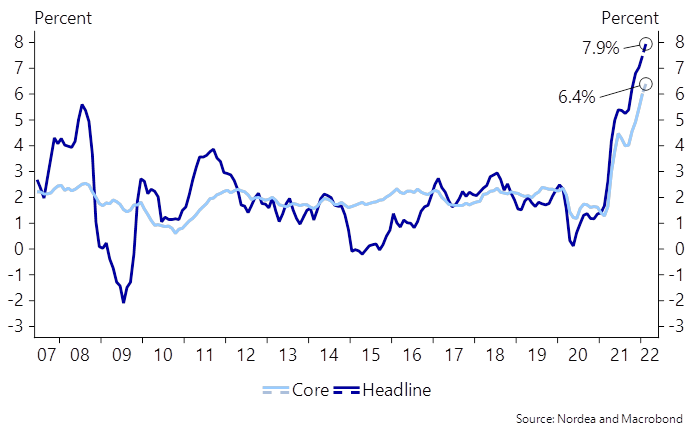
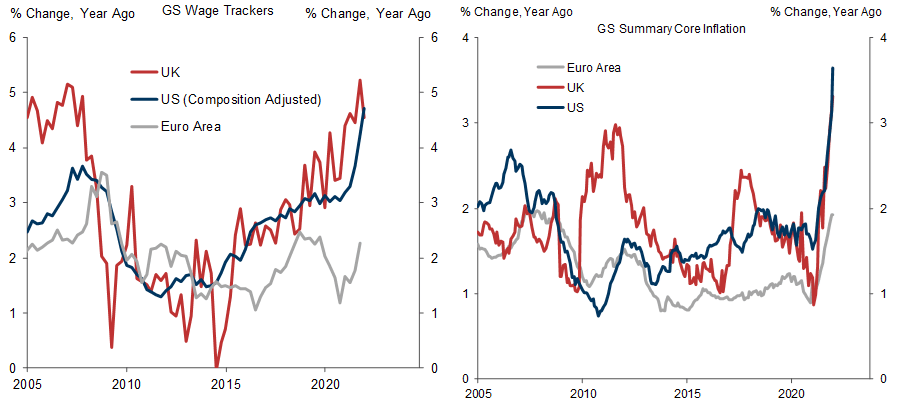
UK wage growth close to record high

The combination of strong demand for staff and deteriorating staff availability led to a further steep rise in wages as firms competed to attract staff.

Average starting salaries and average pay for temp/contract staff rose steeply again in December. For permanent salaries, only in October and November 2021 had the recruitment industry survey ever recorded a stronger rate of wage inflation than that seen in December.

Such a lack of available staff is not surprising. The latest available official data show that the number of unfilled vacancies had risen to 1.2 million in the three months to October, while unemployment was down to 1.4 million; an implied record low ratio of job seekers to vacancies, pointing to a tight labour market which is conducive of course to high wage growth.

Pretty similar to the U.S. as I showed a few days ago. But Mr. Powell Tuesday argued that there is no evidence that rising wages have transpired into rising prices so far. This nice man is quickly losing all credibility. I don’t know what he reads but he sure is not reading me, nor any of the monthly PMI reports which offer the best, real world, almost real time, data-backed narrative of what biz people right on the front line are seeing.

Here’s the latest Markit report from the UK (don’t think the USA is so different):

The impact of staff wages on prices is already clearly evident in the PMI survey responses. Record numbers of companies cited higher staff costs as a contributor to higher prices throughout the fourth quarter of 2021.

unnamed - 2022-01-13T123743.566

Powell will eventually backtrack from the above statement, like he did “transitory inflation”.

David Rosenberg also backtracked yesterday from his noflationist view:

(…) the three-month trend in the core CPI, at a 7.0% annual rate, is pointing to an intensification of the price pressures. I would have preferred this not to be the case, and it is problematic for the real economy and the Fed is in a real box. (…) Fed tightening into inflation like this, regardless of when it comes down or the causes (which are mostly pandemic-related), has led to an outright economic recession 100% of the time in the past.

Count one more on “Recession Watch”.

But can the U.S. actually trip in recession given

  • the liquidity in the system, particularly the humongous $2.5T in “excess cash” sitting in Americans’ checking accounts accumulated during the pandemic?

fredgraph - 2022-01-13T135724.538

  • and the consumers’ strong balance sheet and low leverage. Debt servicing is now 9.2% of now normalized DPI. Interest rates would need to rise hugely before debt servicing reaches previous choke points of 12-13%.

fredgraph - 2022-01-13T141250.185

The problem with the $2.5T in “excess cash” is illustrated by this next chart: 54% of the increase in deposits since Q1’20 rests in the accounts of the wealthiest 10% of households (red and pink bars). Another 42% went to the next 40% group (blue), averaging $25k per household. The bottom 50% (black) got only 4% of the increased deposits, an average of $2,000 per household, now largely eroded by inflation.

fredgraph - 2022-01-14T065302.781

The recession buffer is thus with the 51.5 million households (40% of the total) who would need to offset the financial stress of the 64.4 million households with little if any financial cushion.

The additional wealth created by rising equity and home values also aggregated in the wealthiest 10% as Ed Yardeni illustrates:

image

image

That’s far from the median U.S. household income in 2020 of $67,521, according to the U.S. Census Bureau. (…) In 2021’s final quarter, 34% of respondents said they felt financially healthy, compared with 48% in early 2021. (…)

Of those surveyed, 30% agreed that “expenses are constantly piling on,” a jump from 23% who agreed with that in 2021’s first quarter.

Nearly half of those surveyed said that their debt is “unmanageable,” and 37% said a surprise $100 expense would make them anxious. (…)

Money Governor Christopher Waller said in a Bloomberg Television interview that while three hikes in 2022 is a good baseline, the case could be made for four or even five if inflation remains too high.

German Slowdown Sends Global Warning Signs on Supply Chains, China A bellwether of global growth, the German economy slowed sharply at the end of 2021

(…) Germany’s economy probably shrank by between 0.5% and 1% quarter-on-quarter in the September to December quarter, the federal statistics agency said at a news conference on Friday. Germany is the first major economy to give a preliminary estimate of its 2021 gross domestic product.

For 2021 as a whole, German GDP grew by about 2.7% year-over-year, leaving it 2% below its 2019 level. That compares with estimated growth of 5% for the wider eurozone and 5.8% for the U.S. last year, the agency said. (…)

Germany is suffering from its reliance on exports, which support roughly 30% of German jobs, about four times the share in the U.S. German manufacturers are struggling to find parts and labor to produce cars and machinery. They face surging energy prices that are further pushing up sky-high electricity bills.

They are also being squeezed by a slowdown in China, Germany’s largest trading partner in 2020 and a major purchaser of German machine tools and cars. German exports to China declined by 4.2% in November year-over-year, to €8.9 billion, equivalent to $10.2 billion, while exports to the U.S. surged about 15% to €11 billion, according to the federal statistics agency. (…)

The number of furloughed workers in Germany increased to 879,000 in December, or 2.6% of the workforce, up from 712,000 the previous month, according to Ifo.

“The rise in coronavirus cases increased short-time work in hospitality and retail in particular,” said Ifo researcher Sebastian Link.

In the manufacturing sector, the number rose from 381,000 to 390,000 people, or 5.6% of all workers. “This is due to an increase in supply bottlenecks,” Mr. Link said.

Cathie Wood Outflows Grow as Diehard Fans Face Biggest Test Investors pulled $352 million from Wood’s flagship ARK Innovation ETF (ticker ARKK) on Wednesday, according to data compiled by Bloomberg. That was the biggest outflow since March.

(…)  ARKK’s outflow was its third-biggest on record; the last time the fund lost over $300 million it was trading 44% higher. (…)

ARKK is now down about 50% from its all-time high in February last year. Yet many of its investors — who poured billions in after the ETF returned more than 150% in 2020 — have stayed loyal even as they lost money.

Fund assets have declined by about $15 billion since the peak, but only approximately $1.1 billion of that was from net outflows — the rest of the drop has been caused by performance. The ETF is now trading well below an estimate of its average purchase price since-inception. (…)

ARKK's miserable performance finally results in a significant outflow

Russia Threatens to Deploy Troops Near U.S. Russia’s deputy foreign minister said talks with the U.S. over the security situation in Ukraine had stalled and suggested that Moscow could dispatch a military deployment to Venezuela and Cuba.

THE DAILY EDGE: 13 JANUARY 2022: Broadflation!

Inflation Hit Fastest Pace Since 1982 U.S. inflation reached 7% in 2021 as pandemic-related supply and demand imbalances, along with stimulus intended to shore up the economy, put the biggest pressure on prices in nearly four decades.

The so-called core price index, which excludes the often-volatile categories of food and energy, climbed 5.5% in December from a year earlier. That was a bigger increase than November’s 4.9% rise, and the highest rate since 1991.

On a monthly basis, the CPI increased a seasonally adjusted 0.5% in December from the preceding month, decelerating from October and November. (…)

Prices for autos, furniture and other durable goods continue to drive much of the inflationary surge, fueled by largely pandemic-related imbalances of supply and demand that most economists expect to fade as Covid-19’s impact on economic activity eases. Prices of used cars and trucks soared 37.3% in December from a year earlier, while living room, kitchen and dining room furniture jumped 17.3%. (…)

Broadflation:

                                  December a.r.  Last 4 months a.r.   Last 2 months a.r.

Headline CPI:                  6.2%                      8.0%                         8.1%

Core CPI:                          7.4%                     5.8%                          6.1%

Core Goods:                   14.6%                   10.2%                       12.8%

   Core Goods ex-cars      9.8%                     8.1%                         8.5%

Core Services                   3.6%                     3.9%                          4.2%

Shelter:                             4.9%                     5.5%                          5.5%

The only item noflationists can hope on is buried in Table 3:

Services ex-rent              1.2%                      3.0%                         1.8%   but that includes Energy Services which were down 0.1% in December.

The Cleveland Fed’s table shows that everything is 5%+ sequentially:

image

Inflation Surge Is on Many Executives’ List of 2022 Worries Nearly 60% of U.S. CEOs expect elevated inflation to continue until at least mid-2023, according to a survey by the Conference Board, with labor shortages their top concern for 2022.

(…) U.S. chief executives cited labor shortages as their chief external concern for the coming year, followed by inflation and supply-chain problems. Covid-19 came in fourth. (…) In the U.S., 59% of CEOs expect inflation to be elevated until at least mid-2023 or beyond.

Similarly, European CEOs ranked inflation as the top worry and Covid-19 disruption as 10th, below the expected impact of regulators. But CEOs in both China and Japan see Covid-19 having the greatest impact on their business this year.

The pandemic’s ranking in Asia helped push it to the top of the list of concerns among all CEOs surveyed globally, followed by rising inflation and labor shortages. (…)

“It’s a very different view around management of the virus and what that means,” she said. China’s large manufacturing base can’t work from home, while the U.S. economy is more service-focused. “It makes sense to me that Covid disruptions would rise to the top of the list for say China, whereas in the U.S., labor shortages are the topic du jour.” (…)

Earlier this week, an annual risk report from the World Economic Forum showed a significant increase in pessimism about global prospects, with executives and leaders worried about longer-term fallout from the pandemic. Many respondents expected the next three years to be characterized by consistent volatility and surprises. (…)

Mr. Walker said inflation costs can be difficult to pass on, especially in the banking world. “Margins don’t go up because I’m paying people more,” he said in an interview. “There are certain things that we have to be quite careful about with this, because it can erode the returns and profitability of organizations and that can be structural rather than transitory as well.”

When it comes to their internal focus for the coming year, CEOs from all regions said attracting and retaining talent was the priority. The group also acknowledged that remote work would play a more prominent role even after the pandemic subsides.

A third of CEOs globally expect at least 40% of their post-pandemic workforces would remain remote, which is defined as working at least three days a week outside of the physical workplace. Among U.S. CEOs, 53% expect at least 40% of workers to work remotely. (…)

“There is going to be continued pressure on wages and benefits and all the costs that go along with attracting and retaining workers,” Ms. Peterson said. “Businesses are saying, this is going to be a problem not only this year, but next year and maybe even beyond that.”

In a PWC survey last year, 49% of remote workers suggest losing WFH options would increase their likelihood of looking elsewhere for employment. Actually, 31% said it was “extremely likely” a loss of WFH options would ause them to look for new employment.

From the WSJ:

  • “People frequently say [restaurant and catering workers] are low-price people. Well, our base pay is now $30 an hour [$20 pre-covid] for wait staff and we still can’t fill positions,” (John Merritt, vice president of Elaine Bell Catering in Napa, Calif.).
  • “The price we were paying [for filet mignon] went from about $12 a pound to over $25. As a result, we’ve cut those meals out of our diet,” said Mr. McAllister, a 72-year-old retiree in Hilton Head, S.C. “The chicken and beans have been a good protein substitute for the beef.” He said he also has stopped adjusting the thermostat upward because of rising home-heating costs and is going out of his way to find cheaper gasoline. Mr. McAllister said he is golfing less after a number of friends canceled their golf-club memberships to save money. “So there’s kind of a psychic price to inflation too,” he said.

Cass Transportation Index Report December 2021

The U.S. transportation sector delivered in time for the holidays as the shipments component of the Cass Freight Index® accelerated to 7.7% y/y growth in December from 4.5% in November.

Though virtually unchanged m/m, the Cass shipments index jumped 4.2% from November to December on a seasonally adjusted (SA) basis, as shipment volumes held firm despite the normal holiday slowdown.

Though the record backlog of 105 containerships off Southern California and sharp declines in intermodal volumes in early 2022 still demonstrate capacity constraints on freight volumes, the strong finish to 2021 shows progress as the trucking industry has begun to build driver and equipment capacity in spite of extraordinary challenges.

  • The freight rates embedded in the two components of the Cass Freight Index decelerated to a 33% y/y increase in December from 38% in November.
  • Cass Inferred Freight Rates rose another 3.5% m/m on a seasonally adjusted basis in December, to a new record.

For full-year 2021, Cass Inferred Freight Rates rose 23% from 2020, and heading into 2022 are up even more than that on a y/y basis, albeit likely to slow from the 33% increase in December.

While signs that an easing in the everything shortage were beginning to emerge prior to the Omicron wave, the challenges to industry capacity are worsening again as 2022 begins. Absenteeism is surging across drivers, maintenance staff, and administrative personnel at transportation companies, and the effects of the latest COVID variant on factory workers will likely slow the recovery in equipment production.

(…) The backlog rose to 100 ships in late November and reached a record 106 vessels on New Year’s Day. Before the pandemic it was unusual for more than one ship to wait for a berth. (…)

Jim McKenna, the association’s chief executive, said terminals might be able to catch up on some of the work backlog if factories in Asia reduce operations during the Lunar New Year, which begins in a few weeks. But he cautioned that most of his members, who include the world’s largest ocean carriers, expect the cargo surge to continue through the next six months, if not through the end of 2022.

JP Morgan sees OPEC spare capacity falling through 2022

JPM forecasts oil prices to rise as high as $125 a barrel this year and $150 a barrel in 2023. “We see growing market recognition of global underinvestment in supply,” the bank said. (…)

Assuming production at prevailing quotas, OPEC spare capacity will fall to 4% of total production capacity by fourth quarter 2022, from 13% in the third quarter 2021, the U.S. investment bank said in a note.

JPM said this comes at a critical point as other global producers falter. The combination of underinvestment within OPEC+ nations and post-pandemic rising oil demand could lead to a potential energy crisis.

We have liftoff!

(…) “We want to bring inflation under control in a way that does not disrupt the real economy, but we are also firm in our desire to get inflation to return to 2% over the medium term,” Mr. Bullard said in a Wall Street Journal interview Wednesday. (…)

He said the headline figure was higher than expected but consistent with his expectations, adding he sees price pressures easing over the course of the year toward a 3% reading on the personal-consumption expenditures price index.

To get there, Mr. Bullard, who holds a vote on the rate-setting Federal Open Market Committee this year, said a more hawkish path for monetary policy is needed relative to his recent expectations.

Whereas he recently believed the Fed would need to raise rates three times this year, “I actually now think we should maybe go to four hikes in 2022.” He said it is important for the Fed to start raising rates “sooner rather than later” because pulling back on stimulus in the near term and doing so steadily reduces the risk of an even more aggressive path should inflation not moderate back toward the target. (…)

Referencing the Fed’s bond purchases, “these emergency measures on the balance sheet side have overstayed their welcome” and it appears likely that the buying done during 2021 was more stimulus than the economy needed, he said.

“If I had my druthers, we would have ended the purchases sooner than we’re ending up doing,” Mr. Bullard said, adding “we should, in tandem with the rate hikes I’m recommending, also allow passive runoff of the balance sheet, beginning in the spring.” Passive run off means allowing securities to mature and not be replaced. (…)

The central banker said that given how high inflation is right now, it is possible that both monetary policy and broader government actions were too aggressive and ended up serving as key drivers of the inflation surge, which he said is probably more demand driven compared with supply disruptions tied to the pandemic. (…)

“These are some of the tightest labor markets that you’ll ever see in the United States,” Mr. Bullard said. “I think that process is going to continue all the way through 2022, and I’m now expecting the unemployment rate in 2022 to breach the 3% threshold,” he said. The U.S. last saw joblessness at that level in the early 1950s. The jobless rate is currently 3.9.%.

  • Goldman Sachs added an additional Fed rate hike (for a total of four) to its baseline for 2022 based on the latest incoming data and the prospect for an earlier start to balance sheet runoff. “We expect the current inflation surge to get worse before it gets better, but see core PCE inflation falling to 2.5% by end-2022. We expect the unemployment rate to fall to 3.4% by the end of 2022.”
Economists React: Inflation Expected to Cool This Year Today’s high inflation rate looks different than the inflationary episodes of the 1970s and 1980s.

(…) “I don’t believe that we’re headed back towards another rehash of the 1970s,” he said. “The conditions are very different today than they were at the time.” (…)

The last time the U.S. economy recorded such rapid inflation, in the 1970s and 1980s, the public’s longer-term inflation expectations were higher, above 5% versus 3% today. (…)

Let’s all hope we don’t relive the 1970s. But we are reliving the late 1960s, the Lyndon Johnson years of The Great Society, The War on Poverty and the Vietnam war. Inflation, quite for years, rose from 1.2% to 3.3% in 1966 and reached 6% in 1969. Wage inflation peaked at 7.3% in Q4’68 with the unemployment rate at 3.4%.

In 1965, the first session of the Eighty-Ninth Congress created the core of the Great Society. It began by enacting long-stalled legislation such as Medicare and federal aid to education and then moved into other areas, including high-speed mass transit, rental supplements, truth in packaging, environmental safety legislation, new provisions for mental health facilities, the Teacher Corps, manpower training, the Head Start program, aid to urban mass transit, a demonstration cities program, a housing act that included rental subsidies, and an act for higher education. (Wikipedia)

image

Fed Beige Book: Economy Grew at Modest Pace to Close 2021 Supply-chain constraints and labor shortages continued to hamper growth, while some companies reported an easing of price increases

The report contains information gathered through Jan. 3 as new reported cases of the disease were rising sharply. (…)

Employers said they continued to struggle to fill open positions, holding down payrolls and pushing up wages. Respondents in the New York area expected wage increases to average 6% in 2022.

One manufacturer in the Dallas area said three to five new hires were needed to fill one open position due to rapid labor turnover.

Firms also said they were expanding benefits and offering part-time work options to draw candidates.

In some cases, businesses said they had started to automate some tasks or had put in place changes such as less frequent replenishing of towels in hotels to save on labor.

Prices continued to rise, the report said, although some companies said the pace of increases had slowed. Transportation bottlenecks also eased slightly in recent weeks, respondents said. (…)

Directly from the Beige Book:

  • Consumer spending continued to grow at a steady pace ahead of the rapid spread of the Omicron COVID-19 variant. Most Districts noted a sudden pull back in leisure travel, hotel occupancy and patronage at restaurants as the number of new cases rose in recent weeks. Although optimism remained high generally, several Districts cited reports from businesses that expectations for growth over the next several months cooled somewhat during the last few weeks.
  • Employment grew modestly in recent weeks, but contacts from most Districts reported that demand for additional workers remains strong. Job openings were up but overall payroll growth was constrained by persistent labor shortages. Tightness in labor markets drove robust wage growth nationwide, with some Districts highlighting additional growth in labor costs associated with non-wage benefits. While many contacts noted that wage gains among low-skill workers were particularly strong, compensation growth remained well above historical averages across industries, across worker demographics, and across geographies.
  • Contacts from most Federal Reserve Districts reported solid growth in prices charged to customers, but some also noted that price increases had decelerated a bit from the robust pace experienced in recent months. Wholesale and materials prices contributed to pricing pressures across a wide range of industries, spanning service providers and goods producers.

This Is Broad Inflation. Can It Be Controlled? (John Authers) The latest numbers end all debate. Inflation has spread to the wider economy, and there’s only faint hope of making it leave soon.

(…) Many reasons were offered in mid-year, sincerely and honestly, to show that higher inflation numbers were merely a facet of transitory effects of the pandemic. None of them holds water any longer.

The Bureau of Labor Statistics started to publish an index that excluded food, fuel, shelter and used cars and trucks — an odd mix to exclude — that captured most of the weirdest effects of the pandemic. Unfortunately, inflation from that index continues to rise, and is now at a 30-year high (…).

Inflation excluding shelter (accounting for a third of the index) exceeds 8%. Shelter inflation is at its highest in 14 years, and has now topped 4%. The likelihood is that these numbers will converge, but housing looks likely to be a big headwind for any hopes that headline price rises will drop in short order (…).

The share of CPI components whose prices are going down is minimal. Meanwhile, more than 80% of components have inflation above their five-year average. This time last year, fewer than 40% had inflation this high. (…)

There is every reason to expect that rises cannot continue like this for much longer. If we look at month-on-month figures for flexible prices (which the Atlanta Fed shows on an annualized basis), we can see that the rate of increase of prices that can most easily be moved is already dropping substantially. It’s reasonable to think that the first wave of price rises in response to the pandemic is over. (…)

The bad news, which we knew about already, is that the main measures of inflation are uncompromisingly bleak. Commodity prices have grown more concerning, while wage inflation has also increased. (…)

Technical patterns matter a lot in foreign exchange. Wednesday’s fall brought the dollar below its 100-day moving average and also broke the upward trend it had been moving in since last summer. Confirmation is needed, but it looks as though FX traders are reconsidering their belief that the underlying direction of the dollar is up, buoyed by higher rates on Treasuries (…).

All else being equal, inflation will cause a currency to lose value compared to others. But if rates rise to combat inflation, that will draw money to the currency by increasing the returns on offer. Thus, the dollar has gained nicely throughout the period in which it has become more and more obvious that the U.S. has an inflation problem. However, the combination of another really bad inflation number and an insouciant bond market response has been enough to knock the dollar off course. Many factors drive currencies, but this is consistent with a view that the rate hikes already priced in, and supporting the dollar until now, won’t be enough to head off inflation. The bond market isn’t too nervous about the Fed’s ability to rein in inflation, but the foreign exchange market is much more dubious. Its judgment matters — a weaker dollar makes imports more expensive and increases inflation.

Another market development saw commodity prices rally. Many analysts were proclaiming that commodities had reached their top after a poor December. Now, the widely followed CRB index is at a high since 2014, while Bloomberg’s index of industrial metals is close to its highest level since 2011. This suggests confidence in growth, but also continuing worries about supply bottlenecks. And in themselves, higher commodity prices increase inflation (…).

Broadly, this is a trap that will be difficult to escape. As I’ve said before, the dynamic of pricing power and demands for higher wages after a decade of decline in working-class living standards are the nub of the problem. Somehow, it will be resolved, and that will be the story of 2022. (…)

Reminder: Approximately 57% of U.S. households earn less than $70,000 per year. According to a December 2020 study by CNBC, 63% of
Americans have been living paycheck to paycheck since the start of the pandemic.

My CPI-Essentials measure is at +7.0% YoY, from 2.9% pre-pandemic. It rose only 0.35% MoM in December, thanks to Energy being down 0.4% as oil prices fell to $71. It’s now $82.

CPI-ESSENTIALSfredgraph - 2022-01-13T075735.574