Durable-Goods Orders Rise, Masking Manufacturing Weakness Increase was driven by jump in defense spending
The reading, part of a report on U.S. orders for long-lasting goods, showed that new orders for nondefense capital goods excluding aircraft fell 0.9% in December from the previous month, to $68.6 billion, the Commerce Department said Tuesday. Those so-called core capital goods orders—which set aside volatile defense and transportation orders—are widely viewed as a measure of businesses’ willingness to spend on items such as machinery, equipment and computers.
The department also said new orders for all durable goods—products designed to last at least three years—rose 2.4% in December from the previous month. The increase was driven by defense orders, and came during a month when Congress approved a boost in military spending. (…)
Demand for military equipment surged in December after a steep decline in the prior month, with orders for defense capital goods up 90.2% on the month. New orders for transportation equipment were up 7.6%, boosted by a 168% jump in orders for defense aircraft. (…)
Excluding the often-volatile category of transportation, orders fell by 0.1% last month. Omitting defense, which also can be volatile, orders were down even further, by 2.5%.
Orders for nondefense aircraft fell sharply, which several economists attributed to the continued grounding of Boeing’s 737 MAX passenger jet. Overall orders in November were also weaker than previously estimated, revised to down 3.1%. (…)
New durable goods orders overall decreased 1.5% for all of 2019 compared with 2018, with core orders up 0.8% on the year. (…)
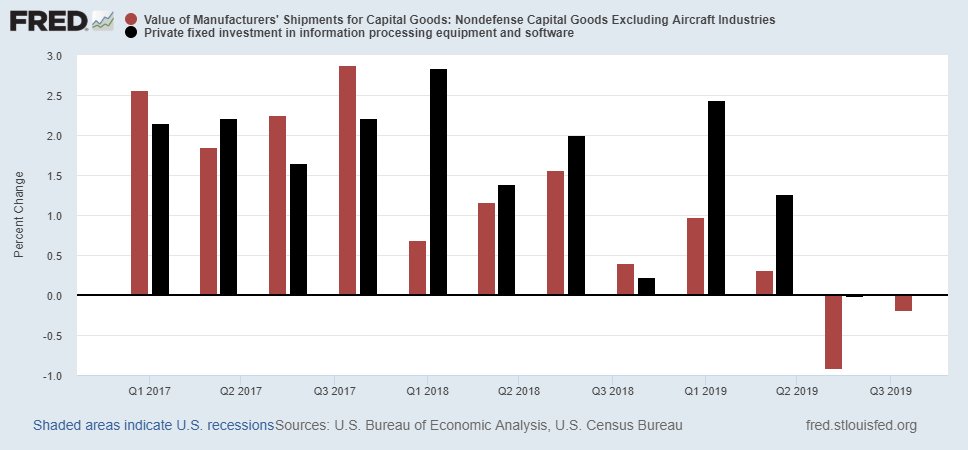
Business investments, capex, is generally shown as manufacturing shipments of goods. But software investment has been rising steadily, even if still relatively small:
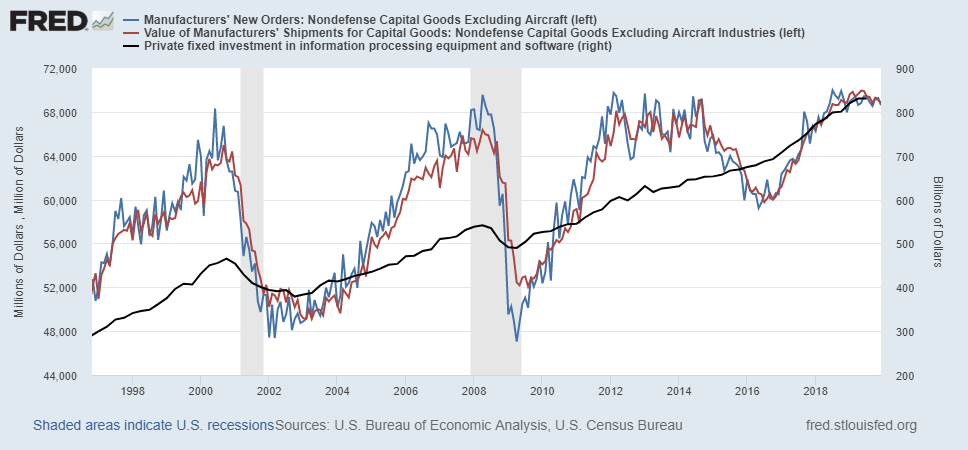
YoY: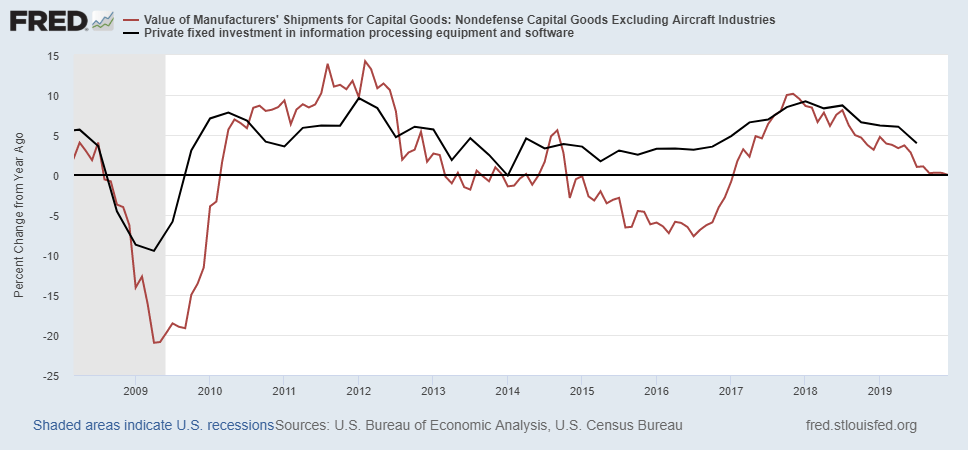
QoQ: not pretty:
Executives Try to Assess Financial Impact of Coronavirus Measures
(…) Companies across a range of industries, including travel, leisure and consumer products, could be negatively affected by the continued spread of the virus that originated in the Chinese city of Wuhan and has since moved across China and to other countries, including the U.S., according to analysts at Moody’s Investors Service.
“The fear of contagion could dampen consumer demand, and affect tourism, travel, trade and services in affected countries,†said Atsi Sheth, a managing director at Moody’s, according to a news release.
Stocks of some travel companies, alongside casino and hotel operators, have taken a hit, and more businesses are expected to report a financial impact should the virus keep spreading, analysts said. (…)
Ford said it is still assessing the costs of the prolongation of the Lunar New Year holiday, which has been extended until early February. Other foreign companies with large facilities in China, including German chemicals maker BASF SE, said it is too early to quantify potential hits to the business from the spread of the virus. (…)
Petrofer Chemie H.R. Fischer GmbH + Co. KG, a German chemicals company with operations in China, said the spread of the virus could hamper its supply chains, both with regard to raw materials as well as with finished products. “We will have problems, but it is too early to tell what the financial impact will be,†managing director Constantin Fischer said in an interview.
The economic and earnings picture, world-wide, for the first half of 2020 is messed up by the spreading of the virus. Not only is consumer demand impacted, but corporations are also feeling the brunt on their own spending and supply chains, already disrupted by the trade war.
ING: “We expect retail sales in China to drop from 8%YoY to around 3% – 4%YoY. Meanwhile, global tourism, which relies heavily on Chinese tourists, could experience a negative growth of more than 30%. We expect Chinese GDP growth to be reduced by 0.3 percentage points to 5.6% in 2020.â€
We should thus expect slower economic growth in Q1 and Q2 and a long string of reduced guidance and downward earnings revisions likely starting with the Q4’19 earnings calls of the next 3 weeks.
Central bankers across the world will lean dovishly amid the uncertainty. China’s PCB, in particular, will likely ease up further, along with the government which will surely announce more stimulus. During the SARS episode in 2003, China’s quarterly growth rate slipped by 2% in one quarter according to economists. Since China’s GDP was then growing 11%, the rest of the world did not feel it as much as if it had been growing by 6%, like it is now. China was 5% of global GDP in 2003. It is now 16%.
This outbreak is happening during China’s biggest spending season and authorities have reacted much earlier and much more seriously than in February-March 2003. The World Health Organization issued a global alert on March 12, 2003. The disease was stopped in July.
U.S. National Debt Will Rise to 98% of GDP by 2030, CBO Projects Sustained federal budget deficits and debt will hit the highest levels since World War II over the next decade, according to a Congressional Budget Office report.
The government will spend $1 trillion more than it collects in 2020 and deficits will reach or exceed that threshold every year for the foreseeable future. As a share of gross domestic product, the deficit will be at least 4.3% every year through 2030. That would be the longest stretch of budget deficits exceeding 4% of GDP over the past century, according to the CBO, an nonpartisan arm of Congress.
Debt held by the public is projected to be 81% of GDP this year and to reach 98% by 2030. That stems from the combination of tax cuts and projected increases in spending—particularly on safety-net programs such as Medicare and Social Security as the population ages and health-care costs rise. (…)
“Not since World War II has the country seen deficits during times of low unemployment that are as large as those that we project,†said CBO Director Phillip Swagel, who warned that the budget is on an unsustainable path.
Tuesday’s deficit forecasts may end up being too low. The CBO’s projections assume there are no changes to current spending and tax law. Deficits and debt would be larger if Congress extends individual tax cuts beyond their scheduled expiration at the end of 2025.
Congressional Republicans want to extend those tax cuts, and President Trump is preparing to propose further cuts as part of his re-election campaign. (…)
Longer-time-span deficit forecasts are even more daunting as the population ages. The federal debt is projected to hit a record 174% of GDP by 2049, 30 percentage points higher than what the CBO forecast last year. (…)
The CBO projected economic growth will gradually slow from 2.2% in 2020 to 1.7% after 2021, and unemployment will start to rise in 2022 while remaining below historical averages. (…)
In the current expansion, annual economic growth averaged 2.3% through 2018, the latest year for which full-year data is available.
That compares with 2.9% during the previous expansion from late 2001 to 2007, and 3.6% in the 10-year expansion that ended in early 2001, according to the Commerce Department. (…)
Could the budget deficit hit double digits?
A couple of weeks ago the White House National Economic Council Director Larry Kudlow hinted that “Tax Cuts 2.0†could be unveiled during the U.S. Presidential election campaign. We’ll wait for more details before considering altering our 2020 U.S. GDP growth forecast which currently stands at 1.9%. But the very mention of tax cuts may not resonate as well as it used to with voters. A recent poll conducted by the Pew Recent Center noted that more than half of Americans view the federal budget deficit as a “very big†problem. Latest projections from the Congressional Budget Office won’t reassure those folks.
As today’s Hot Chart shows, under current law, i.e. before taking into account “Tax Cuts 2.0â€, the CBO is projecting the federal budget deficit to increase to almost 6% of GDP by 2030. That assumes no U.S. recession over the forecast horizon. In other words, should there be an economic downturn within the next decade ─ which will almost certainly dent revenues and boost expenditures via automatic stabilizers ─, the budget deficit as a % of GDP may well end up in double digits. (NBF)

GLOBAL WARNING
The world is drowning in debt
The world’s already huge debt load smashed the record for the highest debt-to-GDP ratio before 2019 was even over.
In fact, it broke that record in the first nine months of last year. Global debt, which comprises borrowings from households, governments and companies, grew by $9 trillion to nearly $253 trillion during that period, according to the Institute of International Finance.
That puts the global debt-to-GDP ratio at 322%, narrowly surpassing 2016 as the highest level on record.
More than half of this enormous number was accumulated in developed markets, such as the United States and Europe, bringing their debt-to-GDP ratio to 383% overall. (…)
Despite favorable borrowing conditions, the refinancing risk is massive. A total of more than $19 trillion of syndicated loans and bonds will mature in 2020. It’s unlikely that all of these will be refinanced or repaid. (…)

 Apple now has $207.06 billion in cash on hand, up slightly from last quarter
European Banking Regulator Encourages Mergers to Boost Profits The eurozone’s main banking regulator encouraged lenders to consider mergers and acquisitions to boost profits, reinforcing an increasingly vocal message to bankers across the region.
- Eurozone bank margins have been drifting lower as rates dipped into negative territory. (The Daily Shot)

Personally, I would not have used “drifting lowerâ€. NIMs have actually been sinking as a result of the ECB’s policies.
BTW:
The U.K. has decided once and for all to allow cellular carriers to use equipment made by Chinese telecom giant Huawei and other “high-risk vendors†in their 5G buildouts. The announcement isn’t exactly a surprise; some British carriers had already been moving forward with Huawei. Still, it’s important, in part because the U.S. has continued threatening to curtail intelligence-sharing with countries that include Huawei in their 5G networks. Just yesterday, Senate Republicans introduced legislation that would turn such threats into a formal ban. As a core “Five Eyes†member, the U.K. boasts a robust intelligence relationship with the U.S., so London’s decision, especially if the U.S. proves to be bluffing on the matter, will likely serve as a de facto green light to other countries that have been reluctant to do business with the Chinese. The Pentagon’s move last week to block Commerce Department plans to ban exports of components and software to Chinese telecom firms will further undermine the U.S. campaign to isolate Huawei.
It’s worth noting that the U.K. isn’t exactly embracing Huawei wholeheartedly. It’s effectively limiting Huawei gear to what’s known as the “edge†of 5G networks – think base stations, routers and antennas – where the security vulnerabilities are arguably the lowest and the buildout costs are certainly highest. It’s also limiting the market share of “high-risk vendors†to 35 percent in order to address sabotage concerns, while banning their equipment from networks around military bases and other sensitive installations. (Geopolitical Futures)
EARNINGS WATCH
We now have 104 S&P 500 companies in, a weak 68% beat rate (22% miss rate) but a +4.6% surprise factor. Aggregate earnings of those 85 companies are up 3.5%, much better than the –0.6% seen at the same time during Q3’19.
SENTIMENT WATCH
From SentimenTrader:
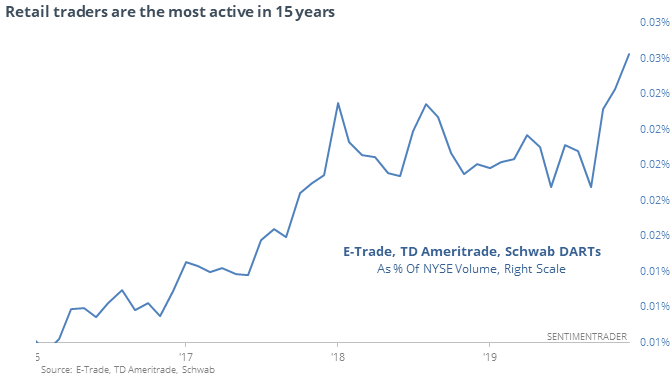
With a combination of no commissions and a runaway market, retail traders haven’t been this active in 15 years. Brokerages with a heavy retail customer base have seen trading activity skyrocket relative to overall market volume.
The introduction of commission-free trading throws a big wrench into this data, because when something is free, people use more of it, and it will become more difficult for the brokers to define what exactly it means for a trade to generate revenue. But activity spikes like this have not been positive for stocks.
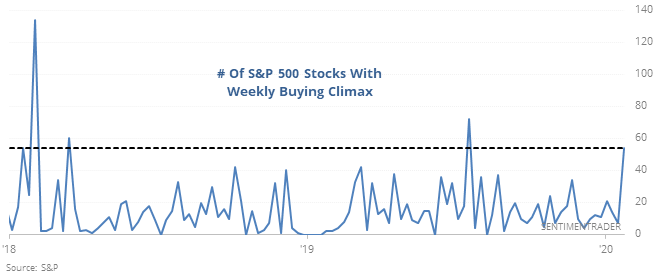
Last week, there was a jump in the number of stocks within the S&P 500 that reached a 52-week high then reversed to close below the prior week’s close. More than 10% of stocks triggered one of these buying climaxes, the 2nd-most in almost 2 years.
Over the past 25 years, any week with more than 50 buying climaxes saw an annualized forward return of -3.3% in the S&P 500, compared to nearly +23% after a week with no climaxes.