The enemy of knowledge is not ignorance, it’s the illusion of knowledge (Stephen Hawking)

It ain’t what you don’t know that gets you into trouble. It’s what you know for sure that just ain’t so (Mark Twain)

Invest with smart knowledge and objective odds

THE DAILY EDGE: 28 JANUARY 2019

Chicago Fed: Slight Increase in Growth in December

The Chicago Fed’s National Activity Index (CFNAI) is a monthly indicator designed to gauge overall economic activity and related inflationary pressure. It is a composite of 85 monthly indicators as explained in this background PDF file on the Chicago Fed’s website. The index is constructed so a zero value for the index indicates that the national economy is expanding at its historical trend rate of growth. Negative values indicate below-average growth, and positive values indicate above-average growth. (…)

CFNAI and Recessions

China confident of keeping 2019 growth within ‘appropriate range’ China is fully confident that it is capable of keeping its economic growth rate within an appropriate range in 2019 in spite of challenges, state news agency Xinhua reported Chinese Premier Li Keqiang as saying on Friday.
AMERICA CURSED:

The FT reports that research firm Strategy Analytics’ numbers reveal that Huawei increased its market share in China during the fourth quarter from 20% to 27.8% in the last year, while Apple saw its share decline from 11.5% to 10.1%. Local rivals Oppo and Vivo also increased their market share. According to Strategy Analytics, Apple now ranks 5th in China, a very uncomfortable position in the largest market in the world.

Pricing may not be Apple’s main handicap. American brands in general seem to be suffering from the trade war. New American made car sales in China dropped 18.5% in 2018 while Japanese, German and Korean brands sales grew 5.7%. 4.8% and 3.1% respectively. In December 2018, American car sales slumped 39.6% while Japanese and German car sales rose 10.%. American brands took 10.5% of the huge Chinese market in 2018, down from 12.3% in 2017. It was down to 9.0% in December 2018 from 12.5% in December 2017.

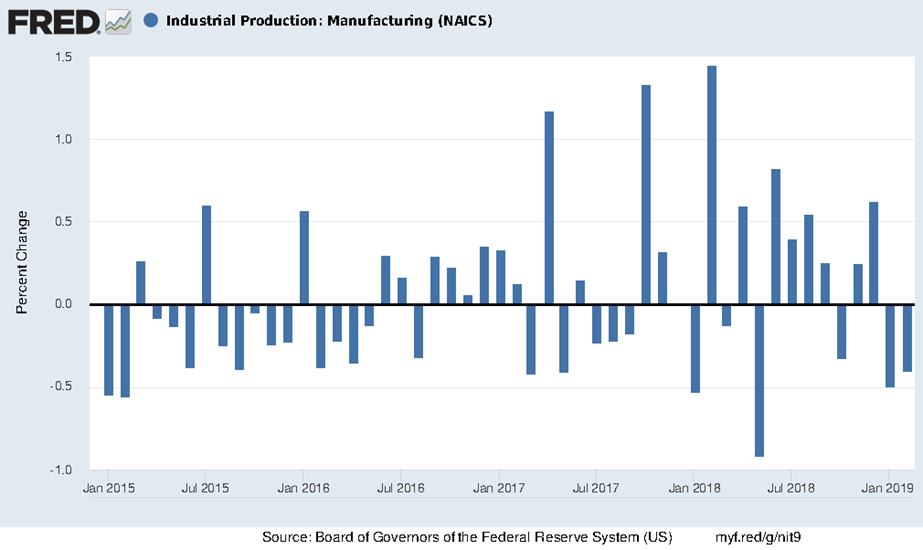
  • Manufacturers Take Sales Hit in China U.S. companies that bet heavily on China’s expansion are watching that opportunity shrink, as Chinese demand for U.S. goods weakens and U.S. factories’ export activity declines.

(…) “China is weaker than normal, weaker than seasonal,” Keith Jackson, chief executive of ON Semiconductor Corp. , said earlier this month. (…) Industrial glue maker H.B. Fuller Co. , which gets about 13% of its sales from China, said weaker demand there had cut $10 million off its profit in 2018 and would likely reduce profit by $20 million this year. (…) PPG Industries Inc. said sales of its coatings for cars made in China fell 15% in the fourth quarter. (…)

China isn’t the only problem for U.S. manufacturers exposed to global trade. A stronger dollar and higher costs as a result of tariffs on some foreign goods are also weighing on some companies.

The WSJ Dollar Index, which tracks the dollar against a basket of currencies, is up 7% from a year ago, meaning overseas sales equate to less earnings in dollar terms. And U.S. companies face higher prices for steel, aluminum and Chinese-made goods like engines and vinyl flooring that are now subject to tariffs.

Correct Craft Inc., a Florida-based boat manufacturer, is paying more for aluminum, and it is losing sales in Europe as a result of retaliatory tariffs placed on boats made in the U.S. (…)

Source: Pantheon Macroeconomics (via The Daily Shot)

Like other manufacturers, Caterpillar has also raised prices to offset rising transportation and material expenses. Some of those higher costs are a result of U.S. tariffs on foreign goods including steel and aluminum.

“Material costs and freight were adverse and worse than we were expecting,” Caterpillar Financial Chief Andrew Bonfield said on Monday in an interview. (…) Caterpillar said costs related to tariffs came in close to the bottom end of the $100 million to $200 million range it had expected for 2018.

The company has said it plans to raise prices between 1% and 4% in 2019 on most of its machines and engines to offset higher costs. (…)

U.S. Treasury Set to Borrow $1 Trillion for a Second Year to Finance the Deficit
EARNINGS WATCH

Of the 112 companies in the S&P 500 that have reported earnings to date for Q4 2018, 72.3% have reported earnings above analyst expectations. This is above the long-term average of 64% and below the average over the past four quarters of 78%.

In aggregate, companies are reporting earnings that are 2.1% above estimates, which is below the 3.2% long-term (since 1994) average surprise factor, and below the 5.7% surprise factor recorded over the past four quarters.

Fourth quarter earnings are expected to increase 14.3% from Q4 2017. Excluding the energy sector, the earnings growth estimate declines to 12.4%.

58.0% of companies have reported Q4 2018 revenue above analyst expectations. This is below the long-term average of 60% and below the average over the past four quarters of 72%. In aggregate, companies are reporting revenues that are 0.4% above estimates.

Fourth quarter revenue is expected to increase 5.6% from Q4 2017. Excluding the energy sector, the revenue growth estimate declines to 4.8%. (Factset)

From Refinitiv:

imageimage

At this point in time, 16 companies in the index have issued EPS guidance for Q1 2019. Of these 16 companies, 15 have issued negative EPS guidance and 1 has issued positive EPS guidance. The percentage of companies issuing negative EPS guidance is 94% (15 out of 16), which is above the 5-year average of 71%. (Factset)

Pension Losses Could Hit Companies Like AT&T and Verizon Hard Late-2018 market plunge could weigh on bottom lines of the telecom giants and others because of how they account for pension plans

These companies and others count gains and losses in their pensions and retiree-benefit plans in the same year that they occur, as opposed to spreading them out over a number of years. They were on track for much of 2018 to get an earnings boost until markets swooned in the fourth quarter.

Now, they may report pension losses that will weigh on their bottom lines, or pension gains will be far lower than would have been expected earlier in the year. In fact, many other companies with defined-benefit plans could see their earnings in 2019 and beyond hit by the markets’ stumbles, pension analysts say, though the effect will be more gradual and harder to notice. (…)

One company already feeling the impact: Ford Motor Co. The auto maker’s fourth-quarter earnings, announced Wednesday, included an $877 million pretax loss from a pension adjustment. The loss was due to “adverse financial market conditions that occurred late in the year,” Chief Financial Officer Bob Shanks said on Ford’s conference call. (…)

Ford uses the same pension-accounting method as Verizon, AT&T and dozens of others: a mark-to-market approach that records changes more immediately than most companies which still “smooth” their plans’ results into earnings over a period of years. That can make companies’ earnings more volatile, but it is simpler and more transparent for investors. (…)

While the impact of the market’s tumble is clearest at mark-to-market companies, ultimately it will affect earnings at many others with defined-benefit plans. Plans whose assets declined in value in 2018 because of the market slump could see that show up in their 2019 pension costs, which are counted as part of overall earnings. (…)

TECHNICALS WATCH

Lowry’s Research analysis of the longer-term trends in Supply and Demand through its Selling Pressure and Buying Power Indexes “confirm that the rally over the past month has been based on a strong expansion in Demand and contraction in Supply, a relationship that has historically been associated with primary market uptrends.”

Lowry’s also says that “it’s clear there has been a powerful expansion in breadth during the market’s month long rally” reaching all three market segments with large cap the primary beneficiary.

The State of the Union Is Missing America loses something worthwhile as Trump and Pelosi cast aside another traditional norm.

(…) As to its other purposes, the speech is a moment of enacted majesty. Not real majesty—real majesty would be Jackie Kennedy walking behind the caisson and behind her a street full of kings. But it’s a night when our democracy struts its stuff. The president, Congress, the Supreme Court, the cabinet, the diplomatic corps, the military, the press in the gallery, all arrayed. The heroes in the balcony, reminding us not of our politics but of our humanity, of the fact that almost against the odds America keeps producing spectacular individuals. All are there acting out comity, dignity, stature. I don’t really care if they feel these things. No one cares. We just want them to show it because children are watching, or at least taking a look as they pass a screen, and learning how adults in public act. (…)

Too bad there are 364 other days when children are watching and learning how adults in public act…

LEADERSHIP MATTERS

This is from Baupost CEO Seth Klarman’s annual investor letter. I though it deserves a special post.

(…) As the post-World War II international order continued to erode, the markets ignored the longer-term implications of a more isolated America, a world increasingly adrift, and global leadership up for grabs. The post-war order relied on philosophical alignment among democratic societies, investment in international institutions, and effective diplomacy to manage competing interests across nations. American hegemony played a key role in supporting this order and the unprecedented peace and prosperity that had generally prevailed since 1945. Recently, foreign affairs pundit Walter Russell Mead wryly observed that the old system was neither liberal nor international nor an order, yet he added that its absence will surely be felt if it disintegrates.

With the U.S. seemingly preoccupied by a desire to withdraw from its long-prized role as a champion of liberty and democracy across the globe, 2018 proved to be a banner year for strongmen. Vladimir Putin maintained his firm grip on power in Russia while suffering no real consequences for interfering in elections in the U.S. and elsewhere, nor for his alleged involvement in the attempted murder of expatriate Russians on British soil, or for his ongoing military encroachments in Crimea and Ukraine. Recep Tayyip Erdogan, Viktor Orbán, and Rodrigo Duterte maintained their respective tight holds over Turkey, Hungary, and the Philippines, while constricting the freedoms allowed to their citizens. The far-right candidate, Jair Bolsonaro, won Brazil’s presidential election in October. Venezuela closed in on failed- state status.

Tensions with North Korea moderated over the course of 2018 as President Trump expressed his affection for North Korean leader Kim Jong-un, although actual progress toward de-nuclearization of the Korean peninsula seems stalled, and potentially illusory. In March, China’s Central Committee eliminated term limits on China’s 65 year-old leader Xi Jinping, who could now head the country with the world’s largest population and second largest economy through the end of his life.

In October, Saudi Crown Prince Mohammed bin Salman allegedly ordered the killing and dismemberment of American resident and Washington Post Columnist Jamal Khashoggi at the Saudi consulate in Istanbul, leading to the imposition of sanctions on those directly involved but not on the Crown Prince. Meanwhile, in mid-December, after a phone call with Turkey’s Erdogan, President Trump tweeted the news that U.S. troops would be leaving Syria, a development that appeared to shock the Pentagon as well as Congressional leaders on both sides of the aisle. Among world leaders, only Erdogan and Putin (and presumably Bashar al-Assad) applauded. Days later, highly respected Secretary of Defense Jim Mattis, one of the last remaining “adults in the room” in the President’s cabinet, announced his retirement in a letter that cited sharp differences of policy and principle with the President.

Social frictions remain a challenge for democracies around the world, and we wonder when investors might take more notice of this. The recent “yellow vest” marches in France, which subsequently spread to Belgium, Holland, and Canada, began as a petition against fuel tax hikes, and grew through social media into a mass protest movement led by suburban commuters, small business owners, and truck drivers. The demonstrations, which appear to have broken out spontaneously throughout the country, became widespread and even violent. While the French government is clearly concerned – in December, it reversed the planned tax increases while announcing a higher minimum wage – the financial markets have taken the unrest largely in stride, as the French 10-year note at year-end yielded a meager 70 basis points.

In the U.S., meanwhile, investors truly have no idea how to react to the steady dose of presidential tweets seasoned with presidential pique. America’s body politic remained inflamed in 2018. The President regularly stirred up his base with campaign-style rallies in which he endlessly warned, without evidence, of rampant voter fraud while stoking fears over the looming arrival of a caravan of Central American refugees. Claiming, also without evidence, that criminals and possible terrorists made up a significant component of this caravan, Trump sent troops to reinforce the border. Yet in the days and weeks following the midterm elections, the caravan disappeared entirely from his rhetoric, its purpose apparently served. Immigration remains a hot button issue, and whether or not to “build the wall” was the proximate issue in the prolonged partial government shutdown that started in late December.

The November midterm elections became, in many ways, a referendum on the President. The result, with record turnout, was that blue states got bluer and red states even redder, as Republicans tightened their grip on the Senate while Democrats rolled to a net gain of 40 House seats and control of that body, winning by the largest midterm popular vote margin in history. Democrats did particularly well among women, minority groups, and suburbanites, groups which have largely found Trump’s policies and tone distasteful. In December, a bipartisan group of 44 former Senators signed an editorial begging today’s Senate to put country ahead of party. Yet the vast majority of Senate Republicans continued to stand resolutely by the President, despite mounting indications that special counsel Robert Mueller and other investigators are delivering not only a growing number of indictments and guilty pleas but are also uncovering damaging information regarding Donald Trump’s Presidential campaign and business interests. The chaos and consequent uncertainty emanating from Washington D.C. will likely only intensify as we approach the 2020 election.

The bottom line is that leadership matters. The growing turmoil in Washington and other world capitals is taking a toll on the country. As The New York Times columnist Bret Stephens recently observed, “the problem with Trump isn’t that he’s an empty vessel. It’s that he’s a malignant one.” Amid all this turmoil, should investors simply hunker down and keep their focus on markets? That might be a challenge. By way of illustration, on December 18, on the FedEx earnings call, CEO Frederick Smith noted that “most of the issues that we’re dealing with today are induced by bad political choices, I mean, making a bad decision about a new tax, creating a tremendously difficult situation with Brexit, the immigration crisis in Germany, the mercantilism and state-owned enterprise initiatives in China, the tariffs that the United States put in unilaterally. So you just go down the list, and they’re all things that have created macroeconomic slowdowns.”

America Entering 2019: Why We Are So Divided, and Why It Should Matter to Investors

These days, Americans do not seem to agree on much of anything. Some of it is today’s politics: “Deep state” or dedicated civil servants? “Witch hunt” or legitimate investigation into crimes? “Fake news” or free press? “Alternative facts” or facts? Accomplished adversary or “lock her up?” And some of it goes beyond politics into the realms of scientific inquiry and American values. Climate change or “climate hoax?” Refugees seeking sanctuary or “caravan of foreign invaders?”

Does this matter? We think it does. It’s hard for our leaders to guide us when we don’t agree on our values or even on how we decide what is true. Worse, our enemies, including but not limited to Russia’s autocratic government, are using social media and internet postings to confuse us and divide us further. They know which hot buttons to push. Moreover, our willful disbelief of facts, truth, and science increases the chance that we will fail to recognize or take seriously growing threats. In 1993, Senator Daniel Patrick Moynihan, who famously said that “everyone is entitled to his own opinion, but not to his own facts,” observed that America was “defining deviancy down.” His point was that behavior that had once been seen as deviant was now considered acceptable. To paraphrase Moynihan, today we may instead be defining reality down.

This post-truth moment is quite dangerous. Imagine an incident that threatens national security. Will Americans see eye-to-eye on the seriousness of the threat? If our leaders are truth-challenged, will Americans believe the official explanation of the threat and the wisdom of the proposed response? Should they?

Jonathan Rauch, an American journalist and author, has written about a Constitution of Knowledge, an objective reality of facts and truth that he believes is now under attack from President Donald Trump. The Washington Post reports a troubling escalation in the rate of Presidential lies, from an average of around six per day in 2017 to 15 per day in 2018. Former C.I.A. Director Michael Hayden recently observed that “We have in the past argued over the values to be applied to objective reality … but never the existence or relevance of objective reality itself.” Nebraska Senator Ben Sasse notes, “we have a risk of getting to a place where we don’t have shared public facts. A republic will not work if we don’t have shared facts.”

Alarmingly, technology does not necessarily contribute to the expansion of shared facts; it can actually assist in undermining them. For example, the technology now exists to create fake audio of our public figures, whereby you hear them saying in their own voices things that they never actually said. Imagine the havoc this could create in the wrong hands with a credulous public. Worse still, the technology to alter video is now upon us. You may soon watch a video of something that didn’t actually happen – such as a foreign threat or even an attack on our country – but your eyes and brain will tell you it is true. And, of course, these days you don’t need a sophisticated team of scientists to Photoshop a picture. The ramifications could be nothing short of a stolen election – or a war.

We are divided in so many ways. The American dream is well-known: that hard work leads to success, that our children shall do better economically than we have, and our children’s children better still. This dream has been a reality for many (but by no means all), over the first two centuries of the republic. Unfortunately, it is a dream that a diminishing number of Americans believe will come true for their families, and for good reason.

Americans have long seen our country as the land of opportunity. Wondrous things have been accomplished here: The U.S. is a democratic republic that has endured for more than two centuries, a country that reversed a legacy of slavery and healed after a Civil War, an upstart country that defeated global powers to secure democracy for Europe, an economic engine that has relentlessly driven growth, innovation, entrepreneurship, and advanced technology to improve the quality of life for its citizens and others around the world. Uniquely, people from everywhere in the world can relocate here and become Americans. And the energy and striving of immigrants has helped America grow and remain vibrant. I’m forever thankful that my father got on a boat and came here from Poland when he was 12. Like so many immigrants, he quickly adjusted to his new circumstances, making the most of them while never looking back. But lately, immigration has become one of the most divisive issues we face.

Social and economic advancement in America today seems increasingly dependent on demography and geography. The economic advantages enjoyed by college graduates continues to grow. Unsurprisingly, income growth in most major metropolitan areas surpasses gains in rural areas of the country. Economic inequality continued to worsen in 2018, and for many, real wages have not increased in decades. It seems clear that economic anxiety contributed to the election of Donald Trump in 2016.

The divide between Americans has been exacerbated by the echo chambers of modern- day media and the internet. Many have written of how, in only about four decades, an America of three broadcast networks has become an America of hundreds of cable channels. A few decades ago, we had less connectivity but more connection. David Brooks and others write regularly about the challenges of increased loneliness and isolation. A person today can have a thousand Facebook friends – and few, if any, actual friends.

I grew up with three television channels, the Baltimore Sun newspaper (which I delivered six days a week), and the World Book Encyclopedia. The facts I digested were everyone’s facts. My news was everyone’s news. The editors of these media outlets were well-informed and pretty much down-the-middle curators who believed their job was to bring balanced perspective to what their readers or viewers should know. They knew that, even if perfect objectivity was unattainable, the constant pursuit of it, armed with humility and intellectual honesty, was the best antidote to ignorance and demagoguery.

The Fairness Doctrine, until it was overturned in 1987, actually required television and radio broadcasters to present contrasting viewpoints on controversial issues of public importance. The network news anchors were among America’s most trusted figures – Walter Cronkite, Chet Huntley, and David Brinkley. But today, this commonality is lost. My news and your news may have nothing in common, and each of us must work hard if we are to experience a diversity of viewpoints and perspectives. As social psychologist Jonathan Haidt and his co-author, Greg Lukianoff, president of the Foundation for Individual Rights in Education, observed in “The Coddling of the American Mind,” “both the physical and the electronic isolation from people we disagree with allow the forces of confirmation bias, groupthink, and tribalism to push us still further apart.”

This is very unfortunate, because, as Haidt argued in his earlier book, “The Happiness Hypothesis,” “A good place to look for wisdom…is where you least expect to find it: in the minds of your opponents. You already know the ideas common on your own side. If you can take off the blinders…you might see some good ideas for the first time.” To perfect our own thoughts and ideas, we need to chew on and debate the ideas of others, even and especially of those with whom we disagree. Yet, it seems more and more people are choosing to only seek out information from those who share their views, and technology and social media have made it increasingly easy to do so.

Virtually all of the human knowledge accumulated since the beginning of time is available instantly on our iPhones. As a society, we have never known more. But some of us choose to know less. We avoid facts and instead consume partisan media content that is largely focused on demonizing supposed adversaries. We have become increasingly tribal, choosing sides and selectively processing only the information that fits with our team’s narrative. Deliberate ignorance and denial of facts and truth are disturbing phenomena, not likely to lead to good decision-making or thoughtful voting choices.

Even science is losing ground in this era. In his commencement address at Caltech in 2016, surgeon, writer, and public health scholar Atul Gawande observed that science was being left behind by increasingly popular anti-scientific beliefs. “From 1974 to 2010, despite increasing education levels, the public’s trust in the scientific community has been decreasing.” This is tragic, he argues, because “having a scientific understanding of the world is fundamentally about how you judge which information to trust.”

By 2018, a growing number of Americans had become concerned about potential erosion in American democracy, a concern for which there is ample evidence. Whereas 71% of those born in the 1930s believed it was important to live in a democracy, only 29% of those born in the 1980s share the same belief. About 40% of eligible voters in the U.S. failed to cast a ballot in the 2016 elections, and tens of millions of Americans are not even registered. Because of increased gerrymandering and the influence of big money in politics, many Americans have come to feel that their votes do not matter. Moreover, as a result of the tendency of primary elections to pull parties to the political extremes, many feel that the candidates in the general elections do not reflect their own views. Yet because of the perceived threat of being “primaried,” incumbents are today less willing to reach across the aisle. It’s almost as though we are living in two countries – there are the battleground states, where the presidential candidates show up and the ads run non-stop. And there are the gerrymandered districts, where elections are effectively over before they begin.

American democracy operates not just from a system of rules but also norms. Norms have provided historically valuable guardrails for proper behavior that protect the integrity of the system from possible misdeeds by the people in it. The critical importance of norms is easily dismissed, especially by those willing to pursue power and self-interest ahead of all other considerations. But norms reflect a core cultural aspiration of fairness, civility, and community that is more socially powerful, and broader in reach, than any statute or regulation. There can be a certain reckless power in violating norms, since the sanctions for doing so are neither immediate nor obvious. But the consequence is a dangerous erosion of our greatest bonds of community.

Rachel Kleinfeld, senior fellow in the Democracy, Conflict, and Governance Program at the Carnegie Endowment for International Peace, sees the breakdown of democratic norms in post-election developments. She notes, “Democracy requires citizens’ votes to be counted fairly, and those votes must determine who wields power … in Wisconsin, the Republican legislature has stripped the incoming Democratic governor of capabilities that voters assumed their leader would have when they voted.” For the great majority of American history, Supreme Court nominees needed 60 votes in the Senate for confirmation; otherwise, a filibuster could hold up a nomination indefinitely. But in 2017, the Republicans exercised the “nuclear option,” changing the required vote to a simple majority. This eliminated the need for the President to identify mutually agreeable centrist nominees and instead increased the politicization of the Court.

We would argue vehemently that democracy, and the liberties and protections it provides, is not just of importance to individual citizens, but also to businesses and markets. In a democracy, businesses have the benefit of equal treatment under the law, including unbiased regulation. Yet these days, the President often singles out for criticism enterprises he finds personally objectionable or executives who disagree with him politically. These anti-democratic tendencies are extremely dangerous, particularly as the Congressional Republicans show no interest in reprimanding him, even though his behavior violates a core principle of the conservatism they claim to espouse.

We would also argue that social cohesion is essential for those who have capital to invest. Businesses need a long-term horizon to plan, and social unrest makes planning more difficult. It can’t be business as usual amidst constant protests, riots, shutdowns, and escalating social tensions. It is not hard to imagine worsening social unrest among a generation that is falling behind economically and feels betrayed by a massive national debt that was incurred without any obvious benefit to them. If things get bad enough, we could see taxes once again raised to confiscatory levels. We should all be rooting for (and acting to support) social cohesion and a renewal of the American dream.

David Moss, a Harvard Business School professor, teaches a course on democracy and has found that over much of American history, partisanship was cutthroat and political divides were wide and bitter. Yes, people said horrible things about each other. But when critically important issues were being decided, even while participants in the debate were intensely focused on winning, they were also focused on how their actions might affect democracy over the long run. More recently, it seems as though politics has been transformed into an intense focus on immediate victory, the system be damned. We have seen behavior in national and local politics where those in power changed the rules to the disadvantage of those out of power (or about to come into power) simply because they could. As stewards of your capital, we see these ominous and widening social divides as risks to the economy and even to the system. Politicians have been putting self-interest and party ahead of country. Absent facts, truth, and science, we expect poor governmental decisions to become the rule and not the exception. There is no hedge to such risks, other than to work together to reverse course, heal the divides, and strengthen American democracy. (…)