Pessimists had a good day Friday as the labor report for February came in at a paltry 20,000 net new jobs even as wages rose at the fastest clip in a decade. The hiring slowdown may be partly a statistical blip, but it is probably also a sign of slower first-quarter growth amid global uncertainties. (…)
The big question is whether the February report is a one-month exception, as happens periodically, or a sign of a more serious growth slowdown. Investors are understandably wary as Europe slouches toward recession, growth slows in China (see nearby), and the Brexit deadline looms without a deal. The yield on the 10-year Treasury has fallen 13 basis points over the last week, and the 2019 stock rally has stalled. The trends on wages and investment should keep the economy going, but the jobs report shows there is less margin to tolerate policy mistakes like tariffs. (WSJ editorial)
U.S. Hiring Pullback Taps Brakes on Economic Expansion The breakneck pace of hiring slumped in February, a sign that U.S. growth is cooling, though strong wage growth and earlier robust job gains suggest the economy’s near decadelong expansion will endure.
(…) Some of February’s weak job growth might have been a response to strong hiring in previous months. Payrolls grew 311,000 in January and 227,000 in December. The three-month average for job gains clocked in at 186,000, near the average for much of the expansion. (…)
Jobs were weak in some seasonal industries that snapped back from big gains in previous months, including construction, retail and hospitality. Construction employment fell 31,000 after rising 53,000 the month before. Leisure and hospitality jobs were flat after rising 89,000 the month before.
Manufacturing employment stayed positive for the 19th straight month, the longest run of gains since the mid-1990s. But payroll growth in the sector slowed, possibly reflecting crimping effects from global trade tensions. (…)
Federal workers might have been counted twice in January, when payrolls were so strong, if they took additional part-time work during the shutdown, said Diane Swonk, chief economist at Grant Thornton. Those same workers who returned to their jobs in February would only be counted once, depressing the overall number. (…)
I should add that Retail Trade employment declined 6k in February following +14k in January and +18k in November-December for a net +25k over the last 4 months. Not a sign of terribly weak retail sales. During the same 4 months, Wholesale Trade employment was up 37k.
The Household survey was up 255k, reversing January’s 251k drop. It is worth revisiting David Rosenberg’s comments after the January employment report:
(…) at turning points in the cycle, it is the Household survey that leads, not the Payroll survey. (…) employment among the “bread winner” class [25-54Y] declined for three months in a row.
As much as I try, I still cannot see a clear “turning point” in household employment:

Bread-winners employment was indeed weak in the last 4 months but considering October’s 559k gain, the average increase during the last 6 months is only marginally lower than that of the previous 18 months.

YoY trends are also not in the high worry zone:
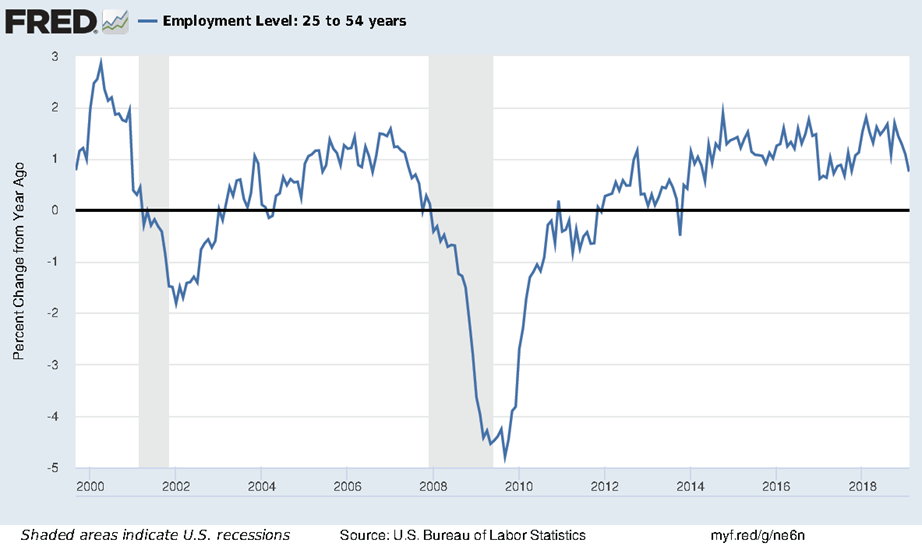
Note that it will be tough to grow the bread-winner employment level much going forward given the current 3.2% unemployment rate in that age-group (50-year record low was 2.9% in April 2000). The 25-54 participation rate is 82.5%, up from 80.6% in 2015 but still below 83.4% reached in January 2007.
From the Association of American Railroads (AAR) Rail Time Indicators.
On the surface, rail traffic in February 2019 wasn’t very good. Total carloads were down 2.7% over February 2018, just the second monthly decline in the past year; 12 of the 20 carload categories were down, the most since January 2018; and intermodal was down 0.9%, its first decline in two years. But, like last month, weather likely played a significant but impossible-to-measure-precisely role in February — e.g., higher than normal rain and snow in California, with mudslides and track washouts thrown in for good measure; high winds, extreme cold, and record snowfalls in the Upper Great Plains; and so on. Winter always brings problems for railroads, but it seems this year was worse than last year in many areas.
BTW, the employment report revealed that 438k employees missed work because of the weather in February, the highest since 2014. Weather also likely had an impact on the workweek. But even in manufacturing, where employment growth slowed to +4k in February compared with the 12-month average of +22k, the work week shows little signs of recessionary shrinking.
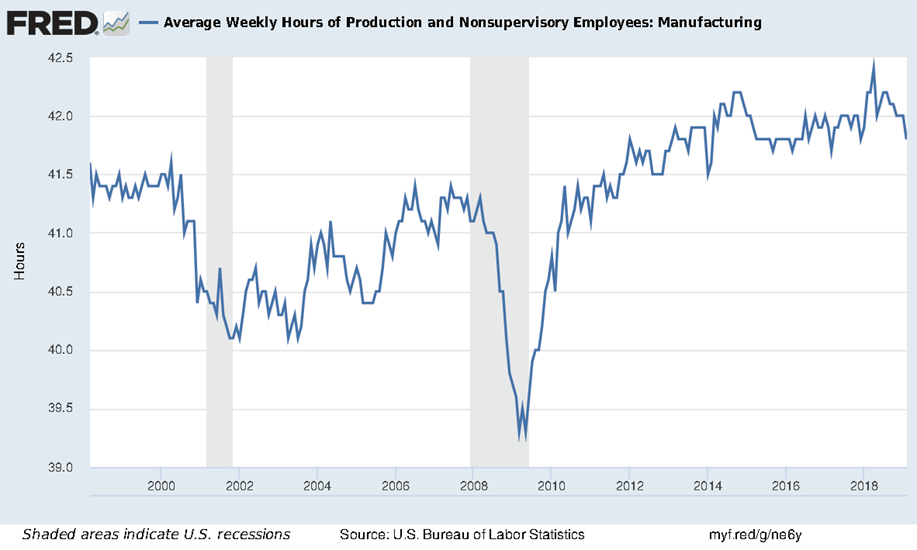
Same picture for aggregate hours in the private sector…

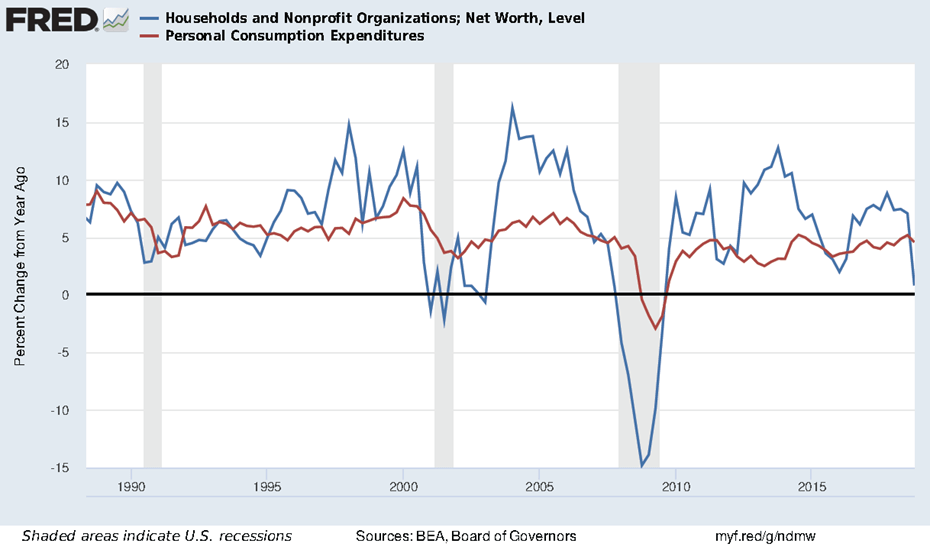
…which leads us to aggregate weekly payrolls (employment x hours x wages) which are up 4.2% in real terms in February, in sharp acceleration from the +2.8% average for 2018 and the best growth rate in real weekly payroll since October 2015. Growth in this real income metric slowed sharply in 2007, dragging real spending down just prior to the recession.
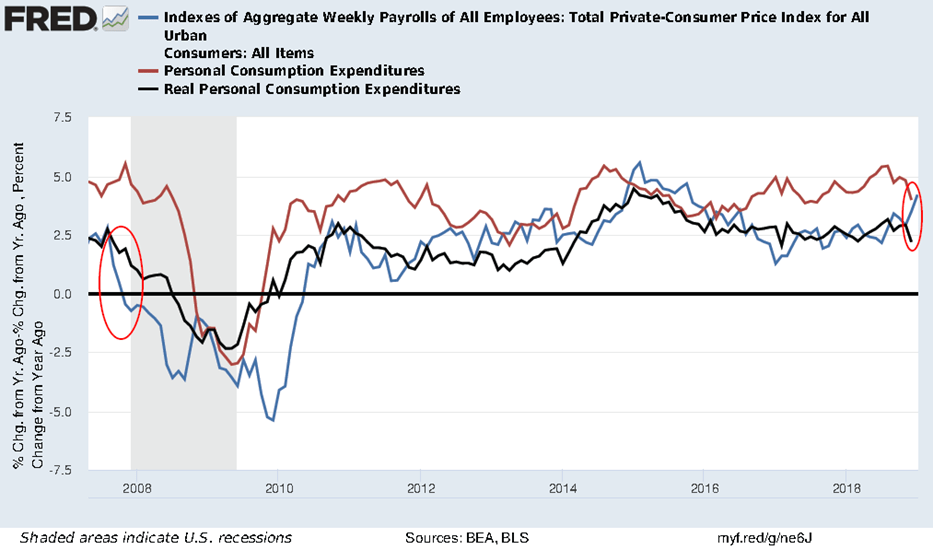
This next chart looks at the same data in nominal dollars, suggesting that, unless inflation picks up significantly, American consumers should keep supporting the economy for a while longer.

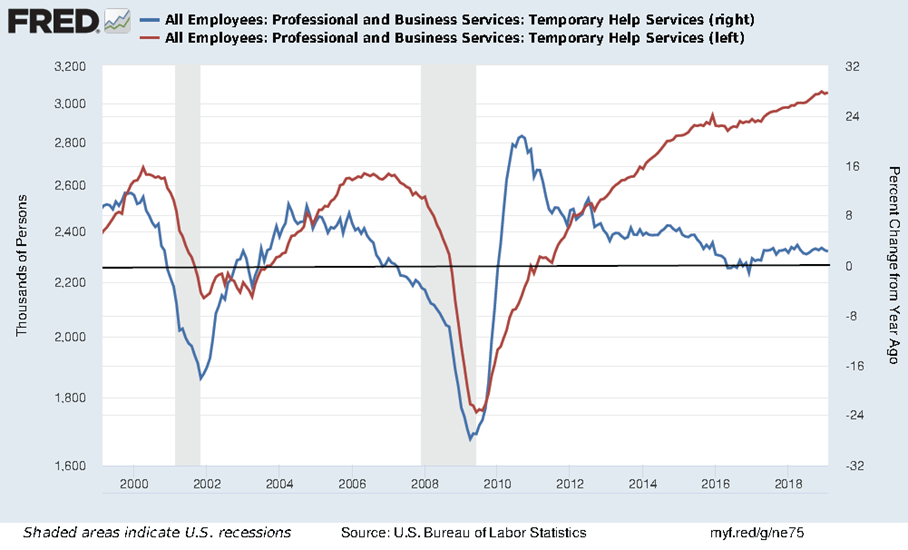
Temporary employment is another leading indicator not flashing red at the moment. Temp workers are often the first out when business slows or when costs need to be reigned in.
Finally, David Rosenberg last month highlighted that the unemployment rate, then at 4.0%, was up 0.3% from its 3.7% cycle low and that
the mean, median and mode is for the jobless rate to rise 0.4 of a point from the low by the time the recession hits. We are now three-quarters there. Data back to 1950 shows that at no point in the past did we see a 0.6 point increase off the trough without seeing a NBER-defined recession.
I pointed out that there have been six occasions since 1950 when the U3 rate rose 0.4 or 0.5 points without being followed by a recession. February just set us back to 3.8%, one quarter of Rosenberg’s 0.4 points, but actually one-sixth of the faultless rule.
Gary Shilling, another thorough economist, is also wearing a bear cape this year (“66% odds of a recession this year”) even though “neither of the usual recession-generators—extreme monetary restraint or a financial crisis like the early 2000s dot com collapse or the mid-2000s subprime mortgage debacle—are in evidence.” Like Rosenberg, Shilling says a recession may result from the earlier Fed credit-tightening as well as everything we already know (the late 2018 stock market fall, weakness in housing, receding corporate profits, consumer retrenchment, economic weakness abroad and the effects of foreign-trade conflicts with China and Europe.) “In that case, the recovery in stocks in January and February will probably prove to be a bear market rally.”
Fed Chief Says No Need to Change Interest Rates at Present The Federal Reserve doesn’t need to change its interest-rate policy right now against a mixed backdrop of restrained price pressures, a generally strong U.S. labor market and slower global growth, Chairman Jerome Powell said.
(…) “With nothing in the outlook demanding an immediate policy response,” the central bank has “adopted a patient, wait-and-see approach to considering any alteration in the stance of policy,” Mr. Powell said in remarks to the Stanford Institute of Economic Policy Research in Stanford, Calif. (…)
Mr. Powell said Friday the latest estimates indicate the Fed’s balance sheet would reach its “new normal” size at some point in the fourth quarter, meaning officials could terminate the runoff process around then. (…)
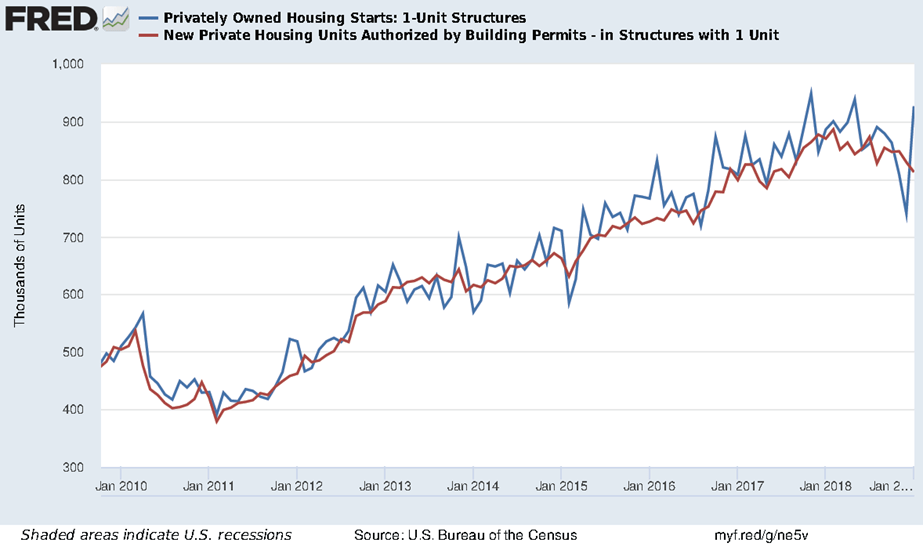
Total housing starts rebounded markedly in January, surging 18.6% m/m (but still down 7.8% y/y) to 1.230 million units at an annual rate after having collapsed 14.0% m/m in December to a slightly downwardly revised 1.037 million units (initially 1.078 million). The January increase was the largest monthly percentage increase since October 2016.
An outsize jump in single family starts accounted for most of the January surge in total starts. Single-family starts exploded 25.1% m/m (4.5% y/y) to 926,000 units following an 8.4% m/m drop in December. This was the largest monthly percentage increase since 1979 but only raised single-family starts up to their May 2018 level. Multi-family starts rose a more modest 2.4% (-32.1% y/y) in January to 304,000 units, falling far short of making up for their 25.4% m/m plunge in December.
Starts rose in three of the four major regions in January after having fallen in each major region in December. (…)
By comparison, building permits only rose slightly in January, edging up 1.4% m/m (-1.5% y/y) to 1.345 million units. Gains in multi-family permits more than accounted for the January increase. Multi-family permits rose 7.2% m/m (7.5% y/y) to 533,000 in January from 497,000 in December. Single-family permits fell 2.1% m/m (-6.7% y/y) to 812,000 in January from 829,000 in December.
Meanwhile, just across the U.S. northern border where winter was also very brutal, Canadian employment jumped 55,900 in February with 64,400 full-time jobs. Private sector jobs rose 31,800 in February, taking the first 2 months total to 143,300. This would be equivalent to 717k monthly new private jobs in the USA!
And yet, Canada’s GDP was up a weak 0.4% annualized in Q4’18. Hours worked dropped 0.7% MoM in February but weather may have had something to do with that.

China Car Sales Keep Skidding Vehicle sales in January and February—a period that includes the movable Lunar New Year holiday—were down 15% from a year earlier
Vehicle sales in January and February—a period that includes China’s movable Lunar New Year holiday—totaled 3.85 million, down 15% from a year earlier, the government-backed China Association of Automobile Manufacturers said Monday. Commercial vehicles sales increased 2% to 608,000 over the two months, but passenger-car sales were off 18% to 3.24 million.
That extended a grim spell for auto makers in the world’s biggest car market, where sales in the second half of 2018 were off 11% from a year earlier. (…)

(ZeroHedge)
CEBM Research adds that
China’s Ministry of Commerce published retail sales and catering service sales for the Lunar New Year holiday in 2019, totaling approximately RMB 100.5 bn, an increase of 8.5% Y/Y but lower than the 10.2% figure for the same period from last year. In addition, box office and tourism revenues were also below expectations. Slower inflation growth early this year also acts as a constraint on nominal retail sales growth. [China CPI was +1.3% YoY in February, down from +1.7%]. We expect that retail sales of consumer goods for the period from January-February will see a moderate decline to 8.1%, as compared to an increase of 8.2% previously.
Global Economy Hits Its Weakest Spell Since Financial Crisis
Bloomberg Economics’ new GDP tracker puts world growth at 2.1 percent on a quarter-on-quarter annualized basis, down from about 4 percent in the middle of last year. While there’s a chance that the economy may find a foothold and arrest the slowdown, “the risk is that downward momentum will be self-sustaining,” say economists Dan Hanson and Tom Orlik. (…)
That’s in line with Markit’s Global PMI:
The good news is that growth of new orders picked up in February to 52.5, after hitting a 28-month low in January (51.9)
Second Wave of U.S. Shale Revolution Is Coming, Says IEA The U.S. is set to become a net petroleum exporter in two years
The U.S. is expected to double its gross crude oil exports to 4.2 million barrels a day by 2024, while total exports of crude and refined products should reach 9 million barrels a day, the IEA said in its annual five-year oil outlook report.
U.S. crude production, driven by relentless growth in shale oil, is expected to account for 70% of the total increase in global production capacity over the next five years, the agency added. The report also said the U.S. should account for 75% of the expansion in liquefied natural gas trade.
“The second wave of the U.S. shale revolution is coming,” said IEA Executive Director Fatih Birol. “This will shake up international oil and gas trade flows, with profound implications for the geopolitics of energy.” (…)
U.S. shale production in 2018 grew faster than it did during the boom years of 2011 to 2014, the IEA said last year. (…)
U.S. crude production is expected to rise to 13.7 million barrels a day by the end of its five-year forecast period, the IEA said Monday.
“Annual gains will boost the U.S. to levels never seen in any country, in excess of maximum capacity in both Russia and Saudi Arabia,” the report noted. (…)
The IEA said it expects the world’s appetite for oil to grow at an average annual rate of 1.2 million barrels a day up to 2024, reaching 106.4 million barrels a day, compared with 99.2 million barrels a day in 2018.
EARNINGS WATCH
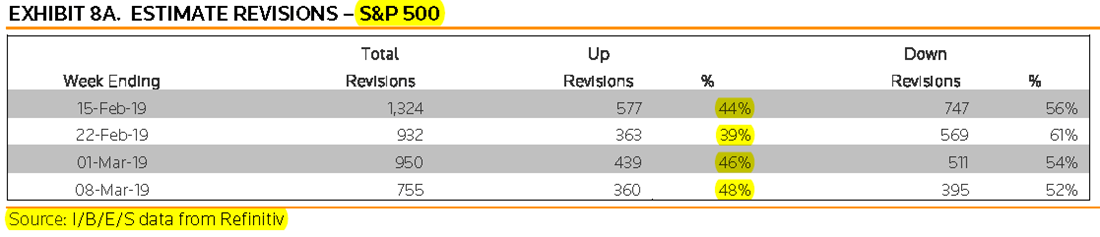
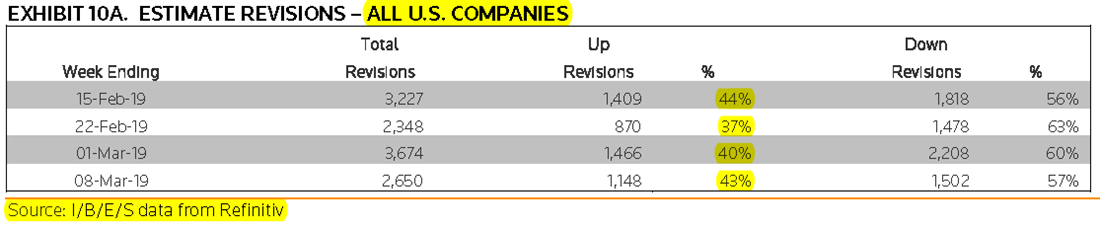
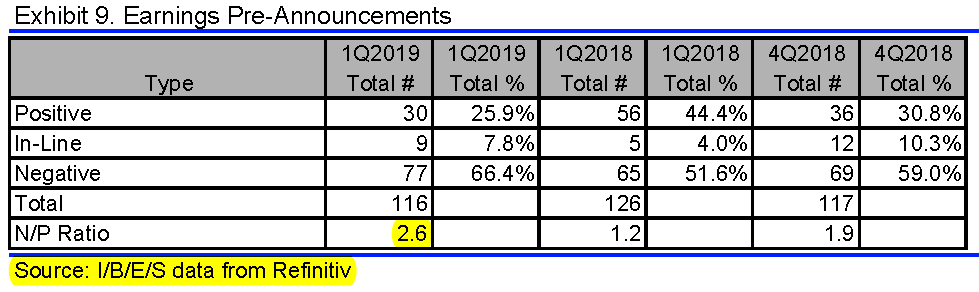
The earnings season is virtually over with 493 companies having reported. Growth of 16.7% (14.0% ex-Energy) slightly exceeded the +15.8% expected on Jan. 1.
Estimates keep coming down and Q1’19 earnings are seen down 1.4% (-0.6% ex-E) before turning back up in Q2 (+3.2%), Q3 (+2.9%) and Q4 (+9.3% thanks to Financials’ +20.4% rebound).
TECHNICALS WATCH
Lowry’s Research says that “the Sept. 20th market top was preceded by months of falling Demand and flat Supply – denoting a weakening rally – while the Mar. 1st high in the S&P 500 was preceded by intermediate-term trends of rising Demand (Buying Power) and falling Supply (Selling Pressure) – consistent with a rally displaying ongoing strength. (…) current signs of market weakness all fall into the category of marking a short-term interruption in an ongoing market rally.”
Lowry’s Demand/Supply reading is supported by Ned Davis Research’s own calculations that “Volume Demand” exceeds “Volume Supply” which has historically proven to be a bullish signal 79% of the time since 1981.
But it looks like retail demand has not been buying this rally, even though NDR’s sentiment readings are all strong, generally a bearish signal.
 Source: Deutsche Bank Research (via The Daily Shot)
It’s possible that global economic growth will stabilize while inflationary pressure remains absent and the top central banks stay on hold for the next 24 months. But that scenario is being overpriced by the markets, according to Morgan Stanley.
At the same time, investors are too dismissive of the “tails,” in which global growth rebounds more strongly amid China’s stimulus, or the first quarter’s notable earnings weakness had a bigger market impact, according to strategists led by Andrew Sheets. (…)
The strategists said in the Sunday note that they expect major market reversals including a cyclical peak for the greenback, outperformance of emerging-market assets and value scoring over growth. They also recommend buying fixed-income volatility.
This year “will see a turning point in macro,” the strategists said. They “see challenges to all parts of the market’s narrative here, across growth, inflation and policy expectations.”
 China Deal Would Mean ‘Very Big Spike’ for Markets, Trump Says
Birth of a bull market: How the search for the bottom 10 years ago confounded even the greatest minds of investing
(…) On March 9, the S&P 500 closed at 676.53, its lowest level since 1996, and many observers could see nothing but more pain ahead and adjusted their targets lower. (…)
Self marketing here: On March 3, 2009, I posted S&P 500 P/E Ratio at Troughs: A Detailed Analysis of the Past 80 Years (sorry the charts have disappeared) with this conclusion:
- Using historical absolute PE lows to assess the potential downside to the S&P 500 Index is simplistic and based on superficial, non-rigorous analysis. The absolute historical lows used by the bears, while strictly accurate, were attained in high inflation periods, not comparable to the present.
- Using the Rule of 20 to assess PE multiples takes into account the inflation environment and is thus a better tool to value equities in general.
- Using this method, and assuming inflation rates in the 0-2% range, trough PE multiples should be 12-14 times trailing earnings.
- The current financial crisis is substantially distorting S&P 500 earnings, both reported and operating, in an unprecedented way. Using trailing earnings, reported and operating, can result in a meaningful underestimation of Index earnings in the present environment.
- Macro earnings estimates are more appropriate in the current exceptional circumstances. Goldman Sachs’ $63 estimate for 2009 appears conservative in light of historical evidence. A low probability worst case scenario would take earnings down to the $43 level.
- Valuation using the Rule of 20 method gives “trough” valuation of 791-923 for the S&P Index using current trailing earnings, 3% to 20% above current levels.
- Using 2009 operating earnings estimates, “trough” valuation would be 720-840.
- The worst case scenario, using the $43 estimate would bring trough valuation of 516-602.
The S&P 500 bottomed at 666 on March 6, 2009.
If you don’t recall, the world economy and financial system then seemed about to totally implode. I started writing a blog on January 3, 2009 to help clear my mind of the futile, distracting details and noise and focus on the essential stuff. A thorough understanding of the earnings dynamics coupled with the simple Rule of 20 valuation method helped me call the probable bottom and the low odds of additional losses.


 (zerohedge.com)




 Bloomberg uses China’s official data. The Brookings Institute disputes the data:
