Did you miss?
-
THE DAILY EDGE: 2 JANUARY 2019: December PMIs
-
TEN YEARS
-
THE BULLY MEETS THE BEAR
-
THE BULL MEETS THE BULLY
Global Manufacturing PMI at lowest level since September 2016
The J.P.Morgan Global Manufacturing PMI™ – a composite index1 produced by J.P.Morgan and IHS Markit in association with ISM and IFPSM – fell to a 27-month low of 51.5 in December, down from 52.0 in November. The average reading over the fourth quarter (51.8) was the lowest since quarter three of 2016.
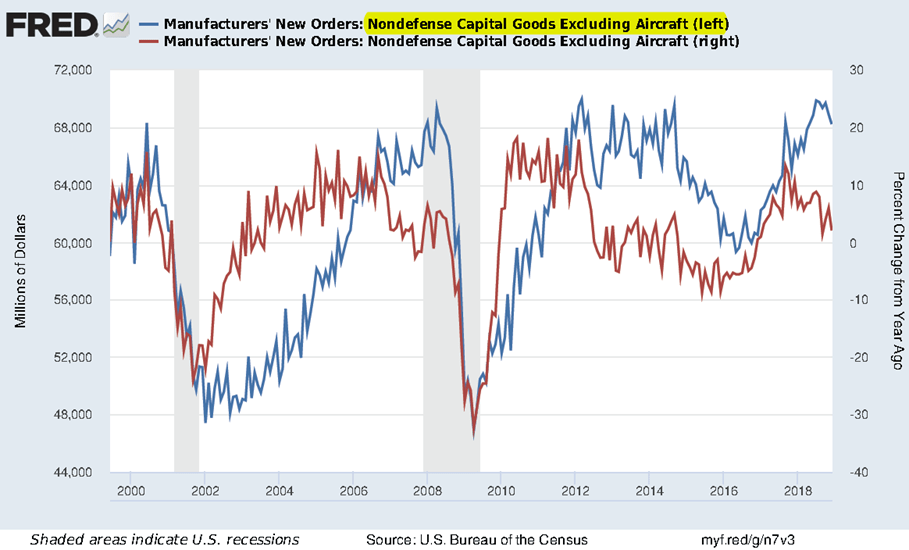
The consumer goods sector was the brightest spot for the global manufacturing industry, with its PMI rising to an eight month high following a solid acceleration in output growth. In contrast, PMI readings at intermediate and investment goods producers fell to 28- and 27-month lows respectively and levels consistent with only mild growth. Investment goods output stagnated as new order inflows decreased for the second time in the past three months.
Developed nations (on average) outperformed emerging markets in December, although growth eased in both cases. PMI readings were above 50.0 for 20 out of the 30 nations for which December data were available, including the US, the euro area, Japan, the UK, India, Brazil and Australia. Countries with PMI figures below the neutral 50.0 mark included China, France, Italy, Taiwan and South Korea.
The rate of expansion in global manufacturing production stayed close to October’s 28-month low in December. New order growth was the weakest since August 2016, while new export business fell for the fourth month in a row. This filtered through to the labour market and business confidence. The pace of job creation slipped to its lowest in over two years, while the degree of optimism among firms was the weakest in the series history.
Price inflationary pressures eased further at the end of 2018. Input costs rose at the slowest rate in 17 months, while the pace of increase in output charges was the weakest since May 2017. Selling price inflation eased (on average) in developed nations, while charges fell in emerging markets for the first time in almost three years.
2012 again? Looks like the American consumer is supporting the global manufacturing sector.
New U.S. business growth weakest since October 2017
The U.S. service sector signalled a solid expansion in business activity in December, albeit the slowest for three-months. The rate of growth in new business eased to a 14-month low, but the pace of job creation picked up. Subsequently, panellists registered a renewed fall in backlogs as pressure on capacity decreased. Concerns surrounding the longevity of the upturn in new business led to the weakest expected rise in future output since December 2017.
Meanwhile, input prices rose at the slowest rate since August. In line with a softer rise in cost burdens and less robust client demand, output charges increased at the weakest pace since December 2017.
The seasonally adjusted final IHS Markit U.S. Services Business Activity Index registered 54.4 in December, down from 54.7 in November, but up from the earlier reported flash figure of 53.6. The upturn in business activity was driven by a further rise in new orders and increased repeat business. Although down on growth rates seen earlier in the year, the upturn was solid overall. The final quarterly average of 2018 matched that seen in the third quarter at 54.7.
The rate of new business growth eased for the third successive month in December, with service providers registering the slowest increase in new orders since October 2017. Where a rise was reported, panellists linked this to favourable demand conditions. However, some firms noted that higher interest rates and greater uncertainty had dampened client demand.
Similarly, service sector firms noted a fall in foreign client demand, with the New Export Business Index signalling the first monthly contraction in new business from abroad since August. Although only fractional, the decrease was attributed to greater competition and ongoing global trade tensions.
In line with a weaker rise in new business, service providers registered a lower degree of optimism towards future business activity in December. The level of positive sentiment was the least confident for a year amid concerns surrounding the longevity of new order growth.
Despite a contraction in the level of outstanding business, service sector firms noted a solid rise in employment. The rate of job creation accelerated to a three-month high amid reports of shortages in capacity following a further increase in workloads. Service providers across the U.S. continued to register a rise in input prices, albeit the weakest since August. Where an increase in costs were reported, panellists linked this to higher wage and transportation costs, with some also noting that higher interest rates were pushing up cost burdens.
Subsequently, firms raised their selling prices in an effort to partly pass on higher input costs to clients. The rate of charge inflation eased to a 12-month low, however, amid greater efforts to attract customers.
The Composite Output Index posted 54.4 in December, down from 54.7 in November. The latest index figure signalled the softest growth since September and was below the series trend. The upturn in business activity eased to a three-month low.
New order growth softened for the third successive month in December to the joint-weakest since April 2017 amid slower rates of expansion in both the manufacturing and service sectors. Private sector new export order growth eased only slightly, despite a contraction in new business from abroad among service providers.
In line with weaker new order growth, the rate of job creation across the U.S. private sector eased to the second-softest in 18 months. Although the pace of increase in employment picked up in the service sector, manufacturing firms registered the slowest rise since June 2017.
On the price front, input cost inflation softened in December to the slowest since January. Panellists continued to suggest that stockpiling and tariff issues drove up purchase prices in the goods producing sector, whilst service providers cited higher wage and transport costs. Charge inflation also eased and was the weakest in 2018.
Chris Williamson, Chief Business Economist at IHS Markit:
(…) Despite the slowing, the December surveys remain consistent with GDP growing at a healthy annualised rate of about 2.5% in the fourth quarter, with momentum easing only very slightly as the quarter proceeded. (…) Growth may continue to moderate in coming months, however, as backlogs of unfinished work across the manufacturing and service sectors failed to rise for the first time since June 2017, reflecting the recent slowing in growth of new business. Firms’ expectations of growth in the coming year also deteriorated markedly, down to the second-lowest in over two years, adding to the gloomier outlook.
Inflationary forces meanwhile cooled during the month as lower oil prices helped to alleviate upward cost pressures from tariffs and, to a lesser extent, wages. Average prices charged for goods and services rose at the slowest rate for a year as a result, which should feed through to lower consumer inflation in coming months, with PCE inflation dipping below 2%.
China Services PMI improves to five-month high in December
The Caixin China Composite PMI™ data (which covers both manufacturing and services) showed a further rise in overall Chinese business activity during December. Furthermore, the rate of expansion picked up from November, with the Composite Output Index rising from 51.9 to a five-month high of 52.2.
The improved headline index reading was supported by higher activity levels across both the manufacturing and service sectors. Services companies registered a solid rate of activity growth, while manufacturing output expanded slightly after two months of stagnation. The solid upturn in services activity was shown by the seasonally adjusted Caixin China General Services Business Activity Index edging up from 53.8 in November to a six-month high of 53.9 at the end of 2018.
Despite the stronger rise in output, overall new business increased only slightly during December. Divergent trends were seen at the sector level, with new orders falling slightly at manufacturers, but rising modestly at services companies.
New work from abroad followed a similar pattern, with a further decline in export sales at manufacturers contrasting with a sustained rise at service providers. Notably, new work from abroad across the service sector expanded at the quickest pace for six months in December. Some panellists mentioned greater efforts to secure export orders.
On the employment front, staffing levels rose only slightly at services companies, while manufacturers continued to reduce their workforce numbers. The pace of job creation across the service sector was marginal, having weakened to a three-month low. Goods producers meanwhile registered a modest decline in employment that was similar to that seen in November. Consequently, staffing levels at the composite level continued to fall slightly during December.
Backlogs of work rose across both monitored sectors in December. Outstanding workloads continued to rise at a modest pace at goods producers. Though only slight, the increase in unfinished business at services providers was the first seen for four months. Overall, the level of work-in-hand (but not yet completed) rose for the thirty-fourth month running, albeit at a marginal pace.
A renewed fall in average input costs across the manufacturing sector contrasted with a further rise at service providers. Though modest, it was the first time that cost burdens had declined at goods producers since May 2017. In contrast, operating expenses continued to increase solidly across the service sector, with many firms linking the rise to higher raw material prices and salary costs. As a result, input prices measured across both sectors increased at the joint-weakest rate for two-and-a-half years.
In line with the trend for costs, average factory gate prices fell for the second month in a row during December. Though modest, the rate of discounting was the quickest seen since February 2016. Concurrently, services companies continued to increase their output charges only slightly at the end of 2018. At the composite level, selling prices fell for the first time since May 2017 (though only slightly).
The level of positive sentiment towards the 12-month business outlook improved slightly at manufacturers and service providers at the end of the year. The degree of optimism edged up to a three-month high at manufacturers, while services companies saw expectations improve from November’s recent low. However, overall business confidence remained relatively subdued in the context of historical data, with a number of surveyed firms citing concerns over relatively soft market conditions.
Eurozone: slowest growth in over four years during December
The IHS Markit Eurozone PMI® Composite Output Index moved closer to the 50.0 no-change mark in December. Registering a final reading of 51.1, down from 52.7 in November and lower than the earlier flash estimate of 51.3, the index was at its weakest level for over four years.
The slowdown in growth during December in part reflected lower activity in France, where the ‘gilets jaunes’ movement reportedly led to a first fall in economic output for two-and-a-half years. That said, growth tended to weaken elsewhere, led by Germany which registered its weakest outturn for five-and-a-half years. Italy bucked the broader
downward trend, though output merely stabilised following two months of contraction.The manufacturing and service sectors registered broadly similar modest growth outturns during December. Goods producers recorded a slightly better increase in production than in November, but this was only achieved via a reduction in work outstanding and an accumulation of warehouse inventories rather than any improvement in demand.
On the contrary, new orders received by manufacturers deteriorated to the greatest extent in over four years. With inflows of new business to service providers rising only modestly, composite data showed the weakest growth in new work since the end of 2014.
In spite of the slowdown of growth in activity and new work, labour market conditions in the eurozone continued to strengthen. Job numbers increased in December for a fiftieth month in succession with the latest growth again solid, despite easing to the lowest since the start of 2017. Job creation remained strongest in Germany and Ireland as firms here sought to keep on top of workloads. Latest data suggested that such efforts were broadly successful as backlogs of work across the eurozone fell for the first time since January 2015.
The latest data on prices indicated that input costs continued to increase at an elevated rate at the end of 2018. Wage and salary pressures remained a key driver of cost pressures. However, with oil related goods reported to be dropping in price, especially for manufacturers, the net rise in overall input prices was the weakest recorded by the survey since August 2017. Output prices also rose at a slower rate in December, with latest data showing inflation at its weakest for 15 months.
Business confidence continued to soften in December, slipping to its lowest level since October 2014. In line with recent surveys, political and economic uncertainties relating to global trade and Brexit weighed on expectations. Sentiment remained especially low in Germany (the weakest since October 2014).
The IHS Markit Eurozone PMI® Services Business Activity Index declined for a third successive month during December to hit its lowest level in over four years. After accounting for seasonality, the index recorded 51.2, down from November’s 53.4 and indicative of modest growth. French services activity fell for the first time since June 2016, reflecting a disruption to activity from the recent ‘gilet jaunes’ movement. Meanwhile, growth in Germany was the slowest since September 2016 and activity in Italy rose only marginally. More positively, Spanish service sector growth was unmoved at a robust rate.
New business volumes in the services economy increased at the weakest rate for four years in December. Nonetheless, job creation remained solid overall and helped companies to keep on top of workloads. Outstanding business increased at the weakest rate since September 2016.
Despite evidence of lower fuel and energy costs, input price inflation remained high during December. Higher labour costs were a key source of inflation, according to service providers. Output charges also continued to rise at a solid pace, underpinned by strong inflation in Germany and Ireland. In contrast, Italian service providers recorded the sharpest discounting for over two years.
Finally, business confidence amongst service providers continued to deteriorate at the end of 2018. Latest data showed that sentiment was the lowest recorded by the survey for four years, reflecting weaker confidence in France and Germany.
Chris Williamson, Chief Business Economist at IHS Markit:
The eurozone economy moved down another gear at the end of 2018, with growth down considerably from the elevated rates at the start of the year. December saw business activity grow at the weakest rate since late-2014 as inflows of new work barely rose. Levels of unfinished business are now falling for the first time in nearly four years as previously-received orders are not being fully replaced with new work.
The data are consistent with eurozone GDP rising by just under 0.3% in the fourth quarter, but with quarterly growth momentum slowing to 0.15% in December.
While a drop in business activity in France could be partly blamed on the ‘yellow vest’ protests, the rest of the region lacks any such mitigating factors, albeit with the recent weakness of the autos sector hopefully a temporary set-back.
Importantly, with expectations of output dropping to the lowest for over four years, companies are not anticipating any imminent revival in demand. Worries reflect multiple headwinds from trade wars, Brexit, heightened political uncertainty, financial market volatility and slower global economic growth. (…)
Better news came in the form of an easing in price pressures to the lowest for over a year, which should provide some breathing space for the European Central Bank to review its policy guidance.
Japan output growth accelerates to eight-month high
The Japanese manufacturing sector finished 2018 on a solid footing, with business conditions improving at a stronger rate. Driving the firmer upturn was a sharper expansion in production, which rose at the strongest rate since last April. New orders also increased at a faster pace, but overall remained relatively muted, while export sales declined on the month. Employment increased to a weaker extent, while input deliveries continued to be delayed. The net effect contributed to another rise in backlogs of work. Meanwhile, business confidence slid to the lowest in just over two years amid concerns towards the impending consumption tax hike.
The headline Nikkei Japan Manufacturing Purchasing Managers’ IndexTM (PMI)® increased to 52.6 in December, rebounding from Novembers 15-month low of 52.2. This signalled a moderate improvement in operating conditions and reflected increases in the two key sub-components of the headline index: output and new orders.
Supporting the strengthening of the PMI was a faster increase in output. The expansion was strong overall and the sharpest since last April. Some panellists indicated that favourable order intakes had underpinned greater output efforts. Survey data indicated a quicker increase in new sales during December. New product launches and larger input needs at clients had driven demand. That said, growth was only modest overall. International orders returned to contraction, however, declining following two months of higher inflows. Unfavourable workload growth in key export markets such as North America, China and Taiwan were reported by panellists.
To accommodate for increased output, input buying was ramped up to the greatest extent for eight months during December. However, supply side constraints were evidenced by a further marked prolonging of input delivery times. Stock shortages, capacity issues at vendors and higher raw material demand weighed on suppliers’ ability to fulfil orders in a timely manner. Capacity pressures were also apparent across the wider-manufacturing sector. Despite output expanding at a faster rate than new business, backlogs of work were accumulated during December.
Hampering the overall increase in the PMI was a softer rise in employment. The rate of job creation was the weakest in three months and only modest. While increased operational requirements encouraged recruitment, retirements hampered the overall extent of the rise.
On the price front, there was a broad cooling of inflationary pressures. Input costs rose sharply, but at the softest pace in eight months. As a result, the rate of increase in selling charges weakened.
Looking ahead, Japanese manufacturers remained upbeat on growth prospects; however, confidence slid for a seventh successive month to the lowest since November 2016. Optimism arising from the 2020 Olympic Games was in part hampered by concerns about the upcoming sales tax hike.
(…) the survey data provide reason to remain cautious on growth prospects. Most notably, demand pressures were relatively subdued. Exports also declined on the month amid reports of sluggish sales to Europe and China. The fall in confidence, the seventh time this has been the case in as many months, also suggests that companies are becoming increasingly less bullish on the year-ahead outlook. With the sales tax increase set to come into play, fears over the durability of demand conditions are worrying.
The Fed will pause rate hikes and QT: Economist
Stephanie Pomboy is among the most respected economists. Her views combine with other excellent economists such as David Rosenberg and Gary Shilling who are both on record with a recession forecast for 2019.
Investors have suddenly turned dovish:
But if they had carefully read the FOMC statement and Jay Powell’s presser of Dec. 19 they would have seen a pretty dovish Fed chair:
(…) our policy decisions are not on a preset course and will change if incoming data materially change the outlook. (…)
What kind of year will 2019 be? We know that the economy may not be as kind to our forecasts next year as it was this year. History attests that unforeseen events as the year unfolds may buffet the economy and call for more than a slight change from the policy projections released today. (…)
Powell admits that the risk is clearly tilted to the downside, that the downside could be serious (“buffet”: to strike sharply) and would rapidly call for “more than a slight change from the policy projections”.
- I think we’ve reached the bottom end of the range of Committee estimates of what might be neutral. I think from this point forward, we’re going to be letting the data speak to us and form the outlook and form our understanding of what would be appropriate policy. So, there’s a fairly high degree of uncertainty about both the path and the ultimate destination of any further increases.
- We’re always data-dependent, but I think it has a particular meaning in this context.
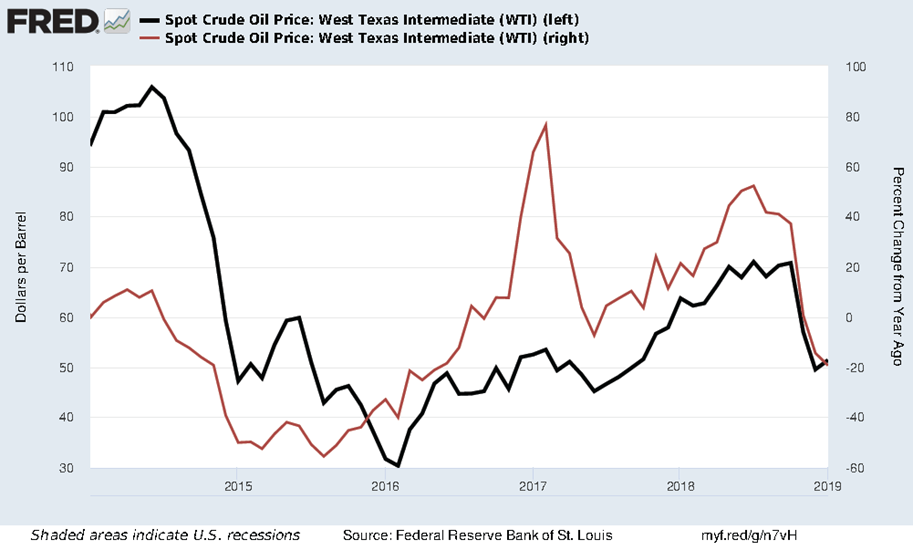
What’s “this context”? Given the “robust economic backdrop and our expectation for healthy growth” amid “low and stable inflation”, “this context” can only be quickly slowing Europe and China, mainly due to Trump’s trade wars, and sharply lower oil prices, combined with high corporate debt and limited fiscal leeway. In reality, the Fed finds itself with really nothing to fight other than an economic contraction induced by sharply lower corporate spending amid trade wars and low oil prices. (See WHERE’S THE BEEF?) And that was last Wednesday morning [Dec. 19], before the S&P 500 nosedived another 8% to enter bear territory. What if consumer spending stalls now?
He even went out of his way to proclaim that accelerating wages would not impact monetary policy:
- I do expect, and I think many forecasters expect, that wage increases will continue, and that would be a welcome development. Wage increases do not need to be inflationary. There’s plenty of evidence of situations, for example, in the very tight labor market of the late 1990s of a, I think in a mentioned in a speech a month or so ago, we had wage increases above productivity plus inflation. We didn’t have high inflation. So, it would be welcome. We hear a great deal of anecdotal information about labor shortages, along with other, you know, bottlenecks and things. So I would expect that wages will keep moving up, and it doesn’t necessarily mean inflation. We don’t think of it that way.
Not dovish? Powell clearly said that inflation is not a problem, that rising wages will not be seen as a problem, quite the opposite, and that the Fed is ready to change policy more than slightly on short notice given the developing negative tone in the economy. More than once during the Q&A session he emphasized that the dot plot, calling for 2 more hikes in 2019, should not be considered the consensus view. This is the Powell Fed.
This a.m. from the BLS: keeps the U.S. consumer sector pretty solid:
Establishment Survey Data:
Total nonfarm payroll employment increased by 312,000 in December, and the unemployment rate rose to 3.9 percent. The change in total nonfarm payroll employment for November was revised up from +155,000 to +176,000, and the change for October was revised up from +237,000 to +274,000. With these revisions, employment gains in October and November combined were 58,000 more than previously reported. After revisions, job gains have averaged 254,000 per month over the last 3 months (full year average: +216k).- The average workweek for all employees on private nonfarm payrolls increased by 0.1 hour to 34.5 hours in December. In manufacturing, both the workweek and overtime increased by 0.1 hour to 40.9 hours and 3.6 hours, respectively. The average workweek for production and nonsupervisory employees on private nonfarm payrolls held at 33.7 hours.
- In December, average hourly earnings for all employees on private nonfarm payrolls rose 11 cents to $27.48. Over the year, average hourly earnings have increased by 84 cents, or 3.2 percent. Average hourly earnings of private-sector production and nonsupervisory employees increased by 9 cents to $23.05 in December. [+3.3%]
Household Survey Data: The unemployment rate rose by 0.2 percentage point to 3.9 percent in December, and the number of unemployed persons increased by 276,000 to 6.3 million.