RECESSION WATCH
Hmmm…more signs that the U.S. economy is no insulated island.
(…) the Cass Shipments Index is indicative of continued economic expansion. Our confidence in this outlook is emboldened by the knowledge that since the end of World War II (the period for which we have reliable data) there has never been an economic contraction without there first being a contraction in freight flows. Conversely, during the same period, there has never been an economic expansion without there first being an expansion in freight flows. Bottom line: even if it is at a slower rate, as long as the volume of freight continues to expand, we see no reason to turn bearish in our economic outlook.
Current consensus estimates of the GDP for the 4th quarter are now predicting 2.7%. Using the Cass Shipments Index as a predictive proxy, this would leave us believing the number reported (now at the end of February) may fall short of those estimates. (…)
The current levels of volume and pricing growth are suggesting that the U.S. economy is still growing, just not at the rate it was, and that it may have reached its short-term expansion limit. The full year 2018 percentage increase was 7.9%, which is very robust. However, the -0.8% decline in December and the -0.3% decline in January are marked decelerations from the 6.2% achieved in October and even more marked decelerations from the low double-digit levels achieved in the first five months of 2018. We are confident that the increased spending on equipment, technology, and people will eventually result in increased capacity in most transportation modes. That said, many modes are continuing to report “limited amounts of capacity.” (…)
I find that this latest Cass report is pretty long on trying to tell us not to worry that its “usually reliable leading indicator” has crashed from 4-5% growth to 2.0% in Q4 and –0.5% on average in December-January. Its chart did not even plot the Q4 data (my red bar in the chart). Perhaps Don Broughton’s background as a sell side analyst is showing…Anyway, the last 2 months in negative territory raise the odds of a negative GDP number early this year, don’t they?

On the other hand, truckers seem to retain pricing power…but mainly because supply remains tight. For how long if demand slows?


Speaking of demand:

 Global copper users output index nears ten-year low prompting growth worries
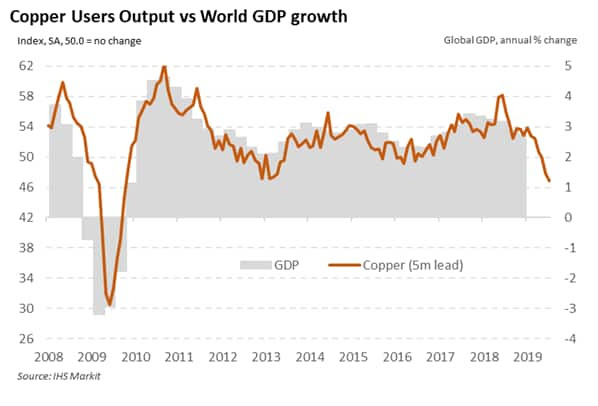
Heavy users of copper saw a solid decline in output in January, boding ill for future demand for the metal in coming months. The Global Copper Users PMI Output Index hit a near ten-year low at the start of 2019, indicating a downturn of the scale not seen since the financial crisis.
This gives worrying indications of the health of the manufacturing sector and suggests a marked weakening of demand for copper from manufacturers in the months ahead, as well as providing a potential early warning signal for slower global economic growth.
The IHS Markit Global Copper Users PMITM is a composite indicator giving an overview of operating conditions at manufacturers identified as heavy users of copper and is based on data provided by companies around the globe.
As many copper users are producers of primary manufacturing goods, the index measuring output levels has a strong correlation with worldwide manufacturing output, and can offer projections for global economic growth in the near-to-medium term.
The Global Copper Users Output Index posted at 46.8 in January, indicating a solid decline in production at heavy users of copper. This was the lowest reading since April 2009, shortly after the global recession. A key factor was notably softer output growth at US copper users, though users in Asia and Europe continued to see declining production levels.
The latest data suggest a possible fall in the wider gauge of manufacturing output in coming months. A comparable, albeit slightly softer contraction in production at copper users in 2012 initiated a four-month sequence of deterioration in output recorded by the JPMorgan Global Manufacturing PMI.
Moreover, as a forward indicator to world GDP growth, January’s copper users data point to a marked slowdown in the first half of 2019. Copper is used in a variety of sectors, including electronics, transport and construction. A downturn in these areas can lead to a notable rippling effect across the global economy.
A strong recurring influence on falling output is declining trade. Copper users have recorded falling new export orders in each of the last eight months, commencing shortly after the US placed tariffs on Chinese copper goods. Notably though, January was the first month in this period where US and European users joined Asian users in reporting falling export sales.
Currently, further tariff hikes have been postponed amid fresh US-China trade talks. If these are successful, they may allow a rebound in output. On the other hand, if talks are unsuccessful, US import tariffs will likely rise from 10% to 25%. In which case, copper – and other metals – users may face even gloomier business conditions in the months ahead.
Weaker new orders may also exert downward pressure on copper prices. The forward-looking New Order: Inventory Ratio has fallen markedly over recent survey periods, as stockpiles have not contracted as quickly as demand, most likely reflecting stock building ahead of future tariff hikes. This is likely to act as a drag on copper prices in the near term as producers use up their stocks. While offering relief to copper users’ balance sheets, such a decline may add further tensions for the whole industry.

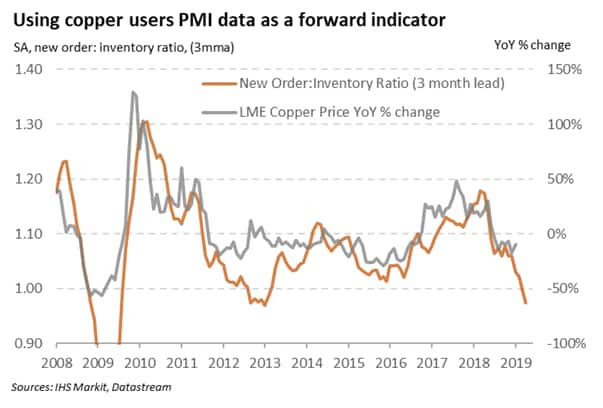
Hmmm…scary!
Speaking of demand:
-
IRS says average tax refund is down nearly 9 percent so far this year Trump Administration confirms that fewer tax refunds will be issued this year.
(…) About 75 percent of Americans received refunds in recent years. The average refund was almost $2,900 last year, a large infusion of cash that many people used to pay down student loans, credit card debt and other big bills. (…)
The IRS estimated that several million tax filers would go from getting a refund last year to not getting one this year or even owing some money. (…)
-
Factory Output Contracts Unexpectedly in January U.S. industrial output fell 0.6% in January, primarily driven by a large drop in vehicle production.
(…) Vehicle assemblies fell in January from a two-year high in December, the Fed said. This signals part of the drop could simply be pull-back from an unsustainable pace of output growth in that category.
Still, production in most other major durable goods categories, including electronic equipment and wood products, also declined. Output in nondurable good categories, such as apparel items, was flat. (…)
- Auto production cratered 8.0% (-0.5% y/y) and reversed two months of strong increase. Excluding the motor vehicle sector, factory output eased 0.2% last month (+3.1% y/y) following a 0.5% rise.
- The Association of Home Appliance Manufacturers (AHAM) reported that January U.S. industry wholesale unit shipments of core 6 appliances were -6% YoY. Eight of the last ten months have been negative.
-
European Car Sales Fall For Fifth Month In A Row

-
In China:

New Tariffs Threaten to Boost Prices of Imported Cars, Parts The Commerce Department is wrapping its probe into whether imported cars and parts pose a national-security threat under U.S. trade law. Its findings could lead to levies that would make autos from Japan, Germany and elsewhere sharply more expensive.
The Commerce Department is concluding its investigation into whether imported cars and parts pose a national-security threat
under Section 232 of U.S. trade law, with a deadline of Sunday to submit its findings to the president.
(…) “There’s a reason why we’ve seen a real slowdown in investment activity,” said Kristin Dziczek, an economist at the industry-backed Center for Automotive Research. “People are waiting to see where the chips fall.” (…)
ING’s take on that:
If the US were to increase tariffs by 20 percentage points on imported cars and car parts from the EU, worth $50 billion, the direct effect would be limited to little less than 0.1% of EU GDP. (…) Despite having a strong industrial base, Germany’s economy is largely made up of services (71%). The car industry adds no more than 4% to German GDP and only one eighth of this depends on exports that end up in the US. Don’t forget that some German car makers like Mercedes and BMW produce 30% to 50% of the cars they sell to Americans locally in the US.
The equivalent of the direct damage for the EU as a whole, is a hit of -0.2% for German GDP. Significant but not shocking. Actually, the effect could be somewhat lower because German car exports include many luxury vehicles, which usually suffer a below-average fall in demand when prices rise.
We estimate that the announcement of a 20 percentage point hike in car tariffs would shave off at least another 0.1% of EU GDP through lower confidence among businesses and consumers.
If a large share of trade between the US and EU becomes subject to higher tariffs, the economic damage would be much more significant on both sides of the ocean. A mutually imposed tariff of 20% on all goods would, by the direct effect alone, cost both the EU and the US around 0.7% of GDP.
Fearing Trump’s China tariffs may never end, companies are taking action
(…) While any accord would presumably forestall the threatened tariff increase to 25 percent, it’s not clear if the current 10 percent levy would continue. Some officials have suggested that it remain in place to encourage China to implement promised reforms designed to address U.S. complaints about compulsory or illicit efforts to acquire American technology. (…)
Some retailers have begun the lengthy process of switching their orders from Chinese factories to suppliers in other Asian countries, said Rick Helfenbein, president of the American Apparel and Footwear Association.
“This is going to be a fact of life for the next 10 or 20 years,” he said. “Once you go, you don’t go back.” (…)
To reduce its exposure to new trade barriers, Philips factories in China, the United States and Europe will increasingly produce a variety of products for their home market rather than specialize in a particular product to be shipped globally. (…)
Companies are moving their orders from Chinese factories to southeast Asia and Mexico, according to Qima, a Hong Kong-based supply chain specialist that advises major brands and retailers. Client requests for inspections rose by 50 percent in Cambodia and Indonesia, 38 percent in Bangladesh and 19 percent in Vietnam, said Sebastien Breteau, the company founder and chief executive. (…)
Linton Crystal Technologies, a Rochester, N.Y., maker of industrial furnaces, says Trump’s tariff war is forcing it to move its research and development work to China. Only a handful of American jobs will be lost. But the shift means that future job-creating innovations will sprout in Dalian, a seaside Chinese city, rather than in Rochester, said Todd Barnum, the company’s chief operating officer. (…)
Barnum says he can’t comply with Trump’s call for companies to produce in the United States. Most of Linton’s customers are in Asia. Plus, even if he could afford to produce new furnaces in Rochester, by the time he tooled up to do so, they would be obsolete in the fast-moving chip business. (…)
-
Whirlpool Not Counting on Trump Resolving Trade Spat With China
In forecasting its 2019 performance on Tuesday, the appliance-maker said it’s factoring in U.S. tariffs on a list of Chinese goods that are scheduled to jump to 25 percent in March. That planned increase, along with higher prices for raw materials in general, will cost the company $300 million this year — similar to 2018 levels.
Farmworker vs Robot Agricultural workers of the future may soon be made of tech and steel. Can a robot pick a strawberry better, faster, and cheaper than a seasonal farmworker?
(…) Growers say it is getting harder to hire enough people to harvest crops before they rot. Fewer seasonal laborers are coming from Mexico, the biggest supplier of U.S. farmworkers. Fewer Americans want to bend over all day in a field, farmers say, even when offered higher wages, free housing and recruitment bonuses. (…)
Agriculture economists at Arizona State University last year estimated that if farmers lost their undocumented workforce entirely, wages would have to rise by 50 percent to replace them — and that would crank up produce prices by another 40 percent. (…)
The future of agricultural work has arrived here in Florida, promising to ease labor shortages and reduce the cost of food, or so says the team behind Harv, a nickname for the latest model from automation company Harvest CROO Robotics. (…)
Expect to see this technology on the market in the next three years, said Manoj Karkee, associate professor at the school’s Center for Precision & Automated Agricultural Systems. (…)
-
Countering the geographical impacts of automation “[Artificial intelligence] and its positive and negative impacts will not be distributed evenly.” In a new report, Mark Muro examines the places, people, and jobs that are most exposed to disruption from emerging technologies and calls for a plan that considers the numerous geographic factors at play.
Record High Name Government as Most Important Problem
Thirty-five percent of Americans name the government, poor leadership or politicians as the greatest problem facing the U.S. This is the highest percentage Gallup has recorded for this concern, edging out the previous high of 33% during the 2013 federal government shutdown. (…)
Gallup has asked Americans what they felt was the most important problem facing the country since 1939 and has regularly compiled mentions of the government since 1964. Prior to 2001, the highest percentage mentioning government was 26% during the Watergate scandal. Thus, the current measure is the highest in at least 55 years. (…)
An analysis of the verbatim responses to the question from the latest survey finds that 11% of Americans specifically cite “Donald Trump” as the most important problem, while 5% name “the Democrats” or “liberals” and 1% “Congress.” About half of those who say the government is the most important problem — 18% of U.S. adults — blame both parties or cite “gridlock,” “lack of cooperation” or the shutdown more generally. The latter figure has grown from 6% in December and 12% in January.
Since January 2017, about the time Donald Trump took office, the government has been the top problem each month except in the November poll, and in July 2018. In both of those months, immigration edged out the government at the top of the list.
Americans have become more likely to name the government and/or leadership as the country’s greatest problem over the past decade. From 2001 through 2009, yearly averages of this measure were consistently below 10%, but mentions of government as the foremost challenge have become more pervasive in the decade since. In 2010 to 2016, average mentions of the government as the biggest problem ranged from 12% to 19%. (…)
Mentions of the government have become more frequent among all party groups in recent months — especially Republicans, among whom there has been a 14-point increase in mentions of the government this past month. (…)
The number of Democrats who mention Trump specifically has been quite stable in recent months, but there has been a surge in the percentage of Democrats seeing both parties as the problem or citing general concerns about gridlock and lack of cooperation. Likewise, there has been a sharp increase in the number of Republicans and independents seeing both parties, gridlock or related issues as the problem. (…)

Import Prices Continue Their Decline; Both Oil and Nonoil Prices Move Lower

-
Why are import prices falling again?
The import price index actually fell for a third consecutive month in January according to latest data from the BLS. So much so that, on a year-on-year basis, the import price of non-petroleum goods is now in negative territory for the first time in years. So, why are import prices falling again? The U.S. dollar’s surge in 2018 has clearly helped cap the price of imported goods. As today’s Hot Charts show, the declining price of imports from China coincides with the yuan’s depreciation against the USD. The lack of inflation pressures, both domestic and imported, and a flat yield curve arguably restrain the ability of the Federal Reserve to tighten U.S. monetary policy much further. (NBF)

-
Janet Yellen on monetary policy, currencies, and manipulation Former Federal Reserve Chair Janet Yellen joins the Brookings Dollar and Sense podcast to break down the sometimes controversial role that currencies and currency values play in international trade, with a particular focus on U.S. and Chinese monetary policies in recent years.
Fitch Ratings: ‘BBB’ Mega Borrowers Nearly Half of Global Corporate Rated Universe
Fitch Ratings’ ‘BBB’ category comprises 43 percent of its total global nonfinancial corporate rating portfolio as of end-January 2019, compared with 38 percent a decade ago, according to a new Fitch Ratings report. (…)
We anticipate median debt and median EBITDAR leverage reducing by 10 percent by the end of 2020, though individual prospects vary materially.”
The ‘BBB’ mega borrowers are double that of the next-largest rating concentration – the ‘BB’ category – and a significant chunk of the investment-grade portfolio that together accounts for 59 percent of total ratings.
Fitch forecasts mega borrowers’ median debt to decrease to USD66 billion in 2019 and USD64 billion in 2020 from approximately USD70 billion in 2018. Declining debt is partly attributed to the prevalence of U.S. borrowers in the sample anticipating improved cash flows following U.S. tax reform in 2018.
Median capex is forecast to remain steady between USD8 billion and USD9 billion annually, with median FCF projected to improve to positive levels in 2018 as cash flow improvements materialize.
Fitch projects median leverage ratios to improve accordingly, with total adjusted debt to EBITDAR declining to 3.6x in 2020 from 4.0x in 2018, and funds from operations-adjusted leverage falling to 4.1x from 4.8x over the same time horizon.
Global nonfinancial corporate mega borrowers, defined as those with USD50 billion or more equivalent of adjusted debt, spanning the range of ‘A-‘, ‘BBB+’, ‘BBB’ and ‘BBB-‘ ratings together hold approximately USD1.6 trillion of consolidated debt.
EARNINGS WATCH
From Refinitiv:
Through Feb. 15, 394 companies in the S&P 500 Index have reported earnings for Q4 2018. Of these companies, 69.5% reported earnings above analyst expectations and 22.7% reported earnings below analyst expectations. In a typical quarter (since 1994), 64% of companies beat estimates and 21% miss estimates. Over the past four quarters, 78% of companies beat the estimates and 15% missed estimates.
In aggregate, companies are reporting earnings that are 3.0% above estimates, which is below the 3.2% long term (since 1994) average surprise factor, and below the 5.7% surprise factor recorded over the past four quarters.
Through Feb. 15, 392 companies in the S&P 500 Index have reported revenues for Q4 2018. Of these companies, 61.7% reported revenues above analyst expectations and 38.3% reported revenues below analyst expectations. In aggregate, companies are reporting revenues that are 0.8% above estimates.
The estimated revenue growth rate for the S&P 500 for 18Q4 is 6.0%. If the energy sector is excluded, the growth rate declines to 5.5%.
The estimated earnings growth rate for the S&P 500 for 18Q4 is 16.2%. If the energy sector is excluded, the growth rate declines to 13.4%.
The estimated earnings growth rate for the S&P 500 for 19Q1 is -0.5%. If the energy sector is excluded, the growth rate improves to 0.2%.
Revisions remain negative across the board:


Pre-announcements: last week, we got 8 positive and 14 negative, an improved N/P ratio but still rather uninspiring in total:

Trailing EPS are $162.75 and the Rule of 20 P/E is 19.2.

Nasdaq Exits Bear Market as Stocks Stage Rally The tech-heavy index closed more than 20% above its Christmas Eve low, entering a new bull-market run
Tech companies have largely reported fourth-quarter results that exceeded expectations, while easing fears among investors about trade tensions and rapid interest-rate increases have also propelled the index higher. (…)
Market at the Crossroads
(…) Investors do this all the time, see what they want to see, hear what they want to hear. Or sometimes see and hear what someone in a position of power wants them to see and hear. Their internal bias, their desire for a particular outcome, clouds their judgment and doesn’t allow them to see markets as they are. Everyone wants to know the future, thinks they need to know the future, to invest wisely and so they see in markets confirmation of what they already believe – or hope – about how that future will unfold. This is particularly so after big changes in the market as we’ve had in the last few months. (…)
Investors stand at the crossroad of bulls and bears, afraid both that the bulls will pass them by and that the bears won’t. They want to believe the bulls but are mesmerized by the convincing arguments of the bears. With no way to judge the merits of the two cases, most investors become paralyzed, afraid to make a wrong move. And most of the time that’s okay, assuming you are already in the market, because the bears may be more erudite than the bulls but they are also usually wrong.
The markets and economy seem to be at a crossroad right now, investors wondering whether the tumult of the fourth quarter was just a warm-up for more pain down the road or a mere pause that refreshes a bull market that has endured more than its fair share of skepticism from its beginning. The fears of the bears and the hopes of the bulls aren’t much different today than they were in 2010, 2011 or 2015.
There are plenty of things to worry about today just as there was in those other years. The Fed could make a mistake. China could devalue the Yuan. Trade negotiations could stall, more tariffs applied to foreign goods. Europe could still fall apart. Brexit may happen or may not (I’m not sure which thing is negative this week). Democrats could make life miserable for President Trump. There are always things to worry about. But should you? (…)
The selling we saw in the 4th quarter was driven by a fear of Federal Reserve policy, fear that they would tighten monetary policy too much and cause a recession. But there was no evidence of recession at the time, no evidence it was imminent and none even now. There was only fear that a downturn might arrive at some point in the future because the Fed might hike interest rates too far.
I do believe one should monitor the economy but there are ways to do so without speculating about the future. Interpreting the present is hard enough but predicting the future is impossible. Markets are not perfect but they will provide you with all the information you need to be forewarned that the odds of recession are rising. Bond markets are particularly helpful in that regard. Stock markets are not.
Correctly identifying a recession in real time is useful because stocks will likely fall much further than they did in the most recent correction. The last two recessions saw stocks fall by roughly half. That doesn’t always happen – the market only dropped 20% during the 1990 recession – but with valuations as high as they are today, one should probably expect a big drawdown.
There are only a few things you need to watch to stay informed and keep your cool when stocks are trying to scare you to death.
- Yield curve – The difference between short term and long term rates. If you’ve been reading the financial press for any time at all you know that an inverted curve – short rates higher than long – is a warning sign for recession. That is true but not the end of the story. Right before recession you should expect to see short term rates drop rapidly and the curve to steepen. As of now, the curve has not inverted and is not acting as we would expect prior to recession
- Credit spreads – The difference in yield between junk bonds and Treasuries. At the onset of recession, spreads will widen as investors start to avoid risky debts. Widening by itself may not mean much; look to the yield curve for confirmation. Today, the curve has widened some but not enough to worry about recession. And the yield curve doesn’t confirm anyway.
- Chicago Fed National Activity Index – The CFNAI is a monthly gauge of overall economic activity and inflationary pressure. It is a weighted average of 85 separate economic indicators constructed to have an average value of zero when the economy is growing at trend. It has a standard deviation of 1 (range is +1 to -1). When the gauge is positive the economy is growing above trend and when negative the economy is growing below trend. Use a 3 month moving average to smooth out volatility. A reading of -0.75 is a warning of imminent recession. The current reading is 0.12 showing growth slightly above trend.
- Conference Board’s Leading Economic Indicators – The LEI has 10 components and a long track record. It isn’t as broad as the CFNAI but does have a track record of turning negative year over year prior to recession. The latest reading in December was 111.7 versus a year ago reading of 107.
The economy is a wildly complicated, chaotic system composed of billions of individuals pursuing their own or others interests. It is, like all other chaotic systems, impossible to predict precisely. Luckily, investors don’t need a high degree of precision to succeed. If you can come within six months of identifying the onset of recession – that’s a full year window – you can probably avoid the worst of whatever bear market comes with it. These four simple indicators are sufficient for that task.
What you really need though is a strategy that allows you to completely miss the recession call and still survive the bear. That means having an asset allocation that you can stick with and achieve your goals no matter what happens, short of nuclear armageddon. The 4th quarter tumult was a tempest in a teapot, easily weathered by those with the comfort of knowledge and a reasonable, well thought out strategy. If that doesn’t describe your experience, you probably need to revisit your plan. Or get one.
Isn’t this comment from Alhambra Investment’s Joseph Calhoun a great introduction to THE RULE OF 20 STRATEGY?
The Rule of 20 strategy I set out returned 9.7% annually between 1957 and 2018 compared with 6.6% for the S&P 500 Price Index. An investment in January 1957 would be worth 5.7 times more today using the Rule of 20 Strategy than buying and holding the S&P 500 Index during the same period. (…) the Strategy aims at capturing as much as prudently possible from rising equity markets but to protect precious capital during significant corrections and bear markets.

Berkshire’s Charlie Munger has a very blunt response to those ‘driving rich people away’ as Amazon scraps HQ2
‘It’s been serious. Driving the rich people out is pretty dumb if you’re a state or a city.
“They’re old. They keep your hospitals busy. They don’t burden your schools, the police department, your prisons. They give a lot. Who wouldn’t want rich people?”
Rather interesting how quickly this AMZN investment bashing erupted and the apparent mood change towards tech companies…
-
Amazon’s grave HQ2 mistake: The political landscape changed but the company’s playbook didn’t The HQ2 contest was very Amazonian. So was its refusal to back down.
(…) When Amazon made the original HQ2 announcement in September 2017, Senator Bernie Sanders (D-VT) hadn’t yet targeted the company’s wages and labor practices and Alexandria Ocasio-Cortez was still a New York bartender and a complete unknown on the national political change.
By November 2018, Sanders had successfully pressured Amazon into raising its minimum pay to $15 an hour and AOC was a Representative-elect with a huge following who excoriated wealthy corporations for not doing enough for everyday Americans. Democrats also won control of the State Senate in the midterm elections, which ultimately resulted in an Amazon opponent being named to a powerful state board that would vote on the deal in 2020.
The local New York Democratic party — galvanized by AOC’s election — was moving decidedly to the left and Amazon seemed astonishingly unprepared to weather the wave.
Gone was former New York City Mayor Mike Bloomberg’s idea of progress for New York City, which included the ambition of becoming a tech hub that could rival Silicon Valley. In its place, AOC drove an altogether different vision that meant going chest to chest with a corporate bully rather than welcoming it with a close embrace. (…)
New York City does not need Amazon. Plus, Ocasio-Cortez’s election and subsequent celebrity meant that when she focused her laser on the Amazon deal, her massive following did too. (…)
Trump Says Japan’s Abe Nominated Him for Nobel Peace Prize
It seems so unnatural to put “Trump” and “peace” side by side…