U.S. JOLTS: Job Openings Rate Remains Elevated in September
The Bureau of Labor Statistics reported that on the last business day of September, the total job openings rate eased to 6.6% from 6.7% in August, revised from 6.6%. The rate hit a record 7.0% in July. The job openings rate is calculated as job openings as a percent of total employment plus jobs that have not yet been filled. The level of job openings fell 1.8% (+57.9% y/y) to 10.438 million from 10.629 million in August, revised from 10.439 million.
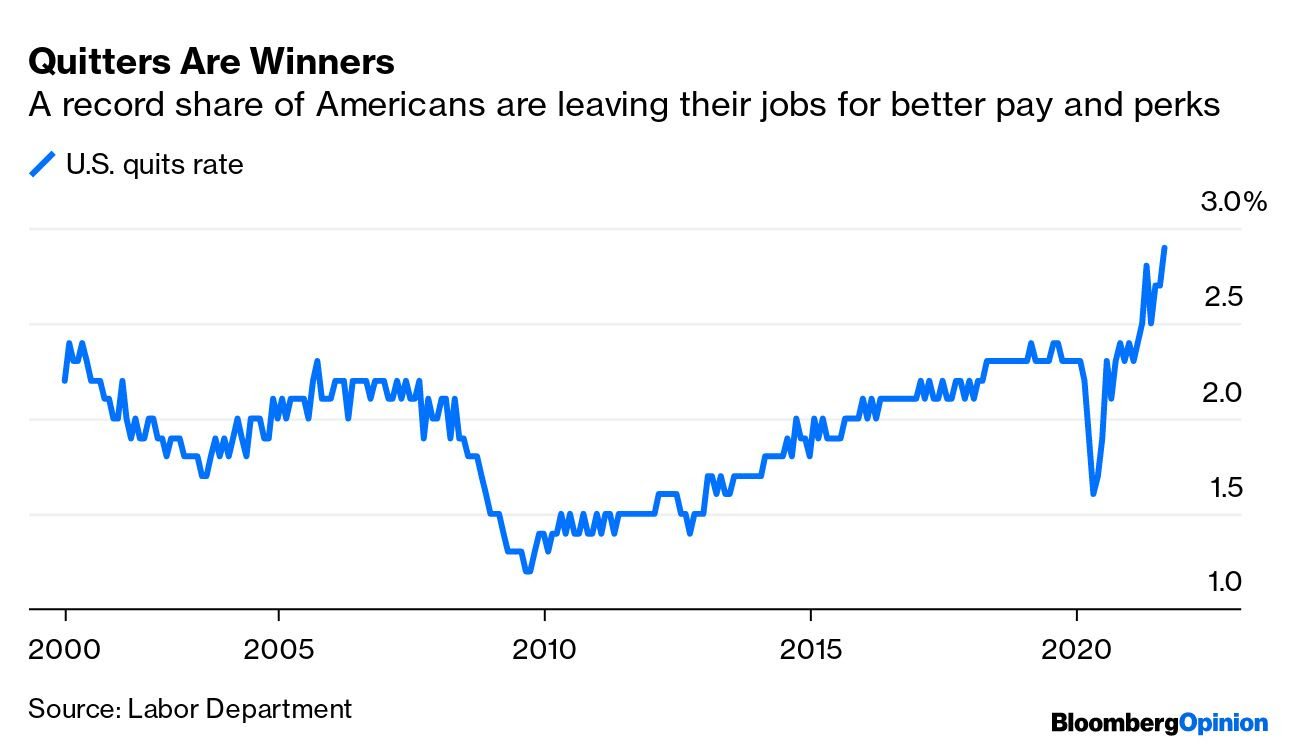
The level of hiring fell 0.6% (+8.9% y/y) as the hiring rate held steady at 4.4%. August was revised from 4.3%. The rate remained higher than the 3.8% low this past January. The overall layoff & discharge rate remained at the record low of 0.9%. The quits rate rose to a record 3.0% in September, well above its low of 1.6% in April 2020. The level of quits rose 34.1% y/y to a record 4.434 million. The JOLTS figures date back to December 2000.
The private-sector job openings rate eased to 7.1% from 7.2% and was below the record 7.4% in July. It has improved from 3.6% April 2020. (…) The government sector job openings rate held at 3.7% after plunging from 4.6% in July. The private sector job openings level declined 2.0% to 9.581 million, but remained up by nearly two-thirds y/y.
The private sector hiring rate held steady at 4.9% in September, but remained up from January’s 4.2% low. It was well below the record 7.2% in May of last year. (…) The level of private sector hiring improved 0.8% in September (10.4% y/y) to 6.19 million.
This chart helps explain the current labor market dynamics: wage gains (red) started to accelerate in mid-2017 when job openings (blue) clearly moved above hires (black). From mid-2018 through 2019, inflation (yellow) slowed and wage demands calmed down. Now, openings exceed hires by 50% and inflation is skyrocketing, prompting higher wage demands that employers, anxious to grow revenues and able to raise prices, are willing to accommodate.

The Atlanta Fed data shows how job switchers improved their wages in recent months. But job stayers are also seeing better wage rates as employers seek to retain and keep loyal employees happy. The WSJ quotes an Indeed job site economist: “The vast majority of the quitting we’ve seen in 2021 has been job switching. Industries that usually hire people out of work may have shifted their approach towards poaching.”

Workers 16 to 24 are reaping the best wage increases. Unfortunately, this next chart is a 12-month moving average, probably hiding the most recent gains in older age groups. For example, the same Atlanta Fed data reveal that prime-age workers’ wages are up 4.2% in October vs 3.8% for the 12-m m.a.. As to the 55+ age group, no wonder they are leaving the labor force… “Goldman Sachs economists point out 3.4 million of the 5 million who have exited the labor market since the pandemic are 55 or older, and many of them may have effectively retired.” (WSJ)

Another WSJ article informs us that (my emphasis)
A group of Amazon.com Inc. AMZN 1.52% warehouse employees in the New York City borough of Staten Island have withdrawn their petition with the National Labor Relations Board to hold a union election at four company warehouses, a labor board spokeswoman said Friday.
The fledgling union, which calls itself the Amazon Labor Union, said it had to withdraw because the labor board, a federal agency that oversees collective bargaining, had communicated that it no longer had adequate support to move forward with an election.
To meet the requirement, unions typically have to collect signatures from 30% of workers showing support. The change came after many workers who had shown support for a union left the company, according to Chris Smalls, a former Amazon employee who leads the group. He said the union planned to collect more signature cards and refile for an election. (…)
Meanwhile, the more than 10,000 John Deere workers in Iowa, Illinois, Kansas, Colorado and Georgia will be voting Wednesday on a new contract to end the first strike at Deere since 1986.
- Deere, UAW Reach New Tentative Agreement on Contract Deere & Co. and the United Auto Workers union reached a third tentative agreement on a contract in the latest bid to end a strike at the agricultural and construction equipment maker that started Oct. 14.
The UAW, which represents more than 10,000 Deere production and maintenance employees, said the latest offer included “modest modifications” to a proposal that union members rejected Nov. 2 by a margin of 55% to 45%. Workers also turned down an offer on Oct. 10. [by 90%] (…)
The company’s prior offer included an immediate 10% increase in hourly pay, plus an $8,500 bonus for each worker. Additional 5% pay raises were proposed for 2023 and 2025, and lump sum bonuses in three other years. Deere had said that offer represented a $3.5 billion investment in compensation for the workers.
Striking employees have said Deere should provide bigger raises and benefit expansions at a time when the company’s farm and construction equipment sales are booming, and other manufacturers are offering significant pay increases and benefits to attract scarce workers. (…)
While on manufacturing, Bloomberg’s Brooke Sutherland explains how the pandemic could prove to be the real MAGA trigger:
Manufacturers Find There’s No Place Like Home Will the pandemic supply-chain disruptions prompt manufacturers to rethink where their factories are situated and build more plants closer to home? Roland Busch — chief executive officer of factory automation and software giant Siemens AG — says yes, for two reasons.
The first is that the majority of the world’s semiconductor and battery manufacturing capabilities are concentrated in Asia, and Western governments have realized that this dynamic is neither wise nor sustainable for such strategically important products. (…) the pace of announcements on new plants in recent months has been dizzying: Samsung Electronics Co. has made a $17 billion commitment; Taiwan Semiconductor Manufacturing Co. is building a $12 billion plant in Arizona and contemplating a factory in Germany; Intel Corp. is investing $20 billion in additional U.S. manufacturing capacity and planning to plow as much as $95 billion into new European factories over the next decade.
Meanwhile, Ford Motor Co. and South Korea’s SK Innovation Co. will spend $11.4 billion to build three battery factories and an assembly plant for electric F-Series pickup trucks in Tennessee and Kentucky. General Motors Co. plans to operate four electric-vehicle battery plants in the U.S. through a joint venture with South Korea’s LG Chem Ltd. Toyota Motor Corp. said this week it would invest $240 million in a new manufacturing line for hybrid transaxles at its existing plant in West Virginia. Electric-vehicle startup Rivian Automotive Inc. — whose more than $100 billion market valuation tops that of GM after an initial public offering this week — has a long list of expansion projects that reportedly include a second car manufacturing facility in the U.S., a plant in Europe costing billions of dollars and in-house battery production at a stand-alone facility.
“There is definitely some reshoring or redistribution of value” in these industries, Busch of Siemens said in an interview.
(…) the ripple effects of reversing that trend are large: These new factories need automation and manufacturing equipment but also air conditioning, lights and roads.
But announcements on U.S. factory expansions are starting to trickle out from other corners of the economy, too. U.S. Steel Corp. and Nucor Corp. are both planning to invest about $3 billion each in new mills. Peloton Interactive Inc. is spending $400 million to open its first U.S. manufacturing facility in Ohio, with an aim of mitigating geopolitical risk and easing shipping challenges. In mid-September, plastic-container maker Berry Global Group Inc. announced a more than $110 million investment to expand its food-service manufacturing capabilities in North America. And then just this week, Schneider Electric SE said it would add three manufacturing plants in North America and hire more than 1,000 new employees to increase production of circuit breakers, switchboards and other electrical equipment and help it speed delivery to domestic customers.
The Schneider (…) facilities are less about repositioning the supply chain and more about adding capacity to meet robust demand for data-center equipment and other electrical infrastructure, Annette Clayton, CEO and president of Schneider’s North American operations, said in an interview.
And that brings us to the second argument from Busch as to why a geographical reassessment of manufacturing capacity may be underway: Automation is the great equalizer that makes European and U.S. factories more economically attractive. (…)
“China’s labor population peaked already,” Busch said. “When you have less and less labor, you have to automate more. Once you’re automating and the salaries are increased, then what’s the advantage of having a footprint in China?” Labor costs aren’t the only consideration: Energy expenses and government subsidies also factor into companies’ manufacturing capacity decisions. One other benefit of producing goods in China is that there’s already a well-established ecosystem of component suppliers. But with trans-Pacific shipping costs so high and a growing number of companies taking actions to curb their carbon emissions, this moment “really cries out for rethinking where you would put an automated factory,” Busch said. (…)
U.S. Consumer Sentiment Drops to 10-Year Low on Inflation Fears
The University of Michigan’s preliminary sentiment index decreased to 66.8 from 71.7 in October, data released Friday showed. The November figure trailed all projections in a Bloomberg survey of economists which called for an increase to 72.5. (…)
Consumers expect inflation to rise 4.9% over the next year, the highest since 2008, the report showed. They expect prices will rise 2.9% over the next five to 10 years, unchanged from the previous month. (…) About half of all families anticipate declines in inflation-adjusted incomes next year, according to the data. (…)
The Michigan report showed buying conditions for household goods deteriorated sharply, with a gauge falling to a reading of 78 that was the second-lowest in data back to 1978. There were more frequent mentions in the survey of higher costs for vehicles, durable goods and homes.
Twenty-four percent of households expect to be worse off in the coming year, the highest since June 2008, according to Curtin.
The gauge of current conditions dropped to 73.2, the lowest since 2011. A measure of future expectations decreased to 62.8, which was the weakest since 2013, according to the survey.
Americans are also more pessimistic about the economy’s prospects over the coming five years. The university’s gauge fell to the lowest since 2011.

ING:
In a major surprise move US University of Michigan consumer sentiment has fallen to a 10-year low, which underscores how concerned households are about inflation. A rise was expected given the improvement in jobs, wages and wealth, but $3.50/gallon for gasoline is clearly an issue that households feel strongly about.
(…) the chart below shows a massive disconnect between the Michigan survey and the Conference Board index so caution is warranted in over interpreting today’s number.
University of Michigan confidence versus Conference Board confidence measure

From my lens, consumer confidence surveys are merely coincident indicators and, as several analysis have shown, tend to be highly sensitive to trends in gasoline prices.
Using more than thirty years of data on consumer sentiment and gasoline prices, we analyze the relationship between these two variables. Using regression analysis, we find a negative relationship between changes in gasoline prices and changes in consumer sentiment. This suggests that as gasoline prices rise (fall), this negatively (positively) impacts consumer sentiment. Further causality analysis provides support that changes in gasoline prices leads consumer sentiment and changes in consumer sentiment for 3, 6 and 12 month periods. This is expected given previous research has found that the demand for gasoline by consumers is inelastic in the short-run. We thus provide empirical support to the notion that changes in gasoline prices does impact consumers’ psyche. (Changes in Gasoline Prices and Consumer Sentiment)
As to their predictive usefulness, the Federal Reserve Bank of New York researched that in 1998:
Our empirical analysis suggests that consumer sentiment can help predict future movements in consumer spending; that forecasting power, however, depends on the survey in question. Measures of consumer attitudes available from the Conference Board have both economically and statistically significant explanatory power for several spending categories— including total personal consumption expenditures; motor vehicles; services; and durables, excluding motor vehicles—even when the information contained in other economic indicators such as income, interest rates, and stock prices is known. Measures available from the University of Michigan’s Survey Research Center, however, exhibit weaker forecasting power for most categories of consumer spending.
The above ING chart suggests that this conclusion still holds.
In another 2004 piece in the Journal of Economic Perspectives, Sydney C. Ludvigson, one of the researchers in the FRBNY paper cited above, confirms:
The evidence suggests that popular survey measures contain some information about future aggregate consumer expenditure growth. However, much of that information is found in other economic and financial indicators, and the independent information provided by consumer confidence predicts a relatively modest amount of additional variation in future consumer spending.
ING adds…
For what it is worth, confidence amongst Republicans hit new all-time lows (a 17 point drop), for Democrats there was a more muted 5.3 point drop. However, for people classifying themselves as independents there was actually a 3.4 point rise. Maybe if we all ignored the politics everyone would feel much happier!
…and finally posts this chart for Jay Powell’s attention:
Inflation expectations not looking quite so anchored at 2%

(Source: Macrobond, ING)
- Bill Dudley: Federal Reserve Put Itself Between a Rock and a Hard Place The central bank will most likely stick to its current path and hope for better news on inflation, inflation expectations and labor market supply. But hope is not a strategy.
Ocean Shipping Rates Fall but Ports Are Still Jammed The cost to ship a container across the Pacific fell by more than one-quarter last week, signaling that demand is finally easing.
(…) The cost to move a container from China to the U.S. West Coast fell 26% last week compared with the week before to $13,295, according to the Freightos Baltic Index. That is still more than three times as high since the start of the year when the same box cost $4,200. (…)
China Economy Stabilizes as Spending, Power Supply Picks Up
Industrial output rose 3.5% in October from a year earlier, while retail sales growth accelerated to 4.9%, beating economists’ forecasts. Growth in fixed-asset investment eased to 6.1% in the first 10 months of the year, with tighter curbs on the real estate market continuing to weigh on the sector. The surveyed jobless rate was steady at 4.9%. (…)
Electricity shortages, which had been a key constraint on industrial output in September, eased last month, with power supply climbing 11.1% in October from a year earlier.
The property slump continued to weigh on output, with production of construction-related commodities, such as steel and iron, contracting. Investment in new construction declined for a fourth month, dropping 7.7% from a year ago. (…)

New-home prices in 70 cities slid 0.25% last month from September, when they fell for the first time in six years, National Bureau of Statistics figures showed Monday. Residential sales dropped 24% from a year earlier, the most since last year, striking a blow for developers during what is traditionally a busy season, Bloomberg calculations based on official data showed. (…)
Falling prices may dissuade homebuyers concerned about the value of their assets, making it harder for developers to sell properties and generate much-needed cash. Last month’s drop in prices, which excludes state-subsidized housing, deepened from 0.08%in September. Home values in the secondary market fell 0.32%, the largest decline since February 2015.
At least 21 cities, mostly smaller and with weaker economies, have imposed floors on the lowest prices developers can sell to limit the market slump there, the China Business News reported Monday. Values dropped 0.37% in so-called tier-3 cities, bigger than tier-2 declines.
Property firms refrained from expenditure, resulting in a widening 5.4% year-on-year contraction in real estate development investments, according to Bloomberg calculations. New starts by developers, a leading indicator of investments, plunged 33% from a year earlier, and their land purchases shrank 24% from September. Projects completed by developers also dwindled 21% from a year prior likely due to hoarding of cash. (…)
EARNINGS WATCH
From Refinitiv/IBES:
Through Nov. 12, 459 companies in the S&P 500 Index have reported earnings for Q3 2021. Of these companies, 80.4% reported earnings above analyst expectations and 15.0% reported earnings below analyst expectations. In a typical quarter (since 1994), 66% of companies beat estimates and 20% miss estimates. Over the past four quarters, 85% of companies beat the estimates and 12% missed estimates.
In aggregate, companies are reporting earnings that are 10.3% above estimates, which compares to a long-term (since 1994) average surprise factor of 4.0% and the average surprise factor over the prior four quarters of 18.3%.
Of these companies, 76.7% reported revenue above analyst expectations and 23.3% reported revenue below analyst expectations. In a typical quarter (since 2002), 61% of companies beat estimates and 39% miss estimates. Over the past four quarters, 79% of companies beat the estimates and 21% missed estimates.
In aggregate, companies are reporting revenues that are 2.9% above estimates, which compares to a long-term (since 2002) average surprise factor of 1.2% and the average surprise factor over the prior four quarters of 4.1%.
The estimated earnings growth rate for the S&P 500 for 21Q3 is 41.5%. If the energy sector is excluded, the growth rate declines to 33.2%. The estimated revenue growth rate for the S&P 500 for 21Q3 is 16.7%. If the energy sector is excluded, the growth rate declines to 13.3%.
The estimated earnings growth rate for the S&P 500 for 21Q4 is 21.5%. If the energy sector is excluded, the growth rate declines to 14.0%
A good quarter, but the earnings surprises were not quite as strong as in recent years. The 10.3% overall surprise factor is way below the recent 18.3% level and was boosted by Financials (reversals of loan loss provisions) and Energy (higher prices). Excluding these 2 sectors, the median earnings surprise is +9.0% and the average +7.5%. The average revenue surprise was +1.9% excluding Fins and Energy.
Analysts remain upbeat and revising upwards…


…while more companies are warning down:

Estimates for 2022 are for earnings growth of 7.6%, down from 9.2% on October 1. The base effect will hurt growth rates in Q1 and Q2, bringing YoY growth close to the zero line.

Amid continued global supply issues, rising costs and demand risks as surging inflation on essentials erodes discretionary incomes, 2022 forecasts are particularly iffy.
Analysts are currently estimating S&P 500 companies will grow revenues 12.2% next year. Ed Yardeni illustrates the tight relationship between Business Sales and S&P 500 revenues. Since 1993, business sales growth only exceeded 10% in 2010 (+10.1%) and 2011 (+10.9%) exiting the terrible 2009 (-14.9%).

In fact, business sales rarely grow faster than nominal GDP which itself has not grown faster than 6.7% YoY between 1993 and 2020.

Even during the inflationary seventies, nominal GDP growth exceeded 12% only in 1978 (+13.0%) and 1981 (+12.2%) when inflation (GDP deflator) reached 7.0% and 9.5% respectively. Let’s all hope we don’t go there again.
The other risk lies in profit margins if the costs of labor and capex rise faster than revenues, a clear trend economy-wide during the last decade. The pandemic helped boost margins when rescue money exploded demand. It is dangerous to extrapolate these highly unusual circumstances, particularly as costs are currently rising fast.

S&P 500 companies’ margins have performed better than average, thanks in large part to the weight (now 28%) of large technology companies. Margins were nonetheless decreasing across the boards after the 2018 tax rate bump. Time will tell if margins hold their pandemic levels but my guess is that revenue growth will normalize well before costs do.

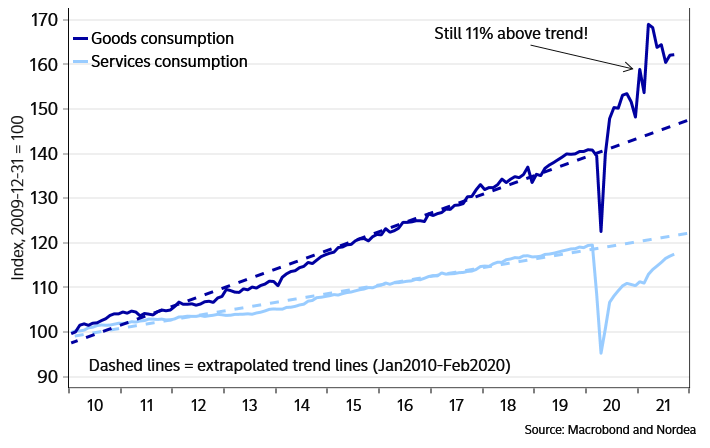
Recall that the S&P 500 index is primarily a “goods” companies index whereas the overall economy is dominated by services. The splurge on goods has peaked and previous trends will reappear as the pandemic disappears. A return to trend for expenditures on goods (blue) would reduce demand by nearly 14%. I doubt a similar cut in costs can be achieved.

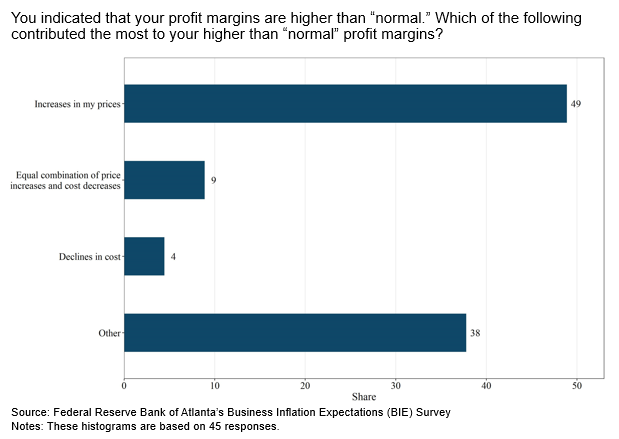
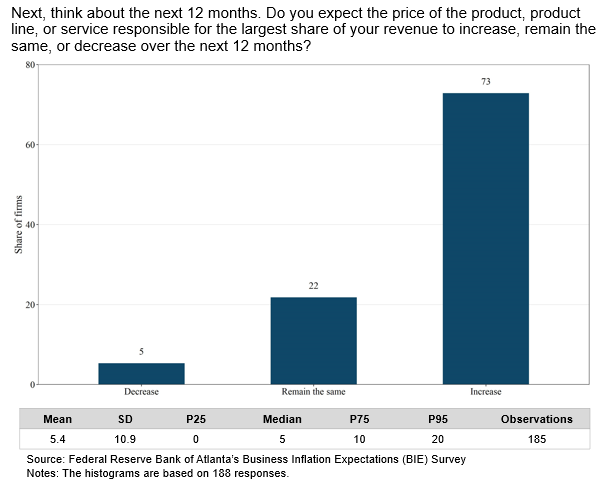
Today’s WSJ has an article (What Does Inflation Mean for American Businesses? For Some, Bigger Profits) depicting how companies have been able to boost profit margins by raising prices amid strong demand. Carrier finance chief sums it up succinctly: “Everyone, including customers, recognizes that in the current environment, there is little choice to get those increases and to pass them on.”
Nearly two out of three of the biggest U.S. publicly traded companies have reported fatter profit margins so far this year than they did over the same stretch of 2019, before the Covid-19 outbreak, data from FactSet show. Nearly 100 of these giants have booked 2021 profit margins—the share of each dollar of sales a company can pocket—that are at least 50% above 2019 levels.
Corporate nirvana…until the end customer runs out of buying power. People tend to spend their real labor income, which eventually declines when business people get carried away, focus on margins and forget the demand component. The red line below deflates the wage part of employment cost index (no compositional bias) with the CPI. Goods producers and distributors could well soon pay the price for both expenditures normalization and a squeezed consumer.

Buyout Bosses Enjoying $1 Trillion Boom See Prices Go ‘Bananas’ There’s been one common topic hot on the lips of private equity bosses at this week’s major industry gathering in Berlin: eye-watering valuations.
Speaker after speaker at the SuperReturn conference lined up to warn masked attendees about the unsustainable prices being paid for assets in the current deal boom, while reassuring investors with their next breath that strong returns would stay intact.
Deal multiples, already a talking point before the pandemic, have gone “bananas,” said Allstate Investments Managing Principal Sarah Farrell. Apollo Global Management Inc. Co-President Scott Kleinman suggested the industry was deluded on valuations when he asked “how is this really feasible that a buyout can happen at 25 times Ebitda?” (…)
- Rivian Is Now Biggest U.S. Company With No Sales Add another milestone to Rivian Automotive Inc.’s blistering and surprising run as a new stock: It’s now the biggest U.S. company by market value [$114B] with no revenue.
TECHNICALS WATCH
The analysis from my favorite technical analysis firm extends last week’s better readings as small caps continue to display greater investor enthusiasm.
Large caps are also back in vogue as the 13/34–Week EMA Trend shows:

THE OTHER RISKS (ECONOMIC AND OTHERS)
Winter is coming in Europe and North America and Covid-19 cases have turned back up, above their previous lows:


The U.S is far behind in vaccination with more than 1 in 4 Americans unwilling or uncertain.

In spite of:


The Brookings Institute:
Along party lines, however, the breakdown of vaccinated people was 92% of Democrats, 68% of Independents, and 56% of Republicans.
There is no reason to believe that these gaps in vaccination rates will disappear anytime soon. According to Gallup, 40% of Republicans “don’t plan” to get vaccinated, versus 26% of Independents and just 3% of Democrats. In response to a more sharply worded KFF question, 23% of Republicans report that they will “definitely not” get vaccinated, compared to 11% of Independents and just 4% of Democrats.
These national divergences are reflected at the state and county level as well, per data from Johns Hopkins University. Of the 21 states with vaccination rates above the national average, Joe Biden carried 20 last November. Of the 29 states below the national average, Donald Trump carried 24. At the county level, the vaccination-rate gap between the counties Biden and Trump won has increased nearly six-fold from 2.2% in April to 12.9% in mid-September, according to KFF.



 I hope he is right, but …
